A Wigner-Seitz cell is the region of real space at least as close to a chosen Bravais lattice point as to any other. It is bounded by perpendicular bisectors of vectors to neighboring lattice points and is a primitive unit cell.
A reciprocal lattice vector satisfies for every lattice translation . With primitive vectors , reciprocal primitive vectors satisfy , and for integers .
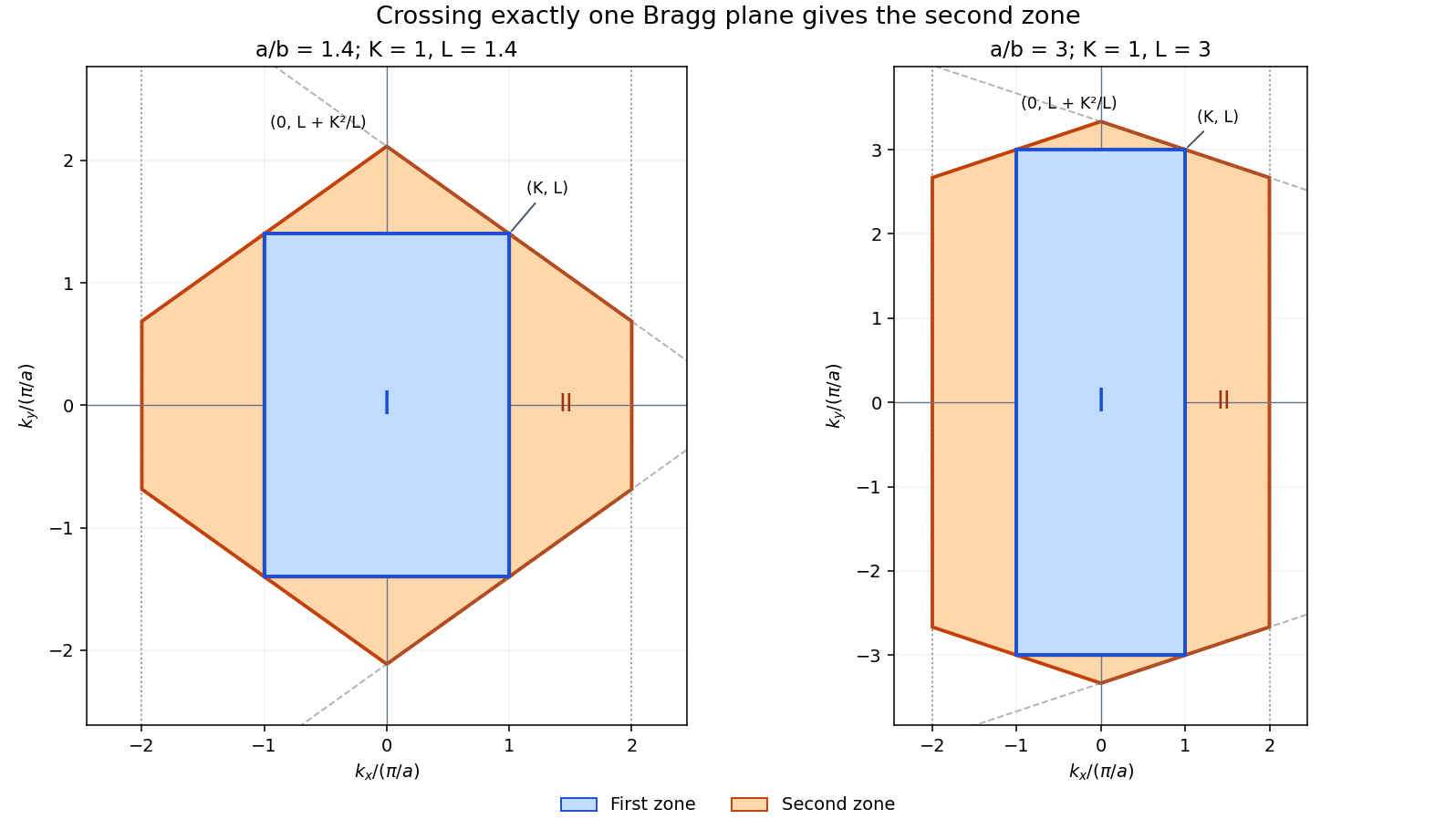
The first Brillouin zone is the Wigner-Seitz cell of that reciprocal lattice, centered at . Its boundaries are Bragg planes, . Higher Brillouin zones are the regions separated from the origin by successively more such planes: an interior point of zone has crossed exactly planes. A second Brillouin zone is generally disconnected in this extended-zone representation; it is not just a translated first-zone rectangle.
For area , allowed wavevectors have density . Include two electron spin states and fill a disk of radius at zero temperature. ThenThe free electron model has parabolic dispersion , with its minimum chosen as zero, soThese are the Fermi wavevector and Fermi energy for a spin-degenerate two-dimensional free electron gas. An imposed spin polarization or additional valley degeneracy would change the state count.
For the first two Brillouin zones of a rectangular lattice, write and , so and the reciprocal lattice vectors are . The perpendicular bisectors to the four nearest axial reciprocal points encloseThe second Brillouin zone consists of points beyond exactly one Bragg plane. In the first quadrant, it is the union of the following two regions:Reflect these regions in both axes. The first is a trapezoidal side lobe; the second is half of a triangular top lobe. The sloping boundary is the bisector for . On the side lobe, is the bisector condition for : crossing that plane too would enter the third or a higher zone. These additional bisectors are why four rectangles pasted onto the first zone would be incorrect.
Equivalently, the full right lobe has verticesand the top lobe has vertices . Add their left and bottom reflections. Their total area isequal to the first-zone area, as required by reciprocal-space state counting. These formulas remain valid for every , including very elongated rectangles; boundaries themselves can be shared by convention.

For one electron per primitive unit cell, the areal number density is . The Fermi circle has radius . The nearer first-zone boundary is , because . The circle protrudes precisely whenAt equality the Fermi surface only touches the boundary. Crossing an extended-zone boundary alone does not make a gap: the free electron gas remains metallic when the ionic periodic potential is neglected.
With spin degeneracy, each energy band contains two electrons per primitive unit cell. Divalency therefore permits a filled first band, but only if its maximum lies below the second band's minimum. With negligible ionic periodic potential, the circular Fermi surface and the rectangular zone have equal enclosed area, not equal shape. Electrons occupy some states outside the first zone while some higher-energy first-zone states remain empty. Folded bands overlap, and the material is a metal.
A periodic potential mixes plane waves differing by a reciprocal lattice vector. At a two-wave Bragg point, the nearly-free electron model gives a direct gap . Increasing appropriate Fourier coefficients can remove the band overlap. With the first band filled, the system is then a band insulator, provided the temperature is small compared with the insulating band gap in energy units.
The rectangular free-electron band-overlap scale follows from two different points in reciprocal space. Put . Before gap opening, the highest first-zone energy is at the corner, while the lowest second-zone energy is at the midpoint of the nearer face:Thus the downward shift of the first-band maximum plus the upward shift of the second-band minimum must overcomeIn a rigid-splitting estimate, an opening lowers the first band by and raises the second by , giving the familiar threshold . Equality is only band touching, not a positive insulating gap. This expression is the overlap that must be removed, under that explicit band-shift approximation.
Positive direct gaps can coexist with band overlap: a local direct splitting and the global indirect band gap are not interchangeable. The shape and Fourier coefficients of the ionic potential are unspecified, so there is no universal exact critical direct-gap width determined by alone. For a concrete demonstration, a separable potential has axial direct gaps and . To first order, the corner's lowest level is , and the two candidate second-band minima are and . Therefore, within this model and neglecting higher-order band shifts, nonoverlap requiresEqual axial gaps would give the first-order estimate , rather than the rigid-splitting estimate. Such a large opening can exceed the quantitative range of weak-potential perturbation theory, but the example identifies the missing model assumption: corner levels feel both couplings. The exact general answer is the positive indirect-gap criterion above; a geometry-only direct-gap threshold would claim more than the supplied potential information supports.
Articles by others on the same topic
There are currently no matching articles.