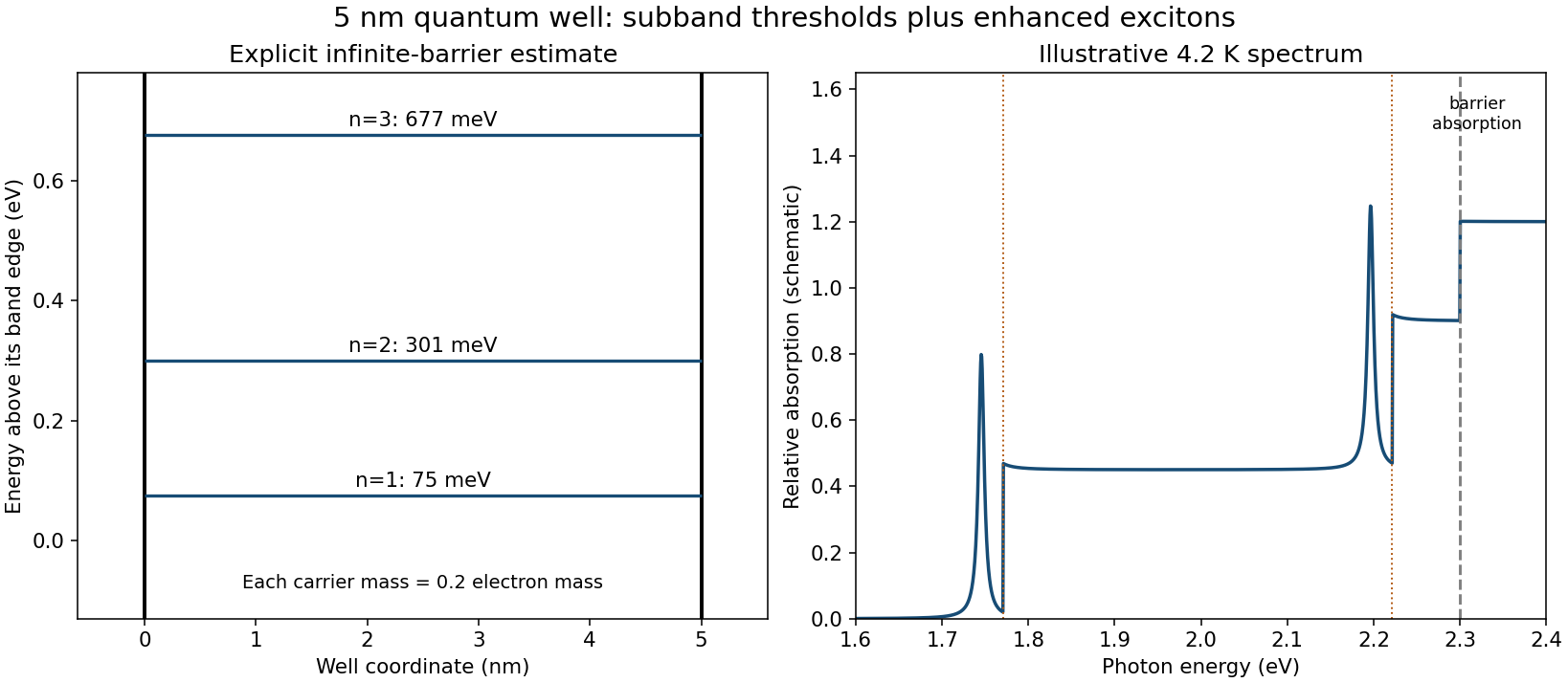
Assume type-I confinement of both carriers, and first use an infinite square well as an explicit estimate. For thickness nm and each carrier mass , confinement measured from the corresponding well band edge isThus the first three infinite-well levels are approximately , and meV for each carrier. Interband envelope overlap favors matching quantum numbers when the electron and hole well profiles are the same. Ignoring exciton binding energy initially, their absorption thresholds areThe first two lie in the requested optical window. Two-dimensional subband joint densities of states produce step-like onsets, with excitonic peaks just below them, rather than only a bulk three-dimensional onset. Confinement strengthens electron–hole binding: the ideal strict-two-dimensional hydrogen ground binding is meV, while a finite-width well interpolates toward the bulk value near meV. The nm width is comparable to the bulk exciton radius, so neither limiting binding value is exact. A schematic based on the infinite-well estimate therefore has first exciton peaks around – eV and – eV, followed by their subband continua; the eV barrier absorption is another feature near the top of the requested window.
The barrier gap alone does not specify the finite confinement energies. Under type-I alignment it supplies only eV. It does not give their division or the barrier effective masses, and a larger gap by itself does not prove type-I alignment. Infinite-well levels are consequently estimates, not uniquely determined measured levels.
For a concrete conditional comparison, assigning equal eV electron and hole barriers and taking the same mass on both sides gives finite square well levels , and meV per carrier. These follow from for even levels and for odd levels, with , . The corresponding unbound-pair optical thresholds would be , and eV before exciton shifts. This example is deliberately conditional and demonstrates why band offsets must not be invented to make a unique finite square well spectrum. The requested schematic below states which approximation it uses.

Articles by others on the same topic
There are currently no matching articles.