Define the auxiliary variable . Differentiating gives , while rearrangement gives . Conversely eliminating recovers the second-order equation, so this phase plane system is equivalent. At an equilibrium forces , and the first equation then forces . Its Jacobian matrix isThus . Expanding givesFor sufficiently small positive both are positive: the equilibrium is an unstable node. For negative the fast root is negative and the slow root positive, so it becomes a saddle equilibrium.
The nullcline is . Write . Away from it at an order-one distance, is order one on the indicated finite phase-space scales. Thus while : the trajectory changes on the fast time in a singular perturbation , with only an change in . Equivalently , which explains the nearly horizontal motion.
For positive , makes the branches fast attracting and the middle branch fast repelling. The arrows point right where and left where , carrying a generic off-nullcline point towards an attracting branch. The reduced description changes near a fold, where ; the rapid/slow distinction there needs a separate transition layer.
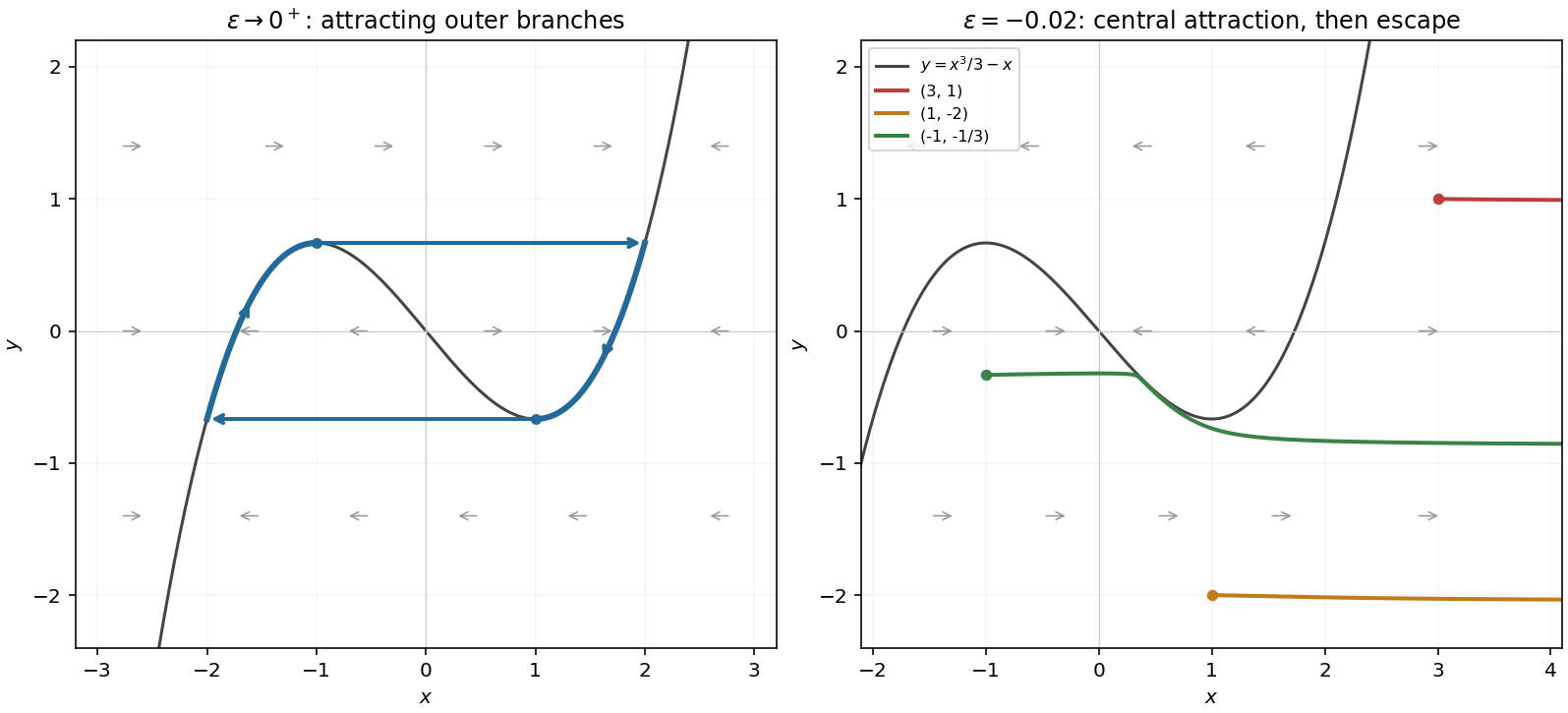

The left panel shows positive ; the right panel shows negative , including the three specified starting points. Horizontal arrows indicate the leading fast motion.
On the attracting right branch, and , so the motion goes from towards the fold . At essentially fixed it jumps to the other attracting root . The left branch then carries it to , where it jumps right to . This gives the clockwise limiting relaxation oscillation shown in the preceding figure.
Along a slow branch , differentiation gives . The right-branch time isReflection symmetry gives the same time on the left. The fast jumps take a time tending to zero as , as do the fold-transition corrections at leading order. HenceThis is a leading asymptotic period, not an exact finite- equality.
For negative the fast arrows reverse: the outer branches become repelling and the middle branch attracting. On the middle branch the slow equation is , so the slow motion goes away from the saddle equilibrium at zero towards a fold.
At , , so : the trajectory immediately escapes to the right. At , , so it also moves rapidly right and escapes. In each case the large- balance is , with decreasing; it is not a bounded relaxation cycle.
At , , so the initial fast motion is rightward. At nearly fixed it approaches the attracting middle root of , approximately . It then moves slowly down/right along the middle branch towards , leaves that fold to the right, and eventually escapes. These are the small-negative- limiting descriptions; the fold locations and fast landing point receive small corrections. The right panel of the figure distinguishes this slow excursion from the two immediate escapes.
Articles by others on the same topic
There are currently no matching articles.