For dry friction, the tangential contact force opposes sliding and has limiting magnitude , where is the compressive normal force and . Sticking requires ; impending sliding reaches equality.
The cohesionless Mohr-Coulomb failure criterion applies the same local condition on internal planes: yield begins when some plane has . In the tension-positive Cauchy convention used here, for a compressive plane, soA cohesive material would add a positive intercept, but the later formulas in this paper are explicitly the zero-cohesion case. The model does not supply a tensile strength law.
The Mohr circle has center on the normal-stress axis and radius . In the compressive regime , yield occurs when the circle first touches either friction line . The perpendicular distance of its center from either line is . Tangency therefore gives , or . But . ThusThe compressive sign restriction remains part of this equivalence: squaring alone would also produce algebraic branches that do not represent cohesionless compressive friction.
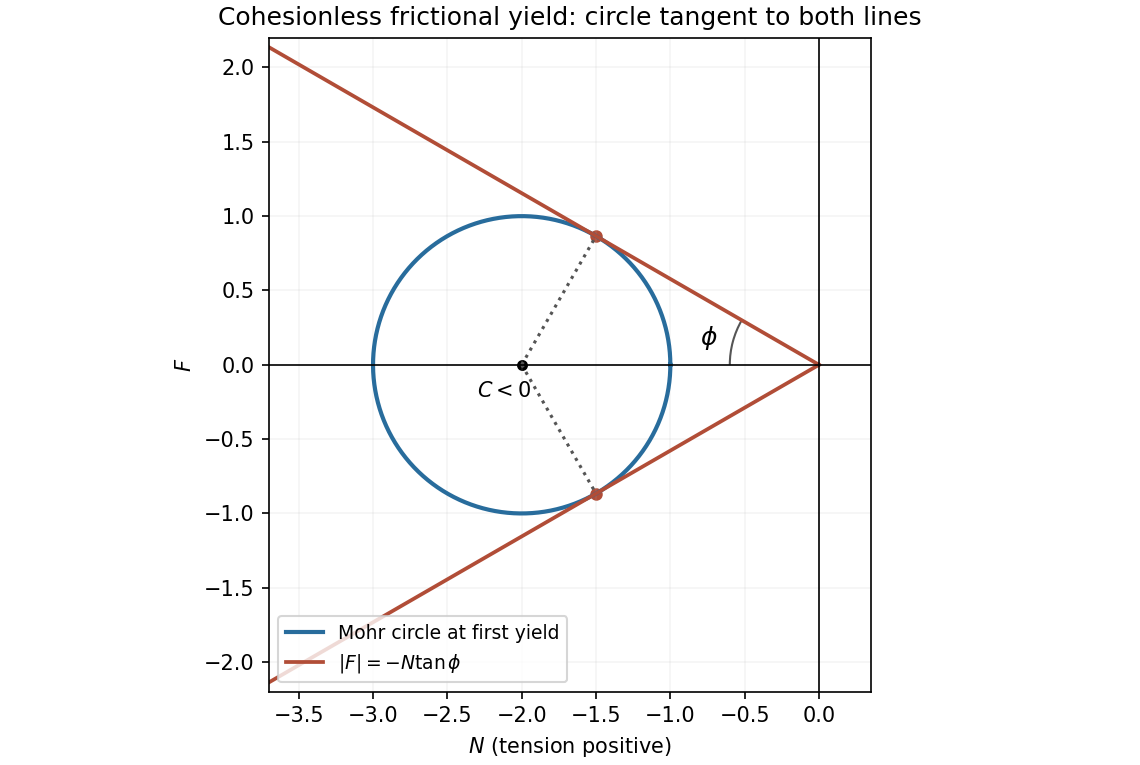

Insert the two constitutive stresses into the radial component of the Cauchy momentum equation. After collecting terms, , so . Its stresses areThe far pressure gives . At the tunnel wall, compressive bracing imposes , so . HenceWith no shear and , divide the yield identity by the nonzero to obtain . Solving its quadratic givesTo locate first yield, the stress-circle center is the constant , while its radius is . The radius is maximal at , so that is where it first meets the friction envelope as the bracing departs from the hydrostatic value. At the wall and ; hence andFor lowering bracing from , the hoop stress becomes more compressive, so and . Increasing bracing instead selects and reaches the other threshold . Stating the loading direction removes any ambiguity between the two reciprocal stress ratios. These conclusions describe first yield of the elastic field, not the later plastic-zone solution.
Articles by others on the same topic
There are currently no matching articles.