Original solutions to the paper released at the source request. The complete editable transcription is retained in the private examination archive.
The infinitesimal strain tensor is the symmetric part of the displacement gradient tensor:Its diagonal entries are infinitesimal normal extensions; twice an off-diagonal entry is the corresponding engineering shear strain. An infinitesimal rigid rotation has an antisymmetric displacement gradient tensor and therefore contributes no linearized strain.
For a surface with unit normal , traction is . Thus is the th force-per-area component on a plane whose positive normal is . Diagonal entries are normal stresses and off-diagonal entries are shear stresses, with tensile normal stress positive in this convention.
The symmetric strain has six independent components and so does the symmetric stress. A general linear map between these two six-dimensional spaces therefore hasEquivalently choose the minor symmetries . Components antisymmetric in the strain indices have no observable effect and are omitted from this representative.
A further distinction is important: if a strain energy density exists, has the major symmetry . Then the six-by-six map is symmetric and has independent coefficients. Thus 36 follows from the two stated tensor symmetries alone; 21 additionally uses the energy/reciprocity assumption, as in the variational setting later in the paper. These are the minor and major symmetries of linear elasticity.
Differentiating the displacement givesThe isotropic stress is diagonal, withThe two transverse traction-free conditions set the latter entries to zero. Hence andSubstitution shows ; solving for the two Lamé parameters givesTo determine the allowed interval without assuming signs not given, put . Then , soTherefore . The endpoints would require a degenerate elastic modulus, so they are excluded by the strict material inequalities.
The perturbation preserves the prescribed displacement because on the boundary. Strain varies as . Taylor expansion of the strain energy density givesSymmetry of the stress makes its contraction with the two symmetric terms equal, henceA minimizer must have zero first variation for both signs of . Integrating by parts and using the zero boundary variation yields . The fundamental lemma of the calculus of variations, applied to arbitrary compactly supported variations, givesThis is the static momentum equation. Fixed-displacement data remove the surface variation; prescribed tractions would instead appear through boundary work in the potential energy.
Plane strain sets all strains involving to zero, including , while , and . ThusIn particular, generally does not vanish: the suppressed out-of-plane strain requires a reaction stress. Setting that entry to zero would instead be a plane-stress assumption.
The Airy stress function determines the in-plane stress through its second derivatives. If two functions give the same stress, their difference has . On a connected domain this implies that its gradient is constant. Thereforeis exactly the local affine gauge freedom. It also preserves biharmonicity. An imposed decay condition for can fix this freedom; adding an arbitrary biharmonic function would usually change the physical stress and is not a gauge transformation.
The source uses the forward Fourier phase , so . For a nonzero wavenumber put . Biharmonicity becomes . The decaying solutions are . The normal-stress condition gives , hence . The shear condition gives , so . ConsequentlyIts second derivatives are and . The given strain/stress inversion therefore yieldsIntegrating in with the stated decaying-mode condition givesThis is the Fourier solution of a loaded elastic half-space.
The zero wavenumber needs separate treatment: these displayed divisions by and are not formulas at . In particular a nonzero resultant is incompatible with an ordinary decaying zero-mode displacement of the stipulated kind; two-dimensional net loading produces a logarithmic displacement reference issue. Balanced loads or an appropriate distributional/reference-displacement formulation are needed for a global transform solution. The nonzero modes and the displacement-gradient kernel below remain the correct formal calculation; the singular zero mode must not be silently assigned a finite value.
Multiplication of the preceding displacement formula by givesFor the supplied kernels, and . The convolution theorem therefore givesSince and , combine the two fractions and divide by two:The sign is tied to the positive forward Fourier phase used here. This is a displacement derivative, so an additive displacement reference drops out. At the kernel is regular near ; the usual decay/integrability of the applied load controls the tails. A boundary-limit singular integral, if wanted at , would require its own principal-value interpretation.
For dry friction, the tangential contact force opposes sliding and has limiting magnitude , where is the compressive normal force and . Sticking requires ; impending sliding reaches equality.
The cohesionless Mohr-Coulomb failure criterion applies the same local condition on internal planes: yield begins when some plane has . In the tension-positive Cauchy convention used here, for a compressive plane, soA cohesive material would add a positive intercept, but the later formulas in this paper are explicitly the zero-cohesion case. The model does not supply a tensile strength law.
The Mohr circle has center on the normal-stress axis and radius . In the compressive regime , yield occurs when the circle first touches either friction line . The perpendicular distance of its center from either line is . Tangency therefore gives , or . But . ThusThe compressive sign restriction remains part of this equivalence: squaring alone would also produce algebraic branches that do not represent cohesionless compressive friction.
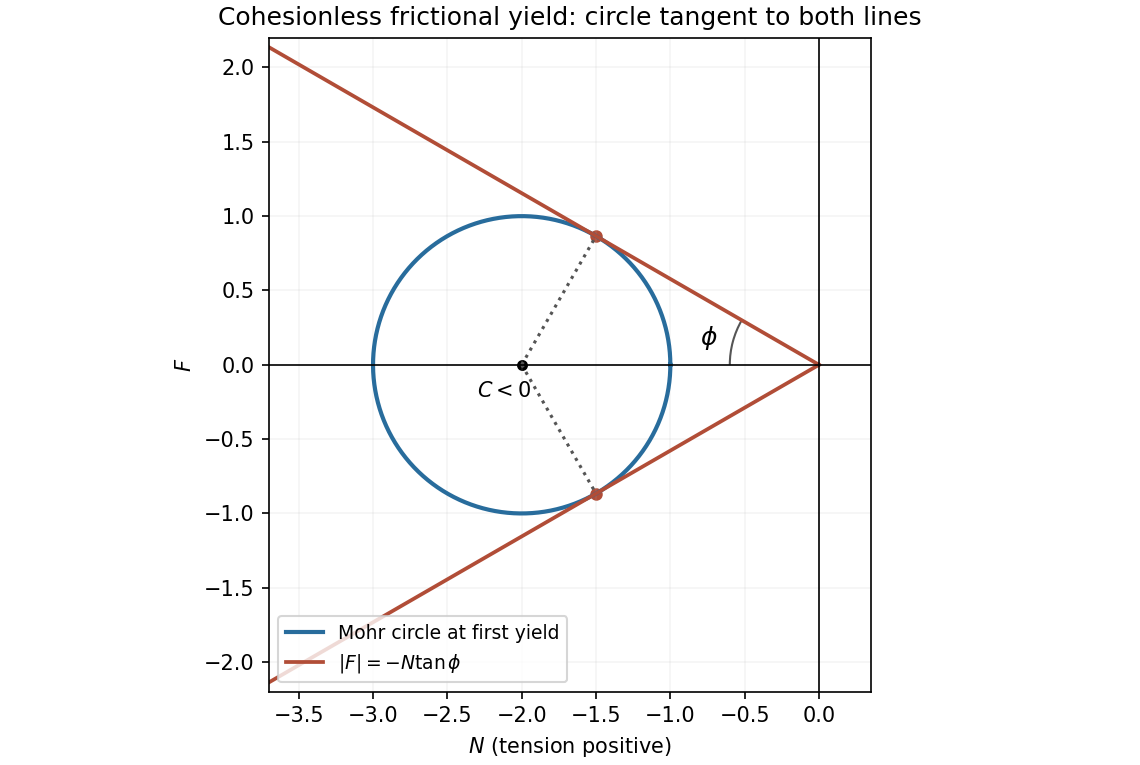

Insert the two constitutive stresses into the radial component of the Cauchy momentum equation. After collecting terms, , so . Its stresses areThe far pressure gives . At the tunnel wall, compressive bracing imposes , so . HenceWith no shear and , divide the yield identity by the nonzero to obtain . Solving its quadratic givesTo locate first yield, the stress-circle center is the constant , while its radius is . The radius is maximal at , so that is where it first meets the friction envelope as the bracing departs from the hydrostatic value. At the wall and ; hence andFor lowering bracing from , the hoop stress becomes more compressive, so and . Increasing bracing instead selects and reaches the other threshold . Stating the loading direction removes any ambiguity between the two reciprocal stress ratios. These conclusions describe first yield of the elastic field, not the later plastic-zone solution.
Articles by others on the same topic
There are currently no matching articles.