Nonhuman animals retain information about particular past events, but this does not by itself establish human-like conscious recollection. The answer depends on what the category episodic memory requires. Knowing that an event happened differs from reliving it as something that happened to oneself. A species could possess useful event representations without satisfying every phenomenological criterion used in human research.
Endel Tulving's 1985 account makes autonoetic consciousness central: the rememberer apprehends the self in subjective time. This distinguishes episodic remembering from semantic memory, in which knowledge can be available without recollecting its acquisition. It is an influential theoretical proposal, supported by human observations and tasks, rather than an experiment establishing that every nonhuman species lacks that awareness.[ref]
Memory and consciousness by Endel Tulving. 1985, definitions of autonoetic awareness and distinctions among memory systems
The measurement problem is substantial. A verbal human report can distinguish knowing from remembering, although it is also vulnerable to instructions and interpretation. An animal's correct choice cannot supply the same report, and a failed verbal test would be inappropriate to its capacities. Thus absence of a linguistic demonstration is not evidence of absence of experience. Conversely, sophisticated behavior should not simply be renamed conscious reliving: trained rules, relative familiarity or a combination of independent cues may sometimes solve the task.
Converging evidence can narrow this uncertainty. Retaining a trial-specific combination, using it flexibly under an unexpected query, and distinguishing earlier from later events are stronger functional criteria than repeating a well-trained response. Hippocampal lesion effects that spare perception or simple item recognition further constrain the mechanism. Yet even a convincing functional resemblance does not uniquely decide whether subjective temporal self-awareness accompanies it. Anatomical similarity is supporting evidence about mechanisms, not a direct measure of private experience.
A defensible position therefore separates the phenomenon from the inference. If episodic memory is defined functionally as flexible memory for individual events and their relations, evidence from animals can support it. If the definition necessarily includes autonoetic consciousness, the same evidence leaves a further question unresolved. The available evidence supports substantial continuity in event-memory capacities, while remaining insufficient for an unqualified claim that animals consciously relive episodes in the human sense. That conclusion expresses a measurement limit rather than a claim that animal consciousness is impossible.
Evidence for episodic-like memory is substantially stronger, because its behavioral requirements can be tested without asserting conscious reliving. The strongest design establishes content, location and temporal information belonging to the same event, then shows that their combination guides behavior. Success on three unrelated tests would establish less.
Nicky Clayton and Anthony Dickinson's 1998 study exploited the ecology of food storage. Scrub jays cached perishable wax worms and nonperishable peanuts at distinct sites. They preferred recovering favored worms after a short interval, but learned to avoid searching for worms after a longer interval when those stores would have deteriorated. The choice therefore depended jointly on food type, caching location and delay, meeting a useful behavioral criterion for episodic-like memory.[ref]
Episodic-like memory during cache recovery by scrub jays by Nicky Clayton and others. 1998, cache contents, spatially distinct sites and interval-dependent recovery
This result should not be expanded into a claim of complete freedom from learned knowledge. Knowledge that worms deteriorate supplies an enduring rule about food, while memory of a particular cache supplies event-specific input to the rule. An episodic-like account can therefore require interaction with learned knowledge rather than its absence. Critical controls and extensions should remove immediately informative odor cues, separate elapsed time from time of day, counterbalance item preferences, and test combinations that cannot be answered by one permanently rewarded location. Such controls are requirements for discriminating explanations, not additional findings attributed here to the original paper.
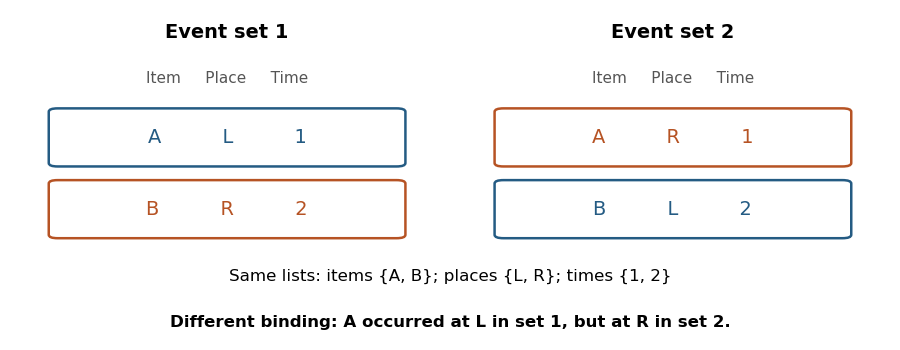
An original example illustrates why conjunction matters. Compare the two event setsBoth contain the same items, places and temporal positions. However, the correct answer to where occurred differs. Separate lists cannot determine that answer. Episodic binding is therefore a stronger claim than retaining the three lists, and a useful experiment tests a relation whose answer changes across otherwise matched combinations.

Rodent studies provide complementary causal evidence. Norbert J. Fortin and colleagues found impaired memory for the order of odor events after hippocampal lesions despite preserved recognition of recently presented odors. Ceren Ergorul and colleagues presented odor events at different locations and found that intact rats used combinations of odor and spatial cues in temporal judgments, whereas hippocampal lesions disrupted this integration. Their probe tests help distinguish a binding deficit from simply being unable to detect the individual cues.[ref]
Critical role of the hippocampus in memory for sequences of events by Norbert J. Fortin and others. 2002, sequence-order versus item-recognition comparison
[ref]The hippocampus and memory for what, where, and when by Ceren Ergorul and others. 2004, single episodes and cue-combination probes
These studies support event-specific relational retention across different species and tasks. They leave open how much a given test depends on relative recency, familiarity or a learned retrieval strategy; selective transfer and matched recognition controls are particularly useful. Episodic-like memory is supported as a graded collection of experimentally demonstrated capacities, without treating every such success as proof of autonoetic remembering.
Articles by others on the same topic
There are currently no matching articles.