Official course page: www.ox.ac.uk/admissions/undergraduate/courses/course-listing/psychology-experimental
Students take three introductory subjects from the published list, including Probability theory and statistics. The branches represent the available subjects, not five compulsory modules.
Worked answers to all five options in the behavioural neuroscience paper of 19 April 2022. Source release: released examination PDF. Each answer addresses one complete source question, within the printed 1,500-word limit; the questions are not reproduced.
The scientific argument is framed using work published by the examination date. Later retrieval dates, repository deposits or portrait photographs are not later scientific evidence smuggled into the 2022 answers. Experimental models are distinguished from clinical diagnoses and treatment recommendations.
Sleep can protect newly acquired information, actively reorganize it, and restore the capacity for subsequent learning. These are distinct claims. Memory consolidation concerns changes after acquisition; better learning the next morning concerns encoding capacity; less interference during an unoccupied interval need not imply an active sleep mechanism. The strongest explanation therefore combines behavioural comparisons with recordings and selective interventions.
A basic retention experiment compares later performance after sleep and waking, ideally relative to an immediate baseline. Yet a night-versus-day comparison also changes circadian phase, interference and alertness at testing. Sleep deprivation adds physiological stress and attentional impairment. Matching acquisition, testing at comparable times, measuring vigilance, and comparing sleep with quiet waking make the inference sharper. A retention advantage after sleep remains compatible with both passive protection and active processing; distinguishing them requires manipulating what happens during the interval.
The active systems consolidation hypothesis provides an active mechanism. Rapid relational encoding by the hippocampus permits later memory reactivation to modify distributed cerebral cortex representations. During NREM sleep, cortical sleep slow oscillations can organize sleep spindles and hippocampal sharp-wave ripples, creating coordinated windows for synaptic plasticity. This is a timing hypothesis about communication, not proof that a complete memory is copied from one anatomical container to another. Systems consolidation and synaptic consolidation can proceed together, and some detailed episodic memories may continue to require hippocampal contributions.
An important recording experiment monitored ensembles of hippocampal place cells in rats during spatial behaviour and during sleep before and after it. Cells active together at particular locations became more likely to fire together in subsequent slow-wave sleep; the pre-experience recording supplied a valuable baseline. This demonstrates experience-related memory reactivation. Pairwise coactivation alone does not establish ordered neural replay, nor does a correlation show that the events improve retention. An apparently memory-related pattern might otherwise be an incidental consequence of prior activity.[ref]
Reactivation of hippocampal ensemble memories during sleep by Matthew A. Wilson and others. Abstract and pp. 676–679: simultaneous ensemble recordings and pre-/post-experience comparison
A stronger causal test interrupted hippocampal sharp-wave ripples during post-training sleep in rats learning a spatial task. An online electrical recording system detected ripple events and triggered brief disruption; a delayed-stimulation comparison helped control stimulation without abolishing the same events. Spatial performance was impaired, while gross sleep architecture was not detectably changed. This supports a functional role for ripple-associated activity beyond simply obtaining sleep. Nevertheless, disruption affects an event and its associated activity, not an experimentally isolated memory message; it does not identify the exact information transferred or establish that all memory consolidation requires the same mechanism.[ref]
Selective suppression of hippocampal ripples impairs spatial memory by Gabrielle Girardeau and others. pp. 1222–1223; Figures 1–2: event-triggered disruption, delayed control and behaviour
Human targeted memory reactivation offers complementary evidence. Participants learned object locations with an odour present, then received that odour again during polysomnographically identified slow-wave sleep. Retention improved compared with an odourless condition. Crucially, the benefit did not appear when the odour had been absent during learning, or when it was presented during waking or REM sleep; procedural finger-tapping did not show the same benefit. The cue–learning relationship and sleep state therefore mattered. The associated hippocampal activation is consistent with memory reactivation, although activation does not reveal all the represented content. This is stronger evidence for selective processing than an undifferentiated sleep/wake advantage.[ref]
Odor cues during slow-wave sleep prompt declarative memory consolidation by Björn Rasch and others. pp. 1426–1429; experiments I–IV: object-location learning, unpaired odour and sleep-state controls
Sleep could also benefit memory by regulating the substrate for learning. The synaptic homeostasis hypothesis proposes that predominantly waking-associated strengthening requires compensatory renormalization, limiting saturation, energy costs and interference. Selective preservation can improve the contrast of important connections even if average strength of synapses falls. Serial electron-microscopy reconstructions of mouse cortical synapses found smaller axon–spine interfaces after sleep, with an average decrease of roughly 18%; the largest synapses were relatively spared. The comparison included spontaneous and enforced waking. These are structural measurements consistent with selective scaling, not a direct measurement of every synapse's efficacy or proof that the measured changes caused a particular memory benefit.[ref]
Synaptic scaling across waking and sleep by Luisa de Vivo and others. pp. 507–510; Figures 1–3: three-dimensional reconstructions and size-dependent changes
Renormalization and selective strengthening are not mutually exclusive. A learning-related ensemble could be selectively stabilized while less useful background connections weaken. Memory reactivation could help select what survives, and improved capacity after sleep could support the next episode rather than merely preserve the last one. An adequate theory must explain both specificity and restoration, rather than equate more firing or larger synapses with better memory everywhere.
The interpretation must remain task-specific. A cueing effect for declarative memory does not assign every procedural memory to REM sleep, and a null cueing result in one stage does not show that stage has no mnemonic function. Sleep-stage manipulations can alter other stages or awaken subjects. Rodent spatial performance provides mechanistic access but does not by itself establish human autobiographical experience. Replicated behavioural effects, adequate controls and selective circuit perturbations are most persuasive when they converge.
Thus sleep is important because it provides a state in which information can be selectively re-expressed and reorganized while conditions at synapses are regulated. Evidence available by April 2022 supports active contributions in addition to passive protection; it does not establish a universal sleep-only route for every kind of learning.
Monoamine signalling contributes to mood regulation and to the actions of several antidepressants, but a universal “low transmitter causes depression” account is not established. Three propositions must be separated: a drug changes a molecular target; that change helps produce improvement; and the untreated disorder was caused by an opposite abnormality. Evidence for one proposition does not logically establish the next.
The monoamine hypothesis of depression developed from pharmacology. Monoamine oxidase inhibition reduces transmitter metabolism, while some tricyclic antidepressants inhibit transmitter reuptake; SSRI principally inhibit serotonin reuptake. Norepinephrine, serotonin and dopamine are distinct monoamines, acting through different receptors and pathways. The historical catecholamine proposal emphasized norepinephrine and already acknowledged the limitations of extrapolating from drug effects to disease mechanisms. Treating every low affective state as depletion of a single interchangeable brain substance is a substantially stronger claim.[ref]
The catecholamine hypothesis of affective disorders: a review of supporting evidence by Joseph J. Schildkraut. 1965 abstract and pp. 509–522: proposed catecholamine account and explicit limits on pharmacological extrapolation
Drug efficacy supplies evidence that manipulating these systems can matter. A 2018 network meta-analysis synthesized 522 double-blind trials in adults with major depressive disorder and found each included antidepressant more efficacious than placebo on its response outcome. This is evidence synthesis, not a direct assay of patients' transmitter levels. Average effects, trial selection, publication bias, blinding and symptom-scale outcomes limit interpretation, and not every patient benefits. Even a perfectly demonstrated effect would show that an intervention can change a pathological state, not that it reverses its original cause. A downstream compensatory mechanism can be therapeutically useful without being the initiating lesion.[ref]
Comparative efficacy and acceptability of 21 antidepressant drugs for the acute treatment of adults with major depressive disorder by Andrea Cipriani and others. Methods, Findings and Discussion: acute adult trials, response outcome and limitations
Measuring the proposed deficiency is itself difficult. Peripheral serotonin is not a direct measurement of release at a particular central synapse. Metabolites combine synthesis, release, reuptake and degradation; receptor or transporter imaging is not simply a concentration gauge. A difference observed after illness onset might be causal, compensatory, treatment-related or associated with physiological stress. Establishing a general deficiency would require convergent measures in appropriate untreated populations, temporal precedence and a relationship to well-defined symptoms, not merely one group-average biomarker.
Precursor depletion supplies a more informative intervention. In a double-blind crossover study, patients in antidepressant-induced remission underwent acute tryptophan depletion and a control condition. Fourteen of 21 experienced a transient depressive relapse after depletion, whereas control testing did not produce significant behavioural effects. This supports dependence of some maintained remissions on serotonin precursor availability. It does not show that all untreated depressed patients began with low serotonin, that depletion is sufficient to generate the full syndrome in everyone, or that norepinephrine and dopamine are irrelevant. The selected, previously treated sample is central to the causal question actually tested.[ref]
Serotonin function and the mechanism of antidepressant action by Pedro L. Delgado and others. Abstract and pp. 411–418: remitted sample, crossover control and 14/21 transient relapses
Time course also challenges a simple replenishment story. Initial transporter inhibition can occur before substantial clinical improvement. That discrepancy motivates slower receptor, circuit, learning and plasticity changes; it does not imply that early drug effects are absent. In a randomized placebo-controlled experiment, an acute dose of a norepinephrine reuptake inhibitor changed positive emotional processing in depressed participants before subjective mood or anxiety changed. Facial-expression judgments and emotionally valenced categorization and recall supplied behavioural readouts. These observations support an affective processing bias account: altered experience processing could accumulate into mood change. They do not establish that the measured early shift mediates every later clinical response.[ref]
Effect of acute antidepressant administration on negative affective bias in depressed patients by Catherine J. Harmer and others. Abstract; Methods and Results, pp. 1178–1184: randomized emotional-processing battery before mood change
Plasticity offers another candidate bridge between early pharmacology and delayed behaviour. In mice, preventing antidepressant-associated adult hippocampal neurogenesis blocked behavioural effects in particular experimental assays. The evidence included genetic and localized irradiation approaches. It supplies a mechanistic dependency within that model, rather than merely a correlation between a drug and cell proliferation. However, the assays are not human major depressive disorder, the interventions can have additional effects, and necessity for one behavioural endpoint does not establish either sufficiency or a universal human mechanism.[ref]
Requirement of hippocampal neurogenesis for the behavioral effects of antidepressants by Luca Santarelli and others. Abstract and pp. 805–809: interference with neurogenesis and model-specific behavioural effects
These alternatives refine rather than simply discard monoaminergic pharmacology. Serotonin or norepinephrine could regulate plasticity and learning within distributed neural circuits; baseline concentrations need not be uniformly low. Receptor sensitivity, pathway-specific activity and environmental experience could determine the effect of an intervention. Conversely, observing altered dopamine-related motivation would not prove that all anhedonia, cognitive slowing and sadness have one cause. Major depressive disorder groups multiple symptom patterns, so a mechanism associated with one dimension can be diluted or misleading when treated as a universal disease explanation.
The strongest conclusion available at the examination date is therefore conditional. Particular monoamine manipulations can alter affective processing and symptoms, and some treatment responses depend on monoaminergic function. The evidence does not identify a single brain-wide deficit that is necessary and sufficient for human depression. A useful successor account specifies transmitter, receptor, circuit, time scale and symptom, and tests how biological changes interact with learning and environment. This evaluation concerns explanatory evidence, not a recommendation to start, stop or choose a medication.
Learned helplessness links uncontrollability to later failure to act; instrumental learning makes that proposal testable by separating outcome value, action–outcome control and the ability to perform an action. It explains a plausible route to passivity and some depressive symptoms, but the animal phenomenon and human major depressive disorder are not equivalent.
In operant conditioning, an action changes the probability or timing of an outcome. Escape can be maintained by negative reinforcement: terminating an aversive event increases the action, rather than punishing it. A simple description of control is the action-outcome contingencywhere can denote relief and an attempted action. Under genuine controllability this difference can be positive. In an uncontrollable setting it may be zero even when relief sometimes occurs. Outcome frequency and controllability are therefore different. Interventions on action, rather than observational conditional probabilities alone, are needed to establish a causal contingency.
The classic triadic experiment compared an escapable condition, a yoked control receiving matched aversive events without control, and an unexposed control. Initially, a panel response in a harness could terminate the event only for the escapable subject. Later, all groups encountered a shuttle-box task in which crossing a barrier permitted escape. The uncontrollable group subsequently showed greater escape failure, whereas the escapable and unexposed groups learned more normally. Matching the physical events made control, rather than exposure alone, the crucial contrast. The historical experiment used harmful procedures; its conceptual importance is the matched-outcome design, not a protocol to repeat.[ref]
Failure to escape traumatic shock by Martin Seligman and others. Experiment I, pp. 1–4: triadic design, panel control and transfer to shuttle-box escape
The original learned helplessness hypothesis proposed that subjects learn that outcomes are independent of their responses. Generalizing that expectation reduces response initiation, impairs learning of a new contingency, and produces emotional disturbance. The motivational and cognitive effects can reinforce each other: fewer attempts provide less evidence that the new environment is controllable. That feedback offers an explanation for persistent inactivity even when opportunities improve. It does not require assuming that an animal represents a verbal proposition about its future.
For human depression, merely observing uncontrollability cannot explain who develops persistent symptoms or why self-esteem falls. An attributional reformulation distinguishes causes viewed as internal or external, stable or unstable, and global or specific. An internal explanation can undermine self-esteem; a stable explanation extends expectations into the future; a global one extends them across situations. Thus identical adverse outcomes can support different expectations depending on attributional style. These are hypotheses about generalization and vulnerability, not proof that a patient's interpretations caused every symptom or that circumstances are actually controllable.[ref]
Learned helplessness in humans: critique and reformulation by Lyn Y. Abramson and others. pp. 49–74, especially the abstract and reformulation: personal/universal helplessness and attribution dimensions
Subsequent circuit evidence also revises the original learning story. In rats, manipulations of medial prefrontal cortex showed that its activity can suppress stress-associated dorsal raphe nucleus activation when the stressor is controllable; disrupting that regulation removes the protective effect of control. This supports a model in which learning and expressing control actively regulates a stress response. It does not require passivity itself always to be learned as an association. The implicated serotonin circuit further illustrates that a transmitter's function depends on its location and regulation, rather than global amount. Translating these rodent pathways directly into human depressive beliefs would go beyond the evidence.[ref]
Medial prefrontal cortex determines how stressor controllability affects behavior and dorsal raphe nucleus by Jose Amat and others. Abstract and Results, pp. 365–371: prefrontal interventions, controllability and raphe activity
Operant conditioning also distinguishes reduced reward sensitivity from a reduced expectation of control. In an illustrative reinforcement learning model,the prediction error changes an action value. Smaller subjective reward , a different update rate , a pessimistic initial value, or less exploratory choice can each reduce rewarded responding. Increased perceived effort can reduce action even when the expected reward is learned correctly. These are distinguishable candidate mechanisms, not fitted patient results. A low response rate alone cannot identify which parameter changed, and standard chosen-action value learning does not automatically represent causal contingency or attribution.
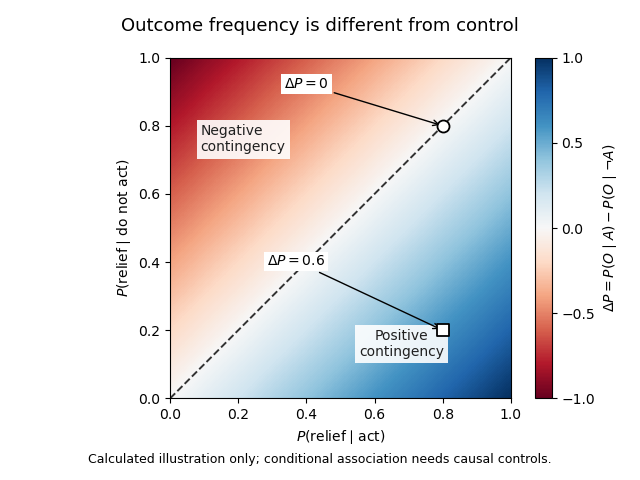
A human probabilistic reward task supplies a concrete example. Participants discriminated subtly different visual stimuli, with correct responses for one stimulus rewarded more often. Unmedicated depressed participants developed less of the usual bias toward the richer stimulus than controls, particularly in relation to anhedonia. Trial-history analyses indicated a problem integrating reinforcement over time rather than complete insensitivity to a single reward. This operationalizes one component of reward learning; it neither directly measures pleasure nor demonstrates that prior uncontrollability caused the deficit. Sensory discriminability, response bias and learning history must be distinguished.[ref]
Reduced hedonic capacity in major depressive disorder: evidence from a probabilistic reward task by Diego A. Pizzagalli and others. Abstract; Methods 2.2–2.3 and Results: asymmetric reinforcement, signal detection and trial-history analyses
The experimental programme can therefore vary controllability, reward frequency, effort and feedback independently, while measuring acquisition and transfer to new actions. It should include motor and attentional controls and distinguish failure to learn from failure to express learned knowledge. Prospective human data are needed to establish vulnerability rather than consequences of an episode; cross-sectional group differences cannot settle that direction. More opportunities to act are not automatically sufficient when fatigue, threat, external constraints or other symptoms remain.
Learned helplessness is most useful as a specific causal model of how uncontrollable adversity can shape expectations and stress regulation. Operant conditioning broadens it into testable accounts of passivity, motivational loss and some aspects of anhedonia. Neither a single animal task nor one computational parameter explains the entire depressive syndrome.
Disruption of an extended hippocampal–diencephalic network explains important forms of amnesia, but a single indispensable serial loop is too strong an account. The distinction is between a useful anatomical network hypothesis and a claim that every connection is equivalent or that all memory failures have the same cause.
The Delay-Brion circuit links temporal-lobe and diencephalic amnesia. Its conventional route runs from the hippocampus through the fornix, mammillary bodies and mammillothalamic tract to the anterior thalamic nuclei, with cingulate and parahippocampal return routes. It overlaps the Papez circuit, originally proposed for emotion, but the historical explanations are not identical. The important question is whether connected structures form a single serial relay or make differentiated contributions within a larger network.
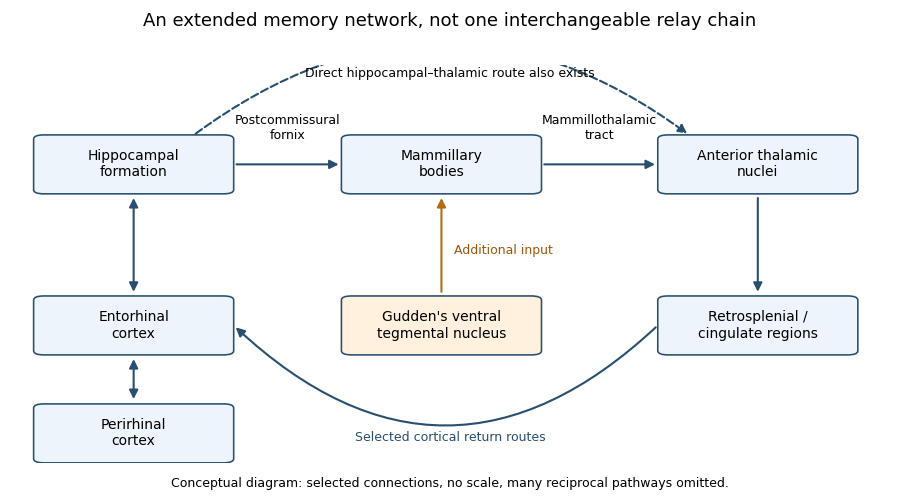
Selected routes in the extended hippocampal memory network
. An original conceptual schematic, not an anatomical atlas or a source figure. The upper chain shows the commonly emphasized mammillary route; the lower arrows show selected additional interactions and an extra-hippocampal input. Arrow presence does not assert equal necessity, and many reciprocal connections are omitted. Details.The network proposal solves a genuine localization problem. Severe new-learning deficits follow damage in anatomically separated sites, so a theory confined to one small storage centre is inadequate. Clinical surgical cases showed marked anterograde amnesia after bilateral medial temporal resections, despite comparatively preserved intellect and some older knowledge. However, the original operations included neighbouring structures, so those observations cannot isolate the hippocampus from surrounding tissue. A subsequent extensively assessed patient, R.B., had marked new-learning impairment and a bilateral lesion largely confined to hippocampal CA1 at postmortem examination, with minor pathology elsewhere. The case strengthens the hippocampal contribution while illustrating why detailed anatomical verification matters.[ref]
Loss of recent memory after bilateral hippocampal lesions by William Beecher Scoville and Brenda Milner. pp. 11–21: clinical cases and anatomical limitations of the resections
[ref]Human amnesia and the medial temporal region: enduring memory impairment following a bilateral lesion limited to field CA1 of the hippocampus by Stuart Zola-Morgan and others. Abstract and pp. 2950–2967: longitudinal testing, CA1 pathology and minor extra-hippocampal abnormalities
Diencephalic pathology supplies convergent evidence. In a comparative postmortem study of alcohol-related disease, mammillary and mediodorsal thalamic neuronal loss occurred in both amnesic and non-amnesic cases with relevant pathology. Consistent anterior thalamic neuronal loss differentiated the cases with Korsakoff syndrome. Such pathological controls are more informative than observing a damaged mammillary body in one amnesic patient. The findings support an anterior thalamic contribution and caution against identifying mammillary damage alone as a sufficient explanation. They remain observational: co-occurring damage, uncertain premorbid abilities and incomplete measures of connectivity constrain causal localization.[ref]
Degeneration of anterior thalamic nuclei differentiates alcoholics with amnesia by A. Harding and others. Abstract and pp. 141–154: stereological comparisons and differentiating anterior thalamic loss
The strong serial version makes a sharper prediction: interrupting hippocampal input to the mammillary bodies should disrupt the same memory functions as interrupting mammillary output. A direct rat comparison challenged that prediction. Selective interruption of descending postcommissural fornix input had much less effect on the tested spatial tasks than lesions of the mammillothalamic tract or Gudden's ventral tegmental nucleus. The latter two also produced remote activity changes. The mammillary contribution therefore cannot be explained simply as passive transmission of hippocampal output. Additional brainstem inputs are functionally important. These comparisons concern particular spatial tasks and selective pathways, not proof that an intact fornix is irrelevant to all memory.[ref]
Dismantling the Papez circuit for memory in rats by Seralynne D. Vann. Abstract; Results and Discussion: postcommissural-fornix, mammillothalamic and tegmental comparisons
This result favours an interacting network over a chain of interchangeable relays. There are direct hippocampal–thalamic connections, multiple return routes and inputs from outside the traditional loop. A lesion can deprive another region of useful input or coordination without destroying it. Conversely, residual pathways may preserve a task after one disconnection. Therefore structural preservation of a node does not guarantee functional preservation, and a lesion effect does not show that the lost tissue was the final storage site. Reversible perturbations, pathway-specific comparisons and remote physiological measurements can complement permanent-lesion evidence.
The outcome to be explained must also be specified. Anterograde amnesia differs from retrograde amnesia, and impaired episodic memory is not equivalent to losing every skill, immediate span or familiar item. Recognition memory can draw on recollection or familiarity; a task allowing a strong familiarity judgment can be performed without recovery of contextual detail. Broader medial temporal lobe damage can affect both processes, while more selective damage can yield a different profile. Thus the circuit is most plausible as an explanation of particular relational and event-memory impairments, rather than all failures loosely called amnesia.
There are methodological traps on both sides. Human cases give direct clinical relevance but rarely offer randomized, anatomically pure lesions. Animal interventions improve causal control, yet spatial working-memory tasks do not demonstrate the entire human experience of remembering an event. Failure on a task can reflect sensory, motivational or strategic changes, so spared comparison tasks are necessary. Recovery and compensation can obscure an original contribution, while damage to fibres passing through a region can exaggerate the apparent role of its local cells. A convincing account predicts both impaired and spared functions, not merely a lesion location.
By the examination date, the defensible theory was therefore an extended, functionally differentiated hippocampal–diencephalic network. The Delay-Brion circuit remains valuable because it unifies important temporal and diencephalic causes of amnesia. Its explanatory power increases when it accommodates additional inputs, parallel routes and memory-process distinctions, rather than claims that all amnesia follows the breaking of one serial loop.
The hippocampus and perirhinal cortex contribute to an interacting cognitive system with different representational emphases: relations and context for the hippocampus, and integrated object representations and familiarity for perirhinal cortex. This distinction is supported by converging task dissociations, but neither “all memory” nor “memory versus perception” maps neatly onto one anatomical boundary.
Both belong to the medial temporal lobe and interact through entorhinal cortex and other cortical routes. Both participate in experience-dependent changes and recognition performance. Their common location and involvement in declarative memory do not imply identical computations. Conversely, different predominant functions do not require independence: recognizing an object in its prior location requires information about the object and its relations to context.
The hippocampus binds or represents relations among items, places and episodes. Hippocampal place cells provide one spatially selective population code, while episodic remembering requires more than a location signal. A comparison of a familiar object in an unfamiliar setting with the same object in its original setting can place demands on contextual relations even though the item's individual familiarity is unchanged. This makes relational complexity a better prediction than assuming every recognition response is equally hippocampal.
The perirhinal cortex integrates information about objects, including combinations of features, and contributes strongly to item familiarity. A familiar-versus-new distinction can therefore survive some hippocampal damage if a task does not require retrieving the accompanying episode. However, an old/new response can also be solved through recollection, so preserved or impaired recognition memory cannot be assigned to one process solely from the response label. Familiarity is not equivalent to weak confidence, nor recollection simply to a strong familiarity signal; tests need assumptions capable of distinguishing those accounts.
An informative lesion comparison tested rats on a radial maze and a spontaneous object recognition task. Bilateral hippocampal lesions impaired spatial memory, whereas peri-postrhinal lesions impaired object recognition and spared the spatial comparison more effectively. The object task used a restricted Y-shaped apparatus to reduce spatial and contextual information: after inspecting two identical objects, the animal later encountered familiar and novel alternatives. This double dissociation argues against treating the two structures as interchangeable components of a homogeneous store. Importantly, the cortical lesions included postrhinal cortex, so the experiment cannot attribute every effect uniquely to perirhinal cortex.[ref]
Double dissociation between the effects of peri-postrhinal cortex and hippocampal lesions on tests of object recognition and spatial memory by Boyer D. Winters and others. pp. 5901–5908; Methods and Figures 1, 5–6: modified recognition apparatus, radial maze and lesion extent
The interpretation depends on controls. A novel-object exploration preference requires adequate sampling, intact discrimination and motivation, not a verbal report of remembering. Position changes and environmental cues can make an apparently simple object task relational. Conversely, radial-maze performance can use nonspatial cues or learned response strategies unless these are controlled. A double dissociation is stronger than finding one impaired group on a difficult task, but different lesion sizes, task sensitivities and compensatory strategies still matter. Comparing a range of delays and feature overlaps is more informative than claiming an absolute boundary from one condition.
Clinical cases also constrain the comparison. Carefully characterized CA1 damage has produced marked anterograde amnesia, demonstrating an important hippocampal role in human new learning. The original report included minor pathology elsewhere, so its strength comes from the combined behavioural and neuropathological analysis rather than a claim of a perfectly isolated experimental lesion. Broader temporal resections cannot establish hippocampal specificity because they also affect nearby tissue. The severity and breadth of a patient's deficit should therefore be related to the full lesion and functional network, rather than assigned automatically to the most familiar structure.[ref]
A pure memory-system classification also faces perceptual evidence. In trial-unique human object-oddity tasks, all alternatives were displayed together and subjects selected the different object. Patients with broader medial temporal damage including perirhinal cortex were impaired when objects shared many features, but could perform conditions solvable from simple features. Patients with more selective hippocampal damage were relatively spared. This supports a feature-conjunction account of perirhinal cortex: representing complex objects can matter during perception as well as retention. Yet the broader patient lesions prevent assigning every deficit uniquely to one cortical region, and simultaneous display minimizes rather than logically abolishes all memory or attentional demands.[ref]
The human medial temporal lobe processes online representations of complex objects by Morgan D. Barense and others. Abstract and pp. 2963–2974: trial-unique object oddity, feature overlap and patient groups
Representational and process accounts can be complementary. Item familiarity may emerge from experience-dependent changes in integrated object representations; binding an object to its location or temporal setting may require hippocampal relational processing. This predicts dependence on what information a task needs, rather than delay alone. At high feature interference, even immediate object discrimination can require perirhinal cortex; when context is essential, even recognizing a familiar item can require hippocampal participation. These are testable predictions, not a claim that every perceptual difficulty is already explained by one model.
The extended-system account makes an additional comparison: hippocampal interactions with the fornix and anterior thalamic nuclei support event-related remembering, whereas a perirhinal–mediodorsal thalamic system can contribute to familiarity judgments. This is a theoretical synthesis of lesion, recording and related evidence, not itself a new experiment proving strict process purity. Anatomical interaction remains compatible with functional specialization, and the proposed two-process mapping should be challenged by tasks that equate strength while changing contextual demands.[ref]
Episodic memory, amnesia, and the hippocampal-anterior thalamic axis by John P. Aggleton and others. Abstract and pp. 425–444: proposed hippocampal–anterior thalamic and perirhinal–mediodorsal systems
The most useful contrast is consequently relational/contextual representation versus integrated item representation, with corresponding differences in recollection and familiarity. The evidence available in April 2022 supports specialization within an interacting network, while leaving the exact relationship between representations, memory processes and perception open to experimental refinement. Neither structure is a universal memory centre, and neither can be understood adequately from a single task label.
Worked essays for the historical Part I Cognition paper dated 19 April 2022, covering all five choices. Source release: Oxford psychology examination release, member
a16817w1.pdf. The cover codes are retained; the last-page footer transposes digits in its X1 code. Each answer develops an argument within the printed 1,500-word limit. The research discussed below was published before the examination; no later findings are silently substituted for the evidence then available.Delay-period activity explains important properties of working memory when its information content and dynamics predict behavior; elevated activity alone is not a complete storage mechanism. An explanation must account for maintaining an absent stimulus, limited working memory capacity, variable precision, interference and flexible prioritization. Different measurements reveal different aspects: extracellular single-unit recording measures individual neurons, electroencephalography measures aggregated electrical signals, and functional magnetic resonance imaging measures a slower hemodynamic response. None directly reads a unitary store.
The classic case for persistent neural activity came from delayed-response tasks. In Shintaro Funahashi and colleagues' 1989 experiment, monkeys maintained fixation after a briefly presented peripheral cue and later made a memory-guided saccade. Dorsolateral prefrontal cortex neurons could maintain location-selective firing during the intervening blank interval; delay-period activity was reduced or absent on some error trials. This connects a maintained code to a remembered location rather than merely to stimulus presence. It also supplies a plausible bridge between a short-lived sensory event and a later response. However, the remembered location and intended eye movement covaried, so the experiment does not isolate human mnemonic storage from prospective action coding.[ref]
Mnemonic Coding of Visual Space in the Monkey's Dorsolateral Prefrontal Cortex by Shintaro Funahashi and others. 1989, Summary and Conclusions; oculomotor delayed-response task
More explanatory leverage comes from linking population dynamics to the pattern of errors. A bump attractor maintains a localized pattern through recurrent excitation and inhibition. Noise can move its center while leaving a memory trace present, predicting increasing uncertainty and trial-specific directional errors. Klaus Wimmer and colleagues tested such predictions against monkey prefrontal recordings and memory-guided eye movements: neural variability was related to fine-grained response errors in ways predicted by a diffusing representation. This is stronger than a generic activation–accuracy association because competing models need to explain that structured relationship. Nevertheless, it is evidence from a trained spatial task in monkeys; it does not by itself explain verbal rehearsal, binding errors or every source of human forgetting.[ref]
Bump attractor dynamics in prefrontal cortex explains behavioral precision in spatial working memory by Klaus Wimmer and others. 2014, abstract and tests of model-predicted neural–behavioral relationships
Human recordings link delay signals to working memory capacity. In Edward K. Vogel and colleagues' visual-memory experiments, people remembered arrays on one side of fixation while ignoring the other. The contralateral delay activity increased with memory load and approached an asymptote associated with each person's behavioral working memory capacity. Its usefulness is the relation between a physiological load function and an independently estimated behavioral limit. It does not prove that the brain has exactly a fixed number of universal slots: stimulus complexity, filtering, allocation and the measurement's sensitivity can influence the signal. A plateau is evidence constraining a working memory capacity mechanism, not the mechanism itself.[ref]
Neural activity predicts individual differences in visual working memory capacity by Edward K. Vogel and others. 2004, load-dependent electrophysiology and individual capacity differences
Delay-period activity also contains specific sensory information. Stephenie A. Harrison and Frank Tong presented oriented patterns and cued which orientation to remember. Multivariate pattern analysis of early visual cortex functional magnetic resonance imaging could identify the remembered orientation during the delay, even when mean activation was weak. This supports sensory recruitment and helps explain why visual memories retain feature-specific detail and may compete with new sensory input. Decoding establishes accessible information, however, not necessarily a local storage site: top-down feedback, attention or task preparation could generate a decodable pattern. Its slow hemodynamics cannot establish uninterrupted moment-to-moment firing.[ref]
Decoding reveals the contents of visual working memory in early visual areas by Stephenie A. Harrison and Frank Tong. 2009, orientation-memory task and delay-period decoding
The temporal and priority structure of working memory challenges an exclusively tonic account. Mikael Lundqvist and colleagues recorded monkey prefrontal spiking and local field potentials and found brief gamma oscillation and beta oscillation bursts rather than uniformly sustained oscillatory activity. A smooth trial average can conceal intermittent events. This finding qualifies the interpretation of averaged persistence; it does not show that every neuron becomes silent between bursts, or that recurrent activity is irrelevant.[ref]
Gamma and Beta Bursts Underlie Working Memory by Mikael Lundqvist and others. 2016, abstract; trial-level prefrontal bursts and sensory reactivation
Human perturbation experiments distinguish current priority from continued retention. In Nathan S. Rose and colleagues' task, a temporarily unattended item could cease to be decodable yet remain relevant for a later probe. A transcranial magnetic stimulation pulse reinstated a detectable representation under appropriate relevance conditions. In Michael J. Wolff and colleagues' experiment, a neutral visual impulse during the delay evoked an electroencephalography response carrying information about remembered items, including temporarily unattended ones; instructed forgetting and temporary inattention had different consequences, and the hidden-state measure related to working memory precision. These results explain how an item may remain available without occupying the same active state as the current focus of attention.[ref]
Reactivation of latent working memories with transcranial magnetic stimulation by Nathan S. Rose and others. 2016, retrocue and perturbation experiments
[ref]Dynamic hidden states underlying working-memory-guided behavior by Michael J. Wolff and others. 2017, impulse-response decoding, instructed forgetting and behavioral precision
An activity-silent working memory interpretation proposes temporarily altered network responsiveness, potentially involving short-term synaptic plasticity. Neither an absent decoding result nor a successful perturbation identifies that molecular mechanism uniquely: weak or recoded activity can evade a particular measurement, and perturbation can recruit distributed networks. The strongest conclusion is therefore pluralistic. Persistent neural activity offers a plausible mechanism for some maintenance and precision effects, while intermittent and latent states help explain prioritization and retained but unattended information. A successful theory must jointly predict errors, load effects and perturbation consequences at the appropriate time scale. Delay-period activity provides substantial mechanistic constraints, but human working memory is better explained by interacting representations and control states than by equating storage with continuously elevated firing.
Converging evidence supports partially distinct, interacting dorsal and ventral language pathways; it does not support two isolated, universally mapped cables. The central computational distinction is between mapping heard speech onto articulatory plans and mapping it onto meaning. Gregory Hickok and David Poeppel's dual-stream framework assigns a stronger leftward bias to the dorsal sensorimotor route and a more bilateral organization to ventral speech-comprehension processes. “Parallel” means that an acoustic input can engage both transformations rather than passing through a single obligatory serial chain. It does not mean identical timing, complete independence or that each linguistic operation belongs to only one route.[ref]
The cortical organization of speech processing by Gregory Hickok and David Poeppel. 2007, dual-stream framework and lateralization claims
The dorsal language pathway connects posterior auditory–temporal and temporoparietal processing with frontal articulatory systems, using pathways that include the arcuate fasciculus and superior longitudinal system. It is particularly useful when sound must guide an unfamiliar articulatory sequence, as in nonword repetition, and for auditory–motor interaction. The ventral language pathway links temporal representations with systems supporting lexical and conceptual interpretation, with temporofrontal connections through ventral white-matter systems including the extreme capsule. These labels name functional–anatomical families. They should not be equated without qualification with particular textbook stream diagrams from vision, or with a claim that language has only one dorsal and one ventral anatomical connection.
An informative test must connect differences in task demands with differences in connectivity. Dorothee Saur and colleagues combined functional magnetic resonance imaging with diffusion-based tractography. They used sublexical repetition and higher-level comprehension tasks to identify functionally relevant regions, then estimated connections among those regions. Repetition-linked temporal and premotor regions were connected dorsally through the arcuate/superior longitudinal system; comprehension-linked temporal and ventrolateral frontal regions were connected by a ventral route through the extreme-capsule region. The study therefore supplied anatomical evidence for the proposed computational distinction rather than inferring pathways from activation maps alone.[ref]
Ventral and dorsal pathways for language by Dorothee Saur and others. 2008, task contrasts and diffusion-based pathway reconstruction
This design also has limitations. Nonword repetition places demands on phonological working memory and overt motor output, whereas a comprehension task adds lexical, semantic and decision demands. An activation difference could reflect any correlated component. Moreover, diffusion-based tractography estimates plausible paths from water diffusion; it does not directly observe axons, synaptic direction, information flow or a pathway's functional necessity. Crossing fibers, seed selection and modeling assumptions affect reconstructions. Thus the evidence is stronger when task effects and anatomy converge, but the labels “sound-to-articulation” and “sound-to-meaning” remain hypotheses to test with other methods.
Lesion studies offer a complementary test because intact performance after damage can challenge claims of necessity and selective deficits can identify vulnerable transformations. Dorothee Kümmerer and colleagues studied one hundred patients with acute left-hemisphere aphasia, deriving repetition and comprehension measures from language tests and relating them to damage. Repetition deficits were associated more strongly with dorsal temporoparietal connections, while comprehension deficits implicated ventral temporal–frontal connections. This convergence with healthy-participant imaging supports a functionally differentiated network. Studying patients soon after injury limits some effects of long-term reorganization, although it introduces sensitivity to acute physiological dysfunction.[ref]
Damage to ventral and dorsal language pathways in acute aphasia by Dorothee Kümmerer and others. 2013, patient sample, repetition/comprehension measures and pathway lesion associations
The relevant dissociation is stronger than the observation that two tasks activate different places, but it is not an experiment that cuts one tract in isolation. Stroke lesions follow vascular territories; nearby cerebral cortex and several fiber systems can be damaged together. General severity, incomplete lesion coverage and disconnection can affect apparent associations. A patient's conduction aphasia, with disproportionately poor repetition, is consequently consistent with dorsal network dysfunction without proving that all such cases arise from an isolated arcuate lesion. Nor does relatively preserved repetition imply completely normal comprehension or vice versa.
Lateralization further qualifies the claim. The ventral framework includes bilateral auditory–speech analysis, whereas detailed lexical, sentence-level and semantic operations can show stronger leftward biases. Evidence for a left ventral temporofrontal connection is not evidence that all ventral processing is left-only. Conversely, a strongly left-biased dorsal network does not imply that the right hemisphere never contributes to speech. The roles of stimulus type, noise, task and level of representation should be specified before assigning a function to a hemisphere or stream.
The same logic prevents “dorsal equals syntax, ventral equals semantics” from becoming an unsupported substitute theory. A sentence requires recognition, retention, structure building and interpretation. Corianne Rogalsky and colleagues' lesion study associated sentence-comprehension difficulties particularly with temporal and inferior-parietal damage, while damage to Broca's area alone did not produce the predicted obligatory comprehension pattern. That finding is compatible with distributed and connected language processing; it is not a direct assignment of every syntactic computation to one ventral tract.[ref]
The Neurobiology of Agrammatic Sentence Comprehension by Corianne Rogalsky and others. 2018, sentence–picture matching, plausibility judgments and lesion analyses
The most persuasive evidence is therefore the convergence of computational distinctions, task-linked structural connections and differential lesion associations, with each method controlling different weaknesses. Stronger tests would match task difficulty, separate auditory recognition from repetition and rehearsal, combine individual functional localization with connectivity, and examine whether damage predicts the relevant computation beyond general impairment. Parallel dorsal and ventral processing is a useful network-level explanation of speech and language, provided it remains a graded division of labor with interaction, rather than an exclusive anatomical partition.
Broca's area contributes to sentence processing, but the evidence does not justify identifying it with a single necessary-and-sufficient syntax processor. “Syntax” includes representing hierarchical relations, combining words, maintaining unresolved dependencies and using structure in interpretation or production. A region can support one of these operations, or the memory and control demands accompanying it, without implementing all of them. The anatomical label itself usually refers to parts of the left inferior frontal gyrus, especially regions corresponding approximately to areas 44 and 45; it is not a functionally homogeneous unit.
The historical association is important but logically limited. Paul Broca's 1861 observations linked severe impairment of articulate speech with left frontal injury. Loss of fluent output is not a selective test of syntactic knowledge, and a large lesion cannot localize every component of its resulting syndrome to the surface region that is most visible. In 2007, Nina F. Dronkers and colleagues used high-resolution magnetic resonance imaging to re-examine the preserved brains from the historic cases and found damage extending substantially beyond the traditionally identified superficial region. This undermines a simple inference from a broad historical syndrome to a small isolated syntax center; it does not invalidate the importance of left frontal language mechanisms.[ref]
Paul Broca's historic cases by Nina F. Dronkers and others. 2007, MRI of preserved historical brains and lesion extent
There is positive experimental evidence for frontal sensitivity to syntax. David Embick and colleagues contrasted visually presented sentences containing grammatical word-order errors with sentences containing spelling errors, asking participants to identify the number of errors. The grammatical condition elicited greater activity in Broca's area, with a larger grammatical–spelling difference there than in comparison language regions. Matching lexical material and requiring error detection in both conditions make this more informative than comparing difficult sentences with an unrelated baseline. It supports a contribution to syntactic processing beyond merely seeing words.[ref]
A syntactic specialization for Broca's area by David Embick and others. 2000, grammatical versus spelling-error conditions; Methods and Discussion
Nevertheless, grammatical violations require detection, reanalysis, conflict resolution and response selection. Matching overt task format does not necessarily equate these internal demands. A greater functional magnetic resonance imaging response therefore does not establish that the region stores grammar rules, is syntax-exclusive or is necessary for ordinary successful comprehension. Those stronger claims would require converging tests separating syntactic computation from accompanying processes. This is the problem of reverse inference: activation associated with a task component does not uniquely identify the process generating it.
Corianne Rogalsky and colleagues directly tested one alternative mechanism. Participants comprehended subject-relative and more demanding object-relative sentences while performing concurrent speech articulation, a manual control task, or no secondary task. Articulation selectively interfered behaviorally with the harder sentence condition. In imaging, concurrent articulation eliminated the complexity effect in pars opercularis, whereas the manual task did not; pars triangularis showed a different secondary-task profile. These results support an articulatory rehearsal contribution to maintaining information during demanding comprehension and show that the frontal anatomical region contains distinguishable operations.[ref]
Broca's area, sentence comprehension, and working memory by Corianne Rogalsky and others. 2008, behavioral and fMRI experiments; articulation versus finger tapping
This is evidence against treating every complexity-related frontal response as syntax-specific, not evidence that syntax is entirely reducible to rehearsal. Articulation may alter strategies and general task demands, and absence of a difference under dual-task conditions can have several causes. Conversely, a syntactic account must explain why an independently motivated memory manipulation changes the response. A satisfactory theory should predict when syntactic dependencies need rehearsal or control and when successful structure building proceeds without those extra demands.
Individual functional anatomy supplies another constraint. Evelina Fedorenko and colleagues identified language-selective and domain-general subregions side by side within the broad anatomical Broca's area. They then tested responses across linguistic and nonlinguistic tasks, including harder and easier memory and control conditions. The distinct profiles were detectable within individuals and did not simply align with the traditional 44/45 boundary. Group averaging across anatomically variable people can therefore merge adjacent populations and produce an apparent multifunctional center. Importantly, language selectivity does not equal syntax selectivity: a region responding to sentences may support lexical–semantic combinations as well as structure.[ref]
Language-Selective and Domain-General Regions Lie Side by Side within Broca's Area by Evelina Fedorenko and others. 2012, individual functional localization and task profiles
Lesion evidence challenges strict necessity claims. In their 2018 study, Corianne Rogalsky and colleagues tested patients using sentence–picture matching and plausibility judgments, including canonical and noncanonical constructions. Analyses implicated superior temporal and inferior-parietal regions in impaired comprehension; patients with frontal damage did not uniformly show the predicted agrammatic comprehension pattern. A traditional diagnostic label and damage to Broca's area cannot therefore be substituted for an independently measured syntactic deficit.[ref]
The Neurobiology of Agrammatic Sentence Comprehension by Corianne Rogalsky and others. 2018, Broca-area analyses and whole-brain lesion–symptom mapping
Yet preserved performance after a chronic lesion does not prove that the region never contributes in an intact brain: spared tissue, compensation, task sensitivity and unequal lesion coverage matter. Likewise, comprehension findings should not automatically settle the neural implementation of syntactic production, where planning and sequencing impose different demands. The strongest interpretation combines these limitations rather than choosing imaging or lesions as universally decisive.
Broca's area is a heterogeneous participant in a distributed language network. The evidence supports frontal contributions to syntactic and sentence-level processing, with some responses attributable to rehearsal and control and others belonging to language-selective tissue. It weighs against both an exclusive syntax organ and a claim of no language-specific frontal contribution. Progress requires explicit computational hypotheses, individual localization, matched comparison conditions and convergent perturbation or lesion evidence, while distinguishing representations from the processes that operate on them.
Human categories show robust category typicality gradients, but those gradients do not uniquely demonstrate that knowledge is stored as a single concept prototype. A concept prototype is a central or especially representative category representation. In prototype theory, new cases are judged through their similarity to that summary. This challenges a simple classical theory of concepts in which every familiar category is represented solely by equally necessary defining features. The crucial distinction is between evidence that members are psychologically unequal and evidence for the particular representation producing that inequality.
Eleanor Rosch's studies showed that category members are not interchangeable in judgments and processing. People agree that some examples are better representatives than others, and a category name can differentially prepare the processing of good and poor members. Her semantic priming experiments went beyond explicit category typicality ratings: a category-name cue preceded judgments on example pairs, and even physically identical pairs were processed differently depending on their representativeness. Convergence across ratings and performance is important because it reduces the chance that category typicality is only an artifact of being asked to rate goodness.[ref]
The family resemblance account explains what can make an example representative. In Eleanor Rosch and colleagues' work, participants listed attributes of members of natural categories. More prototypical examples tended to share many attributes with other members of their category while sharing fewer with contrasting categories. Thus an item's usefulness as a representative depends on distributions of features both within and across categories, rather than on one feature occurring in every member. Such structure can support efficient generalization from incomplete evidence. But a descriptive relation between feature overlap and category typicality is not itself an algorithm for learning or storing a concept prototype.[ref]
Family resemblances: Studies in the internal structure of categories by Eleanor Rosch and others. 1975, attribute-listing experiments and General Discussion
Artificial-category experiments make the abstraction claim more testable. In Michael I. Posner and colleagues' 1968 study, participants learned to classify distortions of dot patterns without seeing the underlying prototypes. They subsequently classified the unseen prototypes especially well relative to control patterns from the learned categories, and training variability influenced generalization to new distortions. The result is striking because direct familiarity with the test concept prototype cannot explain its advantage. A summary preserving the regularities among training examples supplies a natural explanation.[ref]
On the genesis of abstract ideas by Michael I. Posner and others. 1968, training on pattern distortions and transfer to unseen prototypes
It is not, however, a unique explanation. In exemplar theory, a new object is compared with stored examples. A central unseen item can resemble many stored examples at once and therefore receive greater summed support than a less central old item. Robert M. Nosofsky's identification–categorization experiments used multidimensional perceptual stimuli and linked classification to stored instances and selective attention to diagnostic dimensions. This provides an explicit alternative to treating every concept prototype advantage as proof of an abstract average. Theories must be distinguished by predictions across learning, transfer and individual trials, not merely by whether they can generate a category typicality effect.[ref]
Attention, similarity, and the identification-categorization relationship by Robert M. Nosofsky. 1986, perceptual identification, categorization and exemplar-based modeling
A second challenge concerns the difference between identification and membership. Sharon Lee Armstrong and colleagues applied category typicality-rating and verification-time methods to categories including mathematically well-defined ones. Even these categories produced graded judgments and processing differences: an example can seem more representative while being no more genuinely a member. All odd integers, for example, meet the same parity criterion, irrespective of their familiarity or apparent category typicality. Category typicality can therefore reflect an identification heuristic, accessible examples or feature salience rather than the full constitutive content of a concept.[ref]
What some concepts might not be by Sharon Lee Armstrong and others. 1983, Experiments I–II and discussion of well-defined categories
This observation limits, rather than abolishes, concept prototype explanations. It remains possible that many everyday categories have probabilistic feature structure while some concepts require rules or deeper knowledge. It also creates a challenge of conceptual combination: a theory should explain how familiar concepts combine into a new one, including cases where the combination's typical instances are not predicted by simply averaging the separate prototypes. If category typicality is all that a representation contains, logical and compositional inference may become difficult to explain.
Context and goals provide a further constraint. Lawrence W. Barsalou compared common taxonomic categories with goal-derived categories. Central tendency, ideals associated with a goal and frequency of encountering an item could make different contributions to category typicality; central tendency was not a sufficient general account of the goal-derived cases. A food may be a good member of a goal-defined category because it is especially suited to the goal, rather than because it is statistically average. This makes a permanently fixed, context-free central representation implausible as a complete account.[ref]
Ideals, Central Tendency, and Frequency of Instantiation as Determinants of Graded Structure in Categories by Lawrence W. Barsalou. 1985, Experiment 1 and comparison of taxonomic and goal-derived categories
The theoretical implication is a distinction among levels of explanation. Category typicality gradients and family-resemblance structure are phenomena to explain; concept prototype, exemplar, rule-based and knowledge-sensitive models propose mechanisms that can overlap in their predictions. Strong tests manipulate the distribution of training cases, diagnostic features, goals and novelty, then evaluate predicted generalization and errors while controlling familiarity and task demands. A hybrid or flexible system is plausible, but should earn its flexibility by predicting when different information will guide behavior.
The evidence decisively rejects the idea that familiar category members are psychologically equivalent; it does not establish a universal concept prototype-only architecture. Prototypes can organize efficient recognition and generalization, while instance memory, explicit criteria and goal-dependent knowledge constrain how that organization is used. Confusing graded category typicality with graded truth of membership would overstate what the experiments show.
People often underweight base rates when a vivid case description competes with them, but the extent of neglect depends on representation, relevance and task. The normative benchmark is conditional on a known sampling process. If a case is randomly drawn from a population, a prior class proportion must combine with the case evidence's likelihood ratio. In Bayes' theorem,Changing prior odds while holding diagnostic evidence fixed should ordinarily change posterior odds. A judgment driven only by resemblance to a class violates that benchmark when the stated premises apply.
In Daniel Kahneman and Amos Tversky's prediction experiments, descriptions of people were paired with different proportions of engineers and lawyers in the source group. Judgments based on an occupationally suggestive description were surprisingly insensitive to those proportions despite their relevance to a random draw. Without the individualized description, participants could use the stated proportions. This contrast is especially informative: the issue was not simply inability to read a base rate, but the way case-specific evidence displaced it. Similarity and probability can agree in ordinary situations, which helps explain why the substitution is tempting.[ref]
On the psychology of prediction by Daniel Kahneman and Amos Tversky. 1973, category prediction and engineer–lawyer base-rate manipulation
The first account is the representativeness heuristic, potentially supplemented by dual-process theory. An occupational description quickly evokes similarity to a stereotypical engineer or lawyer. That judgment does not inherently encode class prevalence or evidential reliability, so it can dominate the probability estimate. More controlled reasoning can integrate the base rate, but may fail to engage, misunderstand the statistical structure or fail to override the compelling response. This account predicts errors especially when representativeness and prior probability conflict, with possible improvement when people deliberately compare alternative hypotheses and their frequencies.
It is too strong to infer from a biased answer that no statistical information was processed. Wim De Neys and colleagues contrasted problems where descriptions and base rates conflicted with control problems where they agreed. Although verbal reports often emphasized the description, measures including decision time, later memory for the base rates and reconsideration behavior indicated sensitivity to the conflict. Statistical information can therefore influence processing without determining the final answer. This challenges a simple account in which analytic monitoring is always absent; it is compatible with incomplete integration or unsuccessful correction.[ref]
Conflict monitoring in dual process theories of thinking by Wim De Neys and others. 2008, conflict versus control problems; implicit and verbal measures
The second account emphasizes ecological rationality and information format. Gerd Gigerenzer and Ulrich Hoffrage argued that algorithms adapted to natural frequencies can perform Bayesian updating more easily than algorithms given separately normalized probabilities. Natural sampling represents the relevant nested sets directly: how many cases belong to each class, and how many within each class produce the evidence. The denominator can then be the whole set of evidence-positive cases, without reconstructing joint counts by multiplying conditional probabilities.
Their 1995 experiments compared probability and frequency versions of Bayesian problems while also varying the information menu. Frequency formats substantially increased the use of Bayesian solutions across the problem set, assessed using solution processes as well as final answers. This supports a representational contribution to apparently poor reasoning; it does not show that everyone is spontaneously Bayesian or that every frequency phrasing helps. The preserved nesting and common reference population matter. Normalizing both classes to independent “out of one hundred” samples can remove precisely the base-rate information the natural-frequency representation was meant to preserve.[ref]
How to Improve Bayesian Reasoning Without Instruction: Frequency Formats by Gerd Gigerenzer and Ulrich Hoffrage. 1995, Study 1 factorial format/menu comparison and algorithm scoring
An original numerical illustration makes the distinction explicit. Suppose a randomly sampled population contains category- cases and non- cases. A cue occurs in of the first class and of the second. There are then cue-positive cases and cue-positive non- cases, so , approximately . Reporting would confuse the cue's conditional rate in class with the probability of class given the cue. These are constructed teaching counts, not results from a cited experiment.
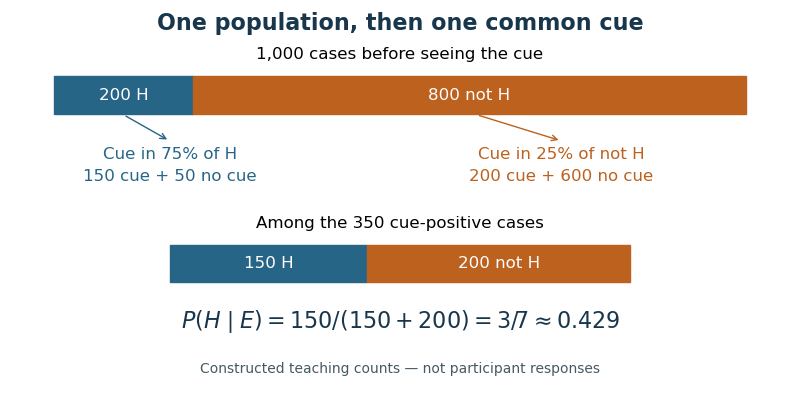
The two accounts agree that the task representation matters and that naïve answers need not obey the normative model. They disagree in emphasis: the heuristic account highlights substitution and control, while the ecological account highlights a mismatch between the supplied representation and an available inference algorithm. Frequency success alone cannot decide between them, because a clearer nested-set display can also make deliberate correction easier. Conversely, conflict sensitivity constrains an absolute “base rates were never noticed” story without proving successful Bayesian computation.
A discriminating design would cross numerical format with description–base-rate conflict, preserve the sampling assumptions and information content, and measure answers together with process indicators. It should distinguish a failure to encode prevalence, a failure to combine encoded evidence and a rational belief that the stated reference group is irrelevant. Verbal descriptions seldom specify a likelihood ratio, so prior-insensitivity is easier to diagnose than a unique numerical Bayesian answer for every description. If descriptions were selectively rather than randomly sampled, or a base rate were not applicable to the individual, the simple benchmark would change. Accordingly, base-rate neglect is a reproducible conditional pattern, not evidence that people invariably ignore statistics or possess no Bayesian competence; both heuristic competition and representational structure help explain when it occurs.
Developmental science, Part I, Trinity Term 2022: 20 April, 09:30 BST; one hour writing time. These independent essays answer all five printed options and use an evidence cutoff of 20 April 2022. Later findings are not used to answer the historical paper.
Course: Developmental science course of the year 2 of the psychology (experimental) course of the University of Oxford. Public source: Oxford-supplied archive, member a16818w1.pdf.[ref]
Developmental science, Part I, 2022 by University of Oxford. Cover and question page, A16818W1
Executive functions should contribute most when learning or assessment requires keeping several pieces of information active, suppressing an attractive error, coordinating successive operations or changing strategy. This predicts particularly strong links with multistep mathematics, mathematical problem solving and reading comprehension, alongside classroom engagement and following instructions. It predicts a smaller direct contribution to well-practised fact retrieval or fluent decoding once those operations are automated. That is a task-demand hypothesis, not a claim that every mathematics score must correlate more strongly with executive functions than every literacy score.
Working memory maintains goals and intermediate results: a child doing a subtraction with borrowing must retain both the original problem and its updated intermediate state. Inhibitory control helps suppress a larger-number answer that is tempting but irrelevant, or a familiar operation when the problem requires another. Cognitive flexibility supports switching between representations or abandoning an unsuccessful strategy. In reading, maintaining earlier propositions and rejecting an initially plausible interpretation should matter especially for comprehension and inference; knowledge of letter–sound correspondences is not itself an executive function. Repeated practice can change which process is the bottleneck, so developmental stage and familiarity matter.
Historically, the unity-and-diversity framework helped replace an undifferentiated “executive ability” with correlated but distinguishable processes. Akira Miyake and colleagues used several tasks per proposed component and latent variable analysis to separate common executive variance from individual task demands. Their influential study tested adults: its factor structure cannot simply be assumed to describe preschool children. It nevertheless supplies a crucial methodological lesson. A single executive task measures the intended control process together with perception, language, motor speed and task-specific strategies. Treating a raw score as a pure capacity risks attributing the wrong source of variance to school achievement.[ref]
More directly, Clancy Blair and Rachel Peters Razza followed 141 children from low-income homes, measuring preschool self-regulation and later kindergarten mathematics and literacy. Their inhibition measure required children to tap once when the experimenter tapped twice and twice after one tap: the apparatus is simple, but the rule requires suppressing imitation and maintaining an opposite response mapping. Inhibitory control was associated with emerging mathematics and reading after accounting for intelligence. This supports the importance of regulation during early learning, but the design was observational, not random assignment to different inhibitory capacities. Shared language, family circumstances or classroom experience could influence both performances.[ref]
Relating effortful control, executive function, and false belief understanding to emerging math and literacy ability in kindergarten by Clancy Blair and Rachel Peters Razza. Child Development 78, 647–663; Measures and academic-outcome regressions
Lucy Cragg and colleagues provided a more differentiated mathematical analysis. Their sample of 293 participants aged eight to twenty-five completed executive tasks and measures of factual knowledge, procedures and conceptual understanding. Working memory had both an association with overall mathematics and indirect associations through mathematical component skills; inhibition measured in a numerical context was linked to factual and procedural knowledge. This is more informative than treating “mathematics” as one outcome. However, statistical mediation in an age-spanning observational sample does not establish that changing the putative mediator would change attainment. Numerically framed executive tasks can also share content with the achievement measures, increasing the apparent specificity of the association.[ref]
Direct and indirect influences of executive functions on mathematics achievement by Lucy Cragg and others. Cognition 162, 12–26; abstract, executive-function battery and mediation models
Kate Cain and colleagues supply a corresponding literacy result. In assessments at ages eight, nine and eleven, working memory and comprehension components such as inference and monitoring predicted reading comprehension after controls for word reading and verbal ability. Sentence-span and digit-working-memory measures helped avoid defining the entire construct by one task. This supports a contribution beyond decoding, but the reported concurrent relations at successive ages are not an experimental demonstration of causal direction; comprehension itself can affect performance on verbally loaded memory tasks.[ref]
Children's reading comprehension ability: concurrent prediction by working memory, verbal ability, and component skills by Kate Cain and others. Journal of Educational Psychology 96, 31–42; longitudinal assessments at eight, nine and eleven years, concurrent prediction models
Evidence across populations qualifies the temptation to make executive functions the master explanation of achievement. Greg J. Duncan and colleagues compared six longitudinal datasets while controlling earlier child skills and family background. School-entry mathematics and reading were strong predictors of subsequent attainment; attention added prediction, whereas several socioemotional measures did not. Attention ratings are not interchangeable with laboratory inhibition or working memory measures. The result supports a classroom-regulation pathway while showing that already acquired domain knowledge remains central. Learning also exercises executive control, so baseline-adjusted longitudinal associations do not eliminate reciprocal influence or unmeasured confounding.[ref]
School readiness and later achievement by Greg J. Duncan and others. Developmental Psychology 43, 1428–1446; abstract and cross-dataset models; corrected version
Intervention offers a sharper causal test, but its target and outcome must be distinguished. Darren L. Dunning and colleagues randomly allocated seven- to nine-year-olds with low working memory to adaptive computerised training, low-load nonadaptive training or no training. The adaptive condition improved several untrained working memory tests, with some gains maintained over time, but did not produce corresponding academic or classroom-analogue benefits. The active comparison helps separate memory-load effects from attention, computer practice and expectations. Crucially, improvement on an untrained but structurally similar memory test is near transfer; improved reading or mathematics would be far transfer. One does not entail the other.[ref]
Does working memory training lead to generalized improvements in children with low working memory? by Darren L. Dunning and others. Developmental Science 16, 915–925; three-arm randomised trial, Results and Discussion
This trial does not show that working memory is irrelevant to achievement. A resource can constrain performance even when practising isolated tasks fails to change how it is deployed in a classroom. Nor does one intervention test all executive components, age groups or teaching methods. It does undermine the stronger inference from correlation to a promise that generic executive training will raise school attainment. Supporting instruction through shorter directions, external reminders and staged problems can reduce executive demands; whether any particular classroom support improves learning still requires an appropriately controlled outcome study.
The most defensible answer is therefore conditional and specific. Executive differences are especially plausible influences on managing novel, attentionally demanding, multistep learning and demonstrating that learning under load. They operate alongside knowledge, language, motivation and opportunity. Strong evidence would combine reliable multi-task executive measures, differentiated academic outcomes, repeated measurements with comparable meaning across ages, and interventions with active controls and delayed achievement tests. Existing prospective and experimental evidence supports executive functions as contributors to learning, while limiting claims that they are a single cause of educational success.
Calling childhood amnesia a myth is defensible only if the supposed myth is that infants cannot form lasting memories, or that adults' earliest reported age is an exact biological boundary. Neither proposition is warranted. It does not follow that the relative scarcity of accessible autobiographical memories from early childhood is imaginary. The central distinction is between forming a memory, retaining information, retrieving it with particular cues, reporting it verbally and assigning it a date. Evidence about one stage cannot automatically settle the others.
An important methodological change was the development of tests that do not ask infants to narrate an event. Carolyn Rovee-Collier and colleagues trained three-month-olds to move a crib mobile through footkicking. A ribbon-linked mobile provides a visible consequence of the infant's action; retention can then be assessed with the mobile present but no longer moving contingently. Elevated kicking relative to a pretraining baseline indicates retention of the learned relation, rather than a verbal report. In their 1980 study, a brief reminder exposure twenty-four hours before testing reinstated performance after delays of two or four weeks, despite the usual loss of the trained response after a much shorter interval. This directly challenges an account equating an initial failure to perform with complete erasure of the earlier experience.[ref]
Reactivation of infant memory by Carolyn Rovee-Collier and others. Science 208, 1159–1161; mobile conditioning, reminder and retention experiments
The inference has limits. Reminder controls must show that the exposure does not simply teach an untrained infant the response, and changes in general activity must be separated from memory-specific kicking. More fundamentally, memory for an action–outcome contingency is not equivalent to an adult's consciously recollected autobiographical episode. A demonstration of infant learning refutes global incapacity to remember; it does not prove that the adult can later re-experience that mobile episode as part of a personal life history. Reactivation under a matching cue also need not imply spontaneous retrieval without that cue.
Gabrielle Simcock and Harlene Hayne brought the verbal-report problem into a more naturalistic event. Young children experienced a novel “Magic Shrinking Machine”: interacting with an apparatus produced apparently smaller versions of toys. Vocabulary was measured when the event occurred and again after a delay; later tests included verbal recall, photograph recognition and behavioural reenactment. Children could retain event information nonverbally while failing to describe aspects for which they had lacked productive vocabulary at encoding, even after their vocabulary expanded. The design provides known event content and an opportunity to compare different response formats. It shows how a later verbal interview can underestimate retained information.[ref]
Breaking the barrier? Children fail to translate their preverbal memories into language by Gabrielle Simcock and Harlene Hayne. Psychological Science 13, 225–231; Magic Shrinking Machine, verbal and nonverbal tests
It would still be too strong to infer intact, adult-like episodic memory hidden behind a purely linguistic barrier. Recognition supplies information unavailable in free recall, and reenactment can exploit familiar objects and motor routines. Unequal performance may therefore reflect unequal cue support as well as representational format. The appropriate conclusion is that reporting limitations contribute to apparent amnesia, not that every unreported early event survives unchanged. Prospective tests should separately vary cue reinstatement and response modality rather than interpreting all nonverbal successes as full autobiographical recollection.
Memory dating provides another challenge to a sharp boundary. Qi Wang and Carole Peterson followed a small group of children across an eight-year interval, asking for their earliest memories and their estimated ages at those events. Some of the same events remained reportable but were assigned progressively later ages. This forward telescoping can make an early-life period seem empty when surviving memories have migrated out of it on a retrospective timeline. Repeatedly following individual events is more informative than comparing different people's single earliest-memory reports. However, substantial attrition and uncertain initial dates limit the inference: a change in reported date does not establish the objectively correct date or show that dating error explains all missing memories.[ref]
The fate of childhood memories by Qi Wang and Carole Peterson. Frontiers in Psychology 6, 2038; initial, two-year and eight-year memory dating interviews
The strongest reason to reject the blanket “myth” claim comes from prospective evidence of actual loss of access. Patricia J. Bauer and Marina Larkina documented conversations about specific events when children were three, then interviewed different subgroups at ages five to nine. Five- to seven-year-olds recalled at least sixty per cent of those early events, whereas eight- and nine-year-olds recalled fewer than forty per cent. Thus memories that demonstrably existed in childhood later became unavailable to the interview procedure. Older children's surviving narratives could be richer even while fewer events remained accessible: increasing narrative skill and increasing loss of early memories are compatible.[ref]
The onset of childhood amnesia in childhood by Patricia J. Bauer and Marina Larkina. Memory 22, 907–924; age-three interviews and prospective follow-ups at ages five to nine
That study does not isolate a single neural cause. Longer retention intervals accompany older test ages, parent–child conversations are themselves retrieval practice, and forgotten-at-test does not mean physically erased. Nevertheless, it rules out explaining the entire phenomenon as failure to encode in the first place, and it cannot be dismissed as adults merely misdating every surviving memory. The outcome to explain is a developmental distribution of accessibility produced over time.
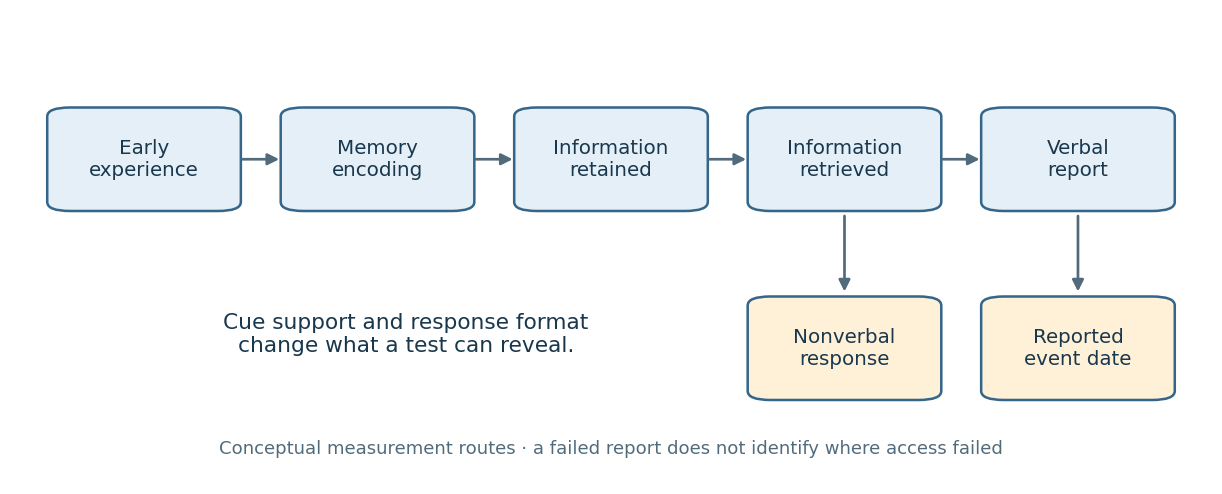


This framework yields clear discriminating predictions. A retrieval account predicts improvement when appropriate cues are reinstated without teaching new event content. A verbal-expression account predicts better nonverbal than verbal performance when language at encoding is limited. A dating account predicts shifts in the age assigned to an otherwise recognisable event. A forgetting account predicts loss of access to prospectively documented events. These mechanisms can coexist, so success for one is not a refutation of all the others.
By the 2022 evidence base, childhood amnesia should therefore be treated as a genuine pattern of sparse later autobiographical access whose boundaries and mechanisms are often oversimplified. The myths are a memoryless infancy, a universal discontinuity at one birthday and the assumption that an unsuccessful verbal report proves no retained information. Rejecting those myths makes the phenomenon more precise; it does not abolish the explanatory problem.
Greater transparency and reproducibility have changed developmental psychology's estimates, measurement practices and theoretical confidence, but have not simply replaced a collection of “true” findings with “false” ones. Computational reproducibility asks whether the same data and documented analysis yield the same result. Scientific replication asks what happens with new observations. Preregistration makes planned tests distinguishable from exploratory choices; open materials permit checking whether ostensibly similar studies actually use the same procedure. None of these, by itself, guarantees construct validity or representative sampling.
The marshmallow task illustrates a substantive change in interpretation. Walter Mischel's early experiments offered preschoolers a smaller immediate reward or a preferred delayed reward and manipulated how attention was directed during waiting. Distraction increased delay. The original experimental programme therefore already showed sensitivity to cognitive strategy and setting, rather than a fixed quantity of virtue revealed by a treat. Later predictive associations are a different claim from those immediate experimental effects.[ref]
Cognitive and attentional mechanisms in delay of gratification by Walter Mischel and others. Journal of Personality and Social Psychology 21, 204–218; experimental manipulations of attention during waiting
Tyler W. Watts and colleagues revisited long-term prediction in a larger and more diverse cohort. Their 2018 conceptual replication used a waiting task at fifty-four months and adolescent achievement outcomes. Associations were substantially reduced after adjustment for family background, early cognitive abilities and the home environment; much of the achievement difference was concentrated at the lowest waiting times. An important measurement difference was the seven-minute ceiling, rather than treating all waiting tasks as interchangeable. These results weaken a simple causal story in which training a preschooler to wait longer should, by itself, transform later attainment. They do not show that self-regulation never matters, because adjustment can remove both confounding and potentially meaningful pathways.[ref]
Revisiting the marshmallow test by Tyler W. Watts and others. Psychological Science 29, 1159–1177; Delay of gratification measure, adjusted models and measurement limitations
Celeste Kidd and colleagues supplied experimental evidence for one alternative mechanism: environmental reliability. Before the waiting task, children encountered an adult who either fulfilled or failed promises about appealing materials. Children subsequently waited longer after reliable experiences. The observation matters because apparent “poor self-control” can be an understandable response to expecting that a promised reward will not arrive. This small experiment supports contextual causation under its own conditions, not a claim that all socioeconomic differences in waiting are caused by trust. Together, the studies shift the target from an isolated child trait to the interaction between control, expectations and circumstances.[ref]
Rational snacking by Celeste Kidd and others. Cognition 126, 109–114; reliable versus unreliable experimenter manipulation
Neonatal imitation illustrates why replicability also depends on the inferential contrast. Andrew N. Meltzoff and M. Keith Moore's 1977 report described very young infants matching facial and manual gestures. In this paradigm an adult models an action and infant responses are recorded and coded; the crucial question is whether the infant produces a given action preferentially after its matching model, not merely whether the action occurs. An increase in tongue protrusion after interesting stimulation is insufficient unless appropriate nonmatching controls exclude general arousal or exploration.[ref]
Imitation of facial and manual gestures by human neonates by Andrew N. Meltzoff and M. Keith Moore. Science 198, 75–78; modelled facial/manual actions and coded infant responses
Janine Oostenbroek and colleagues tested 106 infants longitudinally with nine social and two nonsocial models at one, three, six and nine weeks. Their broad comparisons did not support model-specific imitation, although restricted cross-sections could resemble earlier positive findings. This challenged a general innate-imitation account and highlighted the consequences of selecting particular gestures, ages and contrasts after observing results. Yet the study's breadth also created substantive questions about fatigue, presentation and how each action was scored.[ref]
Comprehensive longitudinal study challenges the existence of neonatal imitation in humans by Janine Oostenbroek and others. Current Biology 26, 1334–1338; nine social and two nonsocial models across four ages
The subsequent requested-data reanalysis by Meltzoff and colleagues reported tongue-protrusion matching under pooled-control contrasts and criticised features of the elicitation and scoring procedures. That was not an independent replication: it reused the same observations. It nevertheless shows the scientific value of access to raw data. The disagreement became one about estimands, comparison sets and measurement sensitivity that another preregistered experiment could adjudicate, rather than an unsupported declaration that one team must be wrong. Evidence for one gesture would also not automatically vindicate a broad, domain-specific imitation mechanism.[ref]
Re-examination of Oostenbroek et al. (2016): evidence for neonatal imitation of tongue protrusion by Andrew N. Meltzoff and others. Developmental Science 21, e12609; requested raw data, pooled-control tongue-protrusion analyses and design criticisms
ManyBabies 1 provides a constructive counterexample to the notion that open developmental research only dismantles effects. In a Registered report, an international collaboration used common speech stimuli and prespecified analyses to test infant-directed versus adult-directed speech preferences. The final sample included 2,329 infants from 67 laboratories. A preference for infant-directed speech survived, while its magnitude varied with age, language experience and measurement method. Laboratories used central fixation, head-turn preference or eye tracking procedures, making methodological variability an object of analysis. The result supports a reproducible average preference without treating the same effect size as universal for every infant or cultural setting.[ref]
Quantifying sources of variability in infancy research using the infant-directed-speech preference by The ManyBabies Consortium. Advances in Methods and Practices in Psychological Science 3, 24–52; Participants, preregistered analyses and Discussion
Several changes to our understanding follow. First, an established group-level tendency can coexist with weak prediction for an individual child. Secondly, stimulus choice, stopping rules, exclusions and coding decisions can change what has actually been measured. Thirdly, heterogeneous outcomes can identify theoretically useful boundary conditions, but a moderator discovered after a failure needs a new test rather than serving as an unlimited excuse. Finally, openly available null results reduce selective visibility of successful studies, improving the evidential base used to build developmental accounts.
The causal claim about reform itself should remain modest. Larger samples, broader recruitment and better controls often accompany transparency, so a change in an estimate cannot be attributed uniquely to preregistration. A perfectly reproducible analysis can reproduce a biased model, and an underpowered replication may be inconclusive. Reliability and measurement equivalence are especially important for looking-time and single-trial child tasks; independent coding and predefined exclusion rules help, but do not establish the intended psychological construct. Open child data also require appropriate consent and controlled access where identification is possible; useful transparency need not mean publishing recognisable videos.
By 2022, these developments justified a more conditional developmental science: waiting reflects more than a decontextualised trait; claims of newborn action matching require precise controls; and an infant speech preference can be robust while method-sensitive. The main advance is a tighter connection between a theoretical claim, an explicitly defined measure and evidence that others can inspect or independently test. Transparency changes what can be learned from disagreement, while replication establishes how far a finding travels.
Performance factors affect both the expression of an existing understanding and, potentially, the experiences through which that understanding emerges. These are different causal claims. An expression account says that a child represents an agent's mistaken belief but fails to demonstrate it because the task overloads language, memory, response selection or inhibition. An emergence account says that developing those capacities helps construct increasingly flexible representations of belief. The same association between executive control and false belief performance is compatible with either account; a discriminating argument must examine manipulations, time course and transfer.
The classic unexpected-transfer procedure, associated with Heinz Wimmer and Josef Perner's 1983 study, makes the diagnostic contrast clear. A protagonist leaves an object in one location, does not witness its displacement, and returns. Predicting the protagonist's initial search requires distinguishing the protagonist's representation from the child's own knowledge of reality. A traditional failure might reflect treating belief as reality, but it might also reflect misunderstanding the request, forgetting the agent's informational access or selecting the salient actual location. Memory and reality-control questions help verify story comprehension without eliminating every demand of coordinating the representations.[ref]
Beliefs about beliefs by Heinz Wimmer and Josef Perner. Cognition 13, 103–128; unexpected-transfer stories
Conversational evidence particularly supports expression. Michael Siegal and Karen Beattie clarified that the question concerned where the protagonist would look first. Three-year-olds were more successful when the intended initial-search interpretation was made explicit. A child answering the actual location to an ambiguous request may be giving helpful advice about where to find the object, rather than revealing an inability to represent a mistaken belief. Because the conceptual relation can remain unchanged while wording changes, the result demonstrates a task contribution. It does not establish that every younger child's standard-task error has that pragmatic origin.[ref]
Where to look first for children's knowledge of false beliefs by Michael Siegal and Karen Beattie. Cognition 38, 1–12; initial-search wording manipulation
Peipei Setoh and colleagues separated two concurrent demands in a picture-book procedure. Two-and-a-half-year-olds followed an illustrated search story in which the object was taken away, reducing the lure of a known competing location. Interspersed “where” practice questions about familiar pictures reduced response-generation demands without directly teaching a false belief answer. In the first experiment, 25 of 32 children selected the belief-consistent container. Further experiments varied the practice procedure; when inhibitory demands were increased, response practice was insufficient. The conjunction is informative: failure can result from interacting demands, so removing one demand need not rescue performance if another remains high.[ref]
Two-and-a-half-year-olds succeed at a traditional false-belief task with reduced processing demands by Peipei Setoh and others. PNAS 113, 13360–13365; Experiments 1–4 and picture-book apparatus
These findings make a purely stage-like inference from standard failure to complete conceptual absence untenable. However, scaffolded success does not prove fully adult-like, context-independent competence. A modified task may supply external support that is part of the solution, and repeated practice may change strategy during the test. Strong expression evidence preserves the false-belief-versus-reality contrast, avoids location cueing and response coaching, and tests transfer to new agents, stories and response formats. Task simplification that removes the need to represent another person's mistaken belief would not be diagnostic.
Nonverbal infant studies extend the argument but increase the measurement burden. Kristine H. Onishi and Renée Baillargeon used a staged apparatus containing green and yellow boxes and a hidden toy. The actor's visual access to the toy's movements produced true- or false belief conditions, after which she reached into a box. Fifteen-month-olds looked longer at belief-incongruent reaches. The factorial manipulation is more informative than a single surprising action because it distinguishes the infant's knowledge of the toy's location from what the actor witnessed. Removing the verbal question is consistent with an expression limitation in older traditional tasks.[ref]
Do 15-month-old infants understand false beliefs? by Kristine H. Onishi and Renée Baillargeon. Science 308, 255–258; green/yellow boxes, true- and false-belief induction and test reaches
Nevertheless, looking longer is an indirect dependent measure. Belief attribution must be distinguished from remembered action–location associations, novelty and other expectations about behaviour. Sebastian Dörrenberg and colleagues tested four nonverbal measures in 66 twenty-four-month-olds. Anticipatory looking and interaction results did not reproduce earlier effects, other measures showed order-sensitive evidence, and there were no systematic intertask correlations. This does not demonstrate that infants lack every belief-related expectation. It weakens the claim that all such measures reveal a single, robustly measured competence already complete in infancy. Low individual-level reliability can itself attenuate intertask correlations, so absence of convergence is a warning about the measures, not decisive proof of conceptual absence.[ref]
How (not) to measure infant theory of mind by Sebastian Dörrenberg and others. Cognitive Development 46, 12–30; four measures in 66 two-year-olds, abstract and convergent-validity analyses
Evidence for emergence is stronger when developing another capacity changes performance beyond an immediate response aid. Courtney Melinda Hale and Helen Tager-Flusberg randomly assigned sixty preschoolers who failed initial false belief and complement tests to training on false belief, sentential complements or relative clauses. Complement training improved both the trained language skill and several theory of mind posttests; relative-clause training did not produce the same transfer. Complement syntax can represent a report such as “she says that the toy is in the box” without requiring the embedded proposition to be true, providing a plausible representational tool. But false belief training improved theory of mind scores without improving complements, so the study does not establish that mastery of that syntax is a necessary prerequisite.[ref]
The influence of language on theory of mind by Courtney Melinda Hale and Helen Tager-Flusberg. Developmental Science 6, 346–359; random allocation to complement, false-belief or relative-clause training
The emergence interpretation must also be calibrated. The posttests followed training over a short interval, so improved coordination or access remains an alternative to a new concept. More persuasive evidence would show retained gains across untrained measures and environments, with reliable baseline assessment. Conversely, an expression-only theory cannot explain every developmental change merely by labelling poor performance a load effect: it must specify the required representation, quantify the demands and predict when targeted reductions should help or fail.
An integrated account is therefore best supported. Language and executive control can enable children to acquire, compare and discuss conflicting perspectives over development; the same capacities then determine whether a representation can be accessed and translated into the demanded answer on a particular trial. A low-load success establishes an ability under supportive conditions. A later high-load success demonstrates more independent and flexible deployment, which is itself a developmental achievement. Short-term demand manipulations primarily test expression; longitudinal and training designs can constrain emergence, provided they separate conceptual change from strategy and practice. The evidence supports contributions from both rather than an unrestricted conclusion of either complete competence from infancy or wholly absent understanding before conventional task success.
Children detect distributional structure at several levels: variation within speech sounds, sequential relations that help identify word-sized units, dependencies across intervening words, and word–referent co-occurrences across scenes. These findings challenge the claim that language is acquired without powerful learning from experience. They do not, by themselves, show that linguistic representations, perceptual constraints or specialised learning biases are dispensable. A learning algorithm and the representations over which it operates are different parts of an explanation.
At the phonetic level, Jessica Maye and colleagues familiarised six- and eight-month-olds with tokens from a speech-sound continuum. Exposure concentrated near one region or around two regions, creating unimodal versus bimodal frequency distributions. Only the bimodally exposed group subsequently discriminated the tested endpoints. Holding the range of speech sounds while changing their frequency profile gives a causal manipulation of distributional input, supporting a mechanism through which experience could tune phonetic categories. Endpoint discrimination is still not equivalent to acquiring the full phoneme inventory of a natural language, and infants' prior perceptual organisation constrains what distributions are available to learn.[ref]
Infant sensitivity to distributional information can affect phonetic discrimination by Jessica Maye and others. Cognition 82, B101–B111; unimodal/bimodal speech-sound exposure and discrimination
At the word-boundary level, Jenny R. Saffran and colleagues exposed eight-month-olds for two minutes to a continuous artificial speech stream with repeated trisyllabic units but no pauses marking their boundaries. A head-turn preference procedure then measured responses to familiar units and comparison sequences. Infants differentiated units supported by the stream's sequential regularities. The arrangement matters: after a central light attracted attention, a side light and loudspeaker supported a controlled measure of how long the infant maintained orientation. Masking sound for the accompanying adult and observer reduced inadvertent cueing. This made a nonverbal test of sequence learning possible well before children could explain a segmentation strategy.[ref]
Statistical learning by 8-month-old infants by Jenny R. Saffran and others. Science 274, 1926–1928; two-minute artificial-speech exposure and head-turn preference tests
The relevant statistic can be expressed as the conditional probability of the next syllable given the current one. High predictability within a recurring unit and lower predictability across units can supply boundary information. This is a candidate computation, not a claim that infants explicitly calculate numerical fractions. Association strength, chunk formation or predictive processing can produce related behavioural discrimination, and a preference test alone may not identify which algorithm was used. Recognition of a recurrent sound sequence also does not yet make it a meaningful word.
Rebecca L. Gómez extended learning beyond adjacent pairs. Adults and eighteen-month-olds heard three-element artificial-language strings whose first and last elements were related while the middle element varied. Adjacent dependencies were matched between the languages; the discriminating information lay in the nonadjacent relation. Greater variability in the middle position helped reveal the invariant outer relation. This shows that variability can improve learning rather than merely introducing noise, and that distributional sensitivity can extend over an intervening element. It remains a constrained sequence-learning result, not a demonstration that infants have induced hierarchical syntax or every long-distance dependency of natural grammar.[ref]
Variability and detection of invariant structure by Rebecca L. Gómez. Psychological Science 13, 431–436; three-element artificial-language strings, middle-element variability and nonadjacent dependencies
At the lexical–semantic interface, Linda B. Smith and Chen Yu presented twelve- and fourteen-month-olds with ambiguous picture–word situations. A single encounter contained two objects and two words, so it did not uniquely specify which word referred to which object. Across encounters, the correct word–object pairings recurred more consistently. At test, a spoken label elicited greater looking to its associated target than to a distractor. Accumulating evidence across individually ambiguous scenes therefore supports learning several mappings without a uniquely informative naming event on each trial. The result does not show whether each infant maintained competing associations or tested a single candidate hypothesis, and the controlled visual scenes simplify the attentional problem of everyday word learning.[ref]
Infants rapidly learn word-referent mappings via cross-situational statistics by Linda B. Smith and Chen Yu. Cognition 106, 1558–1568; ambiguous word/picture pairings and target-versus-distractor looking
These levels address different uncertainty problems. A distribution over acoustic tokens can alter discriminability; a sequence distribution can identify recurring units; nonadjacent relations can support dependency learning; cross-situational co-occurrence can link forms to referents. None entails that the others are solved automatically. To explain a natural language, an account must specify how learners select relevant features, integrate conflicting cues, remember the necessary history and move from surface regularities to productive representations. Successful learning of a small artificial input establishes capacity under those conditions, not that the available natural input necessarily suffices for every proposed grammatical generalisation.
Evidence against exclusive linguistic specialisation comes from transfer of the statistical problem to nonlinguistic materials. In a 1999 study, Saffran and colleagues arranged tones into continuous streams with analogous boundary structure. Eight-month-olds and adults segmented those streams using their regularities. Thus the relevant capacity is not restricted to syllables. This supports a domain-general contribution but does not prove identical neural implementation, equal learnability for every stimulus class or the absence of specialisation elsewhere in language.[ref]
Statistical learning of tone sequences by human infants and adults by Jenny R. Saffran and others. Cognition 70, 27–52; nonlinguistic tone-stream segmentation by infants and adults
The strongest version of an encapsulated linguistic module, if it claims that such acquisition cannot exploit general sequence learning, must accommodate this evidence or be revised. A weaker linguistic toolkit can remain compatible with it. Constraints on representations, attention to particular acoustic dimensions, biases about possible dependencies and socially guided selection of referents can determine the input on which an otherwise general learner operates. Experience can also produce increasing specialisation, so a specialised mature system does not entail a fully specified innate one. Conversely, learning some regularities early does not demonstrate a blank slate: a learner needs a perceptual space, memory and inductive assumptions before any frequency can be counted.
To distinguish these accounts, studies should compare linguistic and carefully matched nonlinguistic materials, separate frequency from conditional predictability, test generalisation to new items, and establish which cues children actually exploit in less constrained settings. A model that fits a familiarisation preference but cannot learn or generalise beyond that particular stream has not explained language acquisition. Evidence of reliable cross-domain learning constrains claims of exclusivity; evidence for selective biases constrains an unrestricted domain-general model. By 2022, the warranted position was to retain distributional learning as a demonstrated part of the toolkit while treating the scope, representational format and degree of specialisation as empirical questions.
Solutions and source-qualified methods for the Experimental Psychology paper Experimental design and methods, dated 25 April 2022. Source release: Oxford Experimental Psychology examination release, member
a16816w1.pdf.The separate supplementary data sheet is absent from the held release. Consequently all eight parts of Question 1, parts (a)–(b) of Question 2, and all six parts of Question 5 retain explicit TODOs; conditional explanations at these leaves do not constitute recovered empirical answers. All available theory parts, including every option in the choice questions, are answered.
TODO: the supplementary sheet is needed to identify the analysis actually conducted. A two-factor factorial design is described, but that alone does not distinguish an independent-groups two-way analysis of variance, a repeated-measures analysis of variance, a mixed design, or a mixed-effects model. The model call, error structure, participant allocation and output headings would establish which analysis was used. In particular, the prose does not establish that every participant experienced every condition.
The two independent variables are social-cue congruence, with congruent and incongruent levels, and cue-to-response delay, with short ( ms) and long ( ms) levels. The response variable is reproduction reaction time, measured in seconds. Thus the known treatment structure is a factorial design, potentially estimating two main effects and their interaction.
TODO: identify the allocation from the missing supplementary sheet or protocol. The eighty recruited participants do not establish whether either factor is within-subjects or between-subjects, whether all observations were retained, or how trials were summarized. The design cannot responsibly be called fully repeated-measures, fully independent-groups or mixed without that information.
TODO: the effect-specific values are unavailable without the supplementary output. Retrieve the rows for congruence, delay and congruence-by-delay interaction, if those terms were fitted. In an appropriate analysis of variance, each F-test compares a term's mean square in ANOVA with its designated error mean square in ANOVA; repeated observations can require different error terms. Neither the factor labels nor the recruited sample size determines those ratios.
TODO: neither the significant effects nor their numerical effect sizes can be determined. Inspect the output's significance results and the definition of its reported effect size. If it supplies partial eta squared, that quantity is ; it is not automatically ordinary eta squared or a fraction of all observed variation. Repeated-measures conventions and the selected error term matter. Report the actual metric and preferably an uncertainty interval; do not manufacture an effect size from the number of participants.
TODO: retrieve both numerator and denominator statistical degrees of freedom for each significant effect from the missing output. The table is also needed to establish which effects, if any, meet the analysis's significance criterion. Participant allocation, exclusions, aggregation and fitted error structure determine the applicable statistical degrees of freedom; the recruitment count is not enough to reconstruct them. No numerical statistical degrees of freedom are asserted here.
TODO: an empirical Results section cannot be completed without the analysis and descriptive output. It must identify the actual factorial design, outcome scale and fitted model; summarize the four condition means with appropriately labeled standard deviations or standard errors; and report the congruence, delay and interaction tests with their actual F-test statistics, statistical degrees of freedom, p-values, effect sizes and relevant confidence intervals.
Interpret an interaction as evidence that the cue-congruence difference varies with delay, not merely as evidence that one separate test was significant and another was not. Any simple-effects analysis must identify its contrasts and multiple testing treatment. If the analysis used transformed reaction times, distinguish the model's scale from raw-second summaries. A nonsignificant result does not establish equality or absence of a theoretically meaningful effect. These are reporting requirements, not placeholders for invented results.
TODO: whether additional analyses are needed depends on the unavailable results and prespecified questions. An estimated congruence-by-delay interaction can be clarified by the cue-congruence contrast at each delay, with confidence intervals and justified multiple testing control. A direct interaction test addresses whether those contrasts differ; comparing their separate significance labels does not.
Even without a significant interaction, an adequately powered, prespecified contrast may address a distinct scientific question; indiscriminate testing until something is significant is not justified. Inspect regression diagnostics and the treatment of dependent trials where appropriate. Without the output, one cannot decide that any particular follow-up is required or conclude that none is necessary.
TODO: the missing condition means and inferential output prevent a conclusion about whether congruent gaze changed reaction time or whether that change depended on delay. The direction, magnitude and uncertainty of those two comparisons are needed before drawing conclusions about attentional guidance in this task.
TODO: the missing output is needed to name the test actually used. A correlation, multiple linear regression adjusting for age, or another model would answer different questions. The presence of power, friendliness and age variables does not identify which were included, which was the response variable, how age was encoded, or whether an interaction was tested. Read the model call and coefficient or test table before identifying the procedure.
TODO: the numerical results, association direction and statistical evidence are unavailable. The required output includes the actual fitted model, estimates and uncertainty, test statistics, statistical degrees of freedom, p-values and an appropriate model-fit summary. An age-adjusted regression coefficient, if reported, would describe a conditional association under that model rather than the same estimand as an unadjusted correlation. Irrespective of its numerical outcome, this observational study does not by itself show that executive power changes real-life friendliness.
Several mechanisms could explain an observed association without a causal effect of power on friendliness. No exposure was assigned, so this is an observational study. Age, organizational role, wealth, gender, industry, public prominence or other common causes could produce confounding. Reverse direction is also possible: interpersonal behavior might influence advancement and hence power. Adjusting for age alone would not remove every alternative explanation.
The measured outcome is perceived friendliness from a photograph. Facial expression, pose, lighting, clothing, attractiveness and familiarity could affect those ratings independently of everyday behavior. If raters recognize an executive or know their status, expectations could alter the outcome; financial experts' power ratings may themselves involve judgment and measurement error. These are construct validity issues, since a photographic impression need not measure friendliness toward colleagues.
The preselected thirty executives are not a probability sample of all workers or even necessarily of all executives. Selection bias, narrow representation and restriction of range could alter associations and limit external validity. Multiple ratings of the same executive are also not independent executive observations; ignoring that structure would be pseudoreplication. These possibilities apply whether the reported association is positive, negative or inconclusive; the unavailable numerical findings are not assumed.
Improve the sampling, measurement and dependence model before interpreting the association. Define the target population and recruit a broader sample with a transparent sampling frame, ideally using probability sampling where feasible and adequate representation across the relevant ages and roles. Justify the sample size for the intended effect size and precision. Preselection on reputation or the outcomes should be avoided or explicitly modeled.
Operationalize workplace friendliness with several relevant measures, such as independently obtained colleague reports and standardized behavioral tasks, rather than relying only on photographs. Use standardized photographs if impressions are themselves the research target, several independent raters, and blinding to power and the specific hypothesis. Measure inter-rater reliability and retain the distinction between impression and behavior. Establish what the power measure actually assesses and record plausible confounders with a causal rationale.
For a linear regression analysis, use friendliness as an explicitly declared outcome and power as a continuous predictor. Retain actual age as a continuous covariate when available instead of treating three age groups as equally spaced measurements; consider justified nonlinearity. If only age categories are available, use explicit categorical contrasts and nonoverlapping category definitions. Check regression diagnostics, influential observations, heteroscedasticity and multicollinearity. Account for executive and rater dependence with an appropriate mixed-effects model when repeated or crossed ratings are analyzed; do not count each rating as a new executive. Report estimates with confidence intervals and disclose exclusions and missing observations.
Preregistration can distinguish planned analyses from exploratory ones. A longitudinal study with repeated measures can establish temporal ordering more clearly, though it remains vulnerable to confounding. A feasible, ethical randomized experiment manipulating assigned power or role in a controlled task could test a more narrowly defined causal effect; its external validity to senior executives must still be assessed. No observational adjustment alone guarantees removal of all unmeasured alternatives.
Use one-way analysis of variance to compare a quantitative response variable across levels of one categorical factor; for example, compare task accuracy across three independently assigned teaching methods. The ordinary independent-groups procedure tests the null hypothesis that all group population means are equal. Its F-test compares variation associated with the group factor against within-group error variation; a significant result indicates that not all population means are equal, without identifying which groups differ.[ref]
One-Way ANOVA by National Institute of Standards and Technology. Handbook Section 3.2.3.1, Description and Model
The classical one-way normal linear model assumes independent observations and within-group errors approximately following a normal distribution with a common variance. Repeated observations on the same people require a different dependence structure; pronounced unequal variances may call for Welch's one-way analysis of variance. Planned contrasts or appropriately controlled follow-up comparisons identify scientifically relevant differences. Report the means, differences and confidence intervals, not just significance. Causal interpretation depends on the design of experiments, particularly randomization, rather than on the F-test alone.
Use a bivariate correlation to describe the direction and strength of association between two measured variables, such as study time and test score. The Pearson correlation coefficient describes linear association between two quantitative variables: its sign gives direction, and its magnitude reflects linear association on a standardized scale. A confidence interval describes estimation uncertainty; a corresponding hypothesis test can assess a specified null association under its sampling assumptions.
Inspect a scatter plot for curvature, clusters, influential observations and restriction of range. A coefficient near zero does not exclude a strong nonlinear relationship. For ordered or markedly nonnormal measurements, a Spearman rank correlation can describe monotone association, using ranks; it does not require a linear relation in the original units. Ordinary inferential procedures require independent observational units and appropriate assumptions for their chosen method. Correlation alone does not identify a causal direction or exclude confounding.
Use a Student t-test to assess a mean or mean difference relative to its standard error. A one-sample version compares a population mean with a specified reference. An independent two-sample version compares two separate groups, such as groups assigned different instructions; Welch's t-test permits unequal group variances. A paired t-test uses within-pair differences, such as each participant's before/after scores, rather than pretending those measurements are independent.[ref]
The relevant normality assumption concerns within-group errors for the independent-groups model or the distribution of within-pair differences for the paired model. Independent participants or pairs remain essential. Report the estimated difference and its confidence interval together with the test result. A small p-value indicates incompatibility with the specified null hypothesis under the model; it does not measure the size of the difference, the probability that the null hypothesis is true, or whether the difference matters practically.
Qualitative research methods investigate meanings, experiences and processes in context. For example, interviews about why lecturers find scheduling difficult could reveal unanticipated constraints that a fixed-response questionnaire omits. Interviews, focus groups, observations and documents provide material; a clearly stated approach such as thematic analysis or qualitative content analysis organizes its interpretation. These methods can develop an explanation or refine a construct rather than estimate a population prevalence.
Recruit participants whose experiences address the research question, for example by purposive sampling across different teaching roles, and explain the basis for the sample's adequacy. Record and transcribe material where appropriate and agreed. Describe how the analysis moved from material to codes, interpretations and claims; support interpretations with contextualized, confidentiality-preserving extracts. Consider contrary cases, alternative interpretations and the researcher's role through researcher reflexivity. The criteria for quality should fit the analytic approach: agreement between coders is useful in some structured coding studies, but is not a universal validity criterion for every interpretive method. Informed consent and protection against identification are especially important when detailed accounts concern identifiable colleagues.
The normality assumption concerns the model's error distribution, not necessarily the pooled raw observations. In an independent-groups analysis of variance, errors around each group mean are modeled as following a normal distribution; combining groups with genuinely different means can produce a nonnormal pooled distribution even when this assumption holds. In a paired t-test, the relevant distribution is that of within-pair differences. Linear regression conventionally assumes normal errors conditional on the predictors for exact small-sample Student t-tests and F-tests.[ref]
The one-way ANOVA model and assumptions by National Institute of Standards and Technology. Handbook Section 7.4.3.2, fixed-effects errors
Inspect suitable within-group or fitted-model regression residuals using a quantile-quantile plot and examine outliers and asymmetry. A formal normality test is not a decisive automatic gatekeeper: with small samples it may miss important departures, while large samples can detect minor departures. Approximate robustness depends on the sample size, balance, tail behavior and intended inference. The central limit theorem concerns sampling distributions and does not make every raw observation normal or repair dependence. Depending on the question, a justified transformation, a better-fitting probability model, robust inference or an appropriate bootstrap may be preferable. The normality assumption, independence and equal variance are distinct assumptions.
Research ethics governs how a worthwhile question is investigated while respecting those involved. The British Psychological Society's framework emphasizes respect for autonomy, privacy and dignity, scientific integrity, social responsibility, and maximizing benefit while minimizing harm. Seek appropriate independent ethical review before recruitment and assess risks in the actual study context.[ref]
Code of Human Research Ethics by British Psychological Society. 2021, Sections 2–3 and 13: principles, risk and ethics review
Give understandable information, seek voluntary informed consent, explain the practical limits of withdrawal, and avoid pressure arising from a teacher–student or employer–employee relationship. Limit identifiable information, control access and distinguish confidential storage from genuine anonymity. Any justified withholding or research deception needs proportionate review and appropriate research debriefing; debriefing does not undo every possible harm. Explain relevant procedures and offer questions and support consistent with the study's risks.[ref]
Code of Human Research Ethics by British Psychological Society. 2021, Section 4: valid consent; informing participants and ongoing consent
In the lecturer questionnaire study, make participation independent of employment evaluation and prevent identifiable responses reaching supervisors. Ethical reporting also requires honest analysis, disclosure of limitations and proportionate data sharing: open science does not require exposing confidential participant records.
TODO: the supplementary model call and tables are needed to identify the actual analyses. The described categorical predictors are compatible with a multiple linear regression containing a distance factor, a size factor and possibly their interaction; a factorial analysis of variance can represent the same mean structure. The mention of a coefficient table does not establish the exact fitted terms, predictor coding, estimation method or dependence assumptions. No particular fitted model is asserted.
TODO: the model's explained-variance value is absent. For an ordinary least-squares linear regression with an intercept, the coefficient of determination is . Its value multiplied by one hundred is the corresponding percentage of sample variation explained by that fitted model. Read the actual reported and distinguish it from the adjusted coefficient of determination; neither is a verified prediction-performance estimate on new data. Without the missing summary or sums of squares, no numerical percentage can be recovered.
TODO: the coefficients and their numerical and entries cannot be recovered. The coefficient estimate gives a modeled difference relative to the stated reference coding; its standard error quantifies uncertainty, and the usual coefficient test uses for a zero-coefficient null hypothesis. The p-value requires the appropriate reference distribution and statistical degrees of freedom. In a conventional R coefficient table an
Estimate is usually an unstandardized regression coefficient, not automatically a standardized regression coefficient; the table and model documentation must establish which meaning of is intended. These definitions supply no missing numerical values.TODO: directions, magnitudes and inferential conclusions require the unavailable coefficient table, coding and model specification. For illustration of interpretation only, let and be binary indicators whose reference levels are explicitly defined. If an ordinary linear model includes both factors and their interaction, its conditional mean has the formThen the distance difference is at the reference size and at the other size; the interaction is the difference between those differences. If the interaction is omitted, the model assumes a common distance difference across sizes. These are conditional model meanings, not a claim that the missing analysis used this model or that either predictor had an observed effect. The uncertainty of a coefficient sum also involves their covariance, not merely their separate p-values.
Articles were limited to the first 100 out of 443 total.
Articles by others on the same topic
There are currently no matching articles.