For , the equilibrium points satisfy , so for every integer . The derivative of the vector field is . ThusBetween an odd multiple and the next even multiple the sine is negative, so the flow points right; between that even multiple and the next odd multiple it points left. A compact phase-line sketch isEvery initial condition strictly between two adjacent repelling points approaches the even multiple between them. The repelling equilibria themselves remain fixed if initialized exactly there.
For , the origin always exists. Its derivative makes it attracting for and repelling for . Nonzero equilibria solveThey occur in symmetric pairs. On the first positive lobe , the sinc function decreases from one to zero, giving one positive and one negative nonzero equilibrium for . Both are repelling, since there. Near ,The unstable branches meet the stable origin in a subcritical pitchfork bifurcation. At the origin is still nonlinearly repelling because the leading term is . For it is the only equilibrium.
For each higher positive-sine lobe , , the sinc function has a single positive maximum at , whereIf , that lobe has two roots: the smaller positive root is attracting and the larger is repelling, because . Their negative counterparts have the same stability. At the pair on each side merges in a saddle-node bifurcation; the double equilibria are semistable. For that lobe contributes none. The first such threshold is about .
For , put ; expanding near the sine maximum gives and . Away from bifurcation values, the exact counting rule for and its small- estimate areAt a saddle-node threshold, count each merged positive or negative equilibrium once rather than twice. Infinitely many thresholds accumulate at , consistent with the infinitely many equilibria in solution.
Restrict the complexified equation to the imaginary axis by writing its coordinate as with real . Transform the left-hand side as well: . Thus the real equation along that axis isFor , away from zero, so the origin is the only equilibrium point and is attracting. At the leading term is , so it remains attracting with algebraic, rather than exponential, relaxation.
For , the origin becomes repelling and a unique pair appears, where . Each nonzero root is attracting, since . Close to the threshold,This is a supercritical pitchfork bifurcation, opposite to the real-axis case. The hyperbolic sine confines large real rather than producing an infinite sequence of oscillatory lobes.
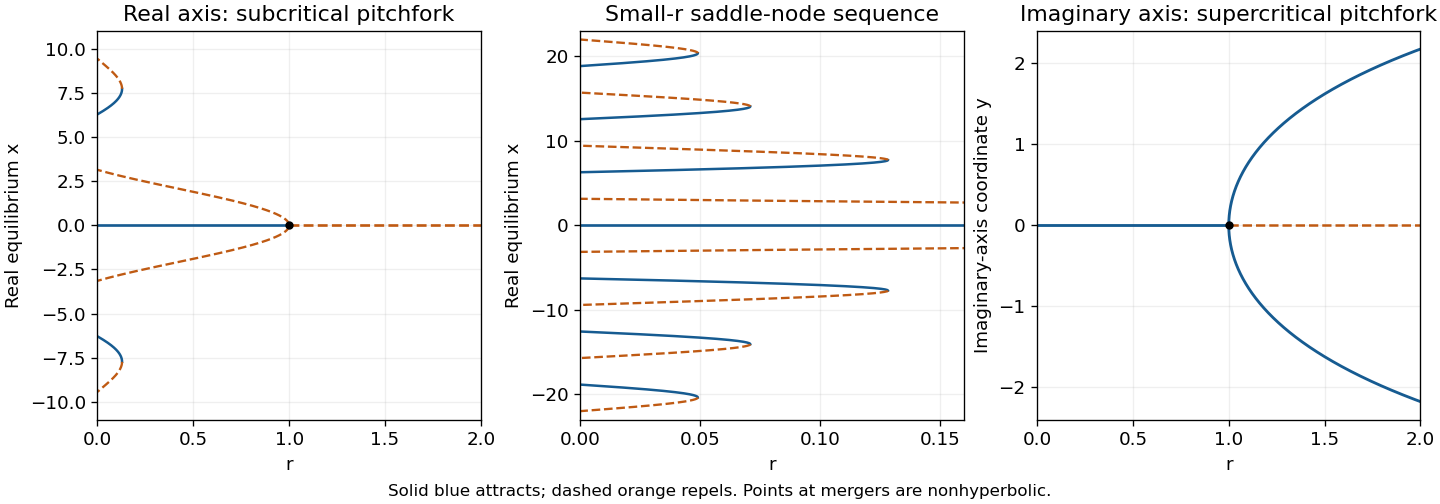
Real-axis sinc equilibrium branches and the imaginary-axis supercritical pitchfork; solid branches attract and dashed branches repel, with a zoom on the small-r saddle-node sequence
. Details. 
The fixed-point conditions are and . They give and . The Jacobian matrix isAt its eigenvalues are ; at they are . Both equilibria are saddle equilibria. At the origin the eigenvalues are . This linear calculation alone does not distinguish a nonlinear center from a weak focus.
To settle the origin and the global connections, setUsing , direct differentiation gives . Hence each parabola is invariant and, away from them, the following is a first integral:The two parabolas intersect precisely at the saddle equilibria. Their arcs between and enclose the lensInside it , . The origin is a critical point of with negative-definite Hessian times the identity. It is therefore a strict local maximum of this first integral, proving a nonlinear center equilibrium. The regular interior levels are closed periodic orbits, circulating anticlockwise. In fact the only critical point of inside the lens is the origin, so these levels fill the lens up to its boundary.
On , , so the interior arc runs from the upper saddle equilibrium to the lower. On it runs from the lower to the upper. Together they form a heteroclinic cycle. Their outer branches supply the remaining stable and unstable separatrices.
For the full exterior portrait, the two invariant parabolas partition the rest of the plane into four regions. Where both , everywhere; where both are negative, . In the region above both saddle equilibria, and ; in the corresponding lower region, and . These exterior trajectories are unbounded and cannot cross the separatrices. The nullclines are for and for .
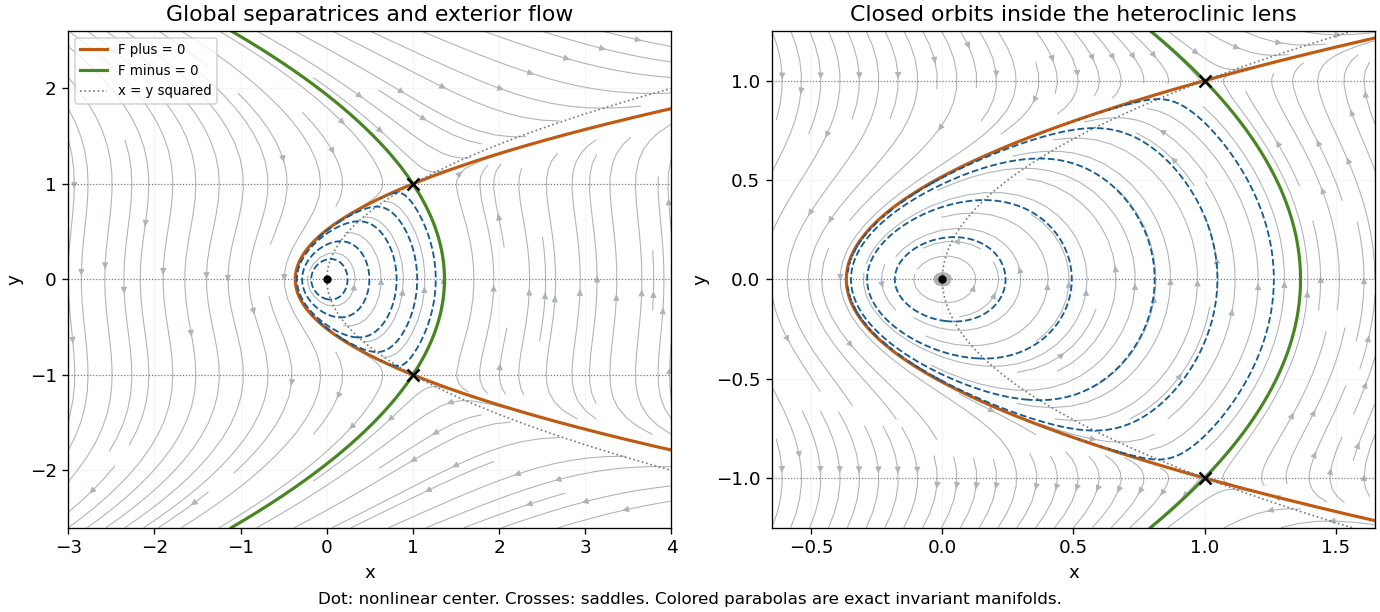
Full cubic-quadratic phase portrait and a central zoom: an anticlockwise family of periodic orbits inside a heteroclinic lens, two saddles, and unbounded exterior trajectories
. Details. 
Articles by others on the same topic
There are currently no matching articles.