In near-edge X-ray absorption fine structure, a photon promotes a core electron into an unoccupied molecular or solid-state level. Near an oxygen K-edge this is principally an O excitation. Bound or resonant final states, orbital symmetry, local bonding and multiple scattering shape the edge. A monochromatic tunable X-ray beam can measure transmission through a thin specimen, or fluorescence or electron yield as an absorption proxy. In scanning transmission X-ray microscopy, a focused spot is scanned while transmitted intensity is recorded; energy stacks across an edge distinguish regions with different chemistry even when their thicknesses are similar. A zone plate or another suitable X-ray optic sets spatial resolution, while energy resolution and reference spectra control chemical discrimination.
The dipole transition amplitude contains , so the incident electric-field direction selects final-orbital orientations. For an approximately free diatomic molecule with axis , the axial transition has strength proportional to . Summing the two perpendicular directions gives strength proportional to , with separate radial matrix-element factors for the two resonance families. This NEXAFS orientation dependence of a diatomic molecule explains the complementary polarization behavior; the molecular axis is not itself the direction of a orbital.
In the supplied geometry, normal incidence has electric field parallel to the surface, whereas near-grazing incidence with the illustrated polarization has a large surface-normal field component. The single-layer curves show a stronger resonance and much weaker structure in the latter geometry. This is consistent with oxygen axes lying largely parallel to the surface: a normal electric field is perpendicular to those axes and excites efficiently, while suppressing the axial transition. For flat molecules with random in-plane azimuths, the ideal axial factor is for a tangential field and zero for a normal field.
The multilayer curves instead have a strong peak at normal incidence and substantially stronger relative response at grazing incidence. Their axes therefore have a substantial surface-normal component, consistent with the proposed tilted, more upright packing. The distinction supports a different orientation distribution in the multilayer and monolayer, rather than one isotropically oriented molecular population in both.
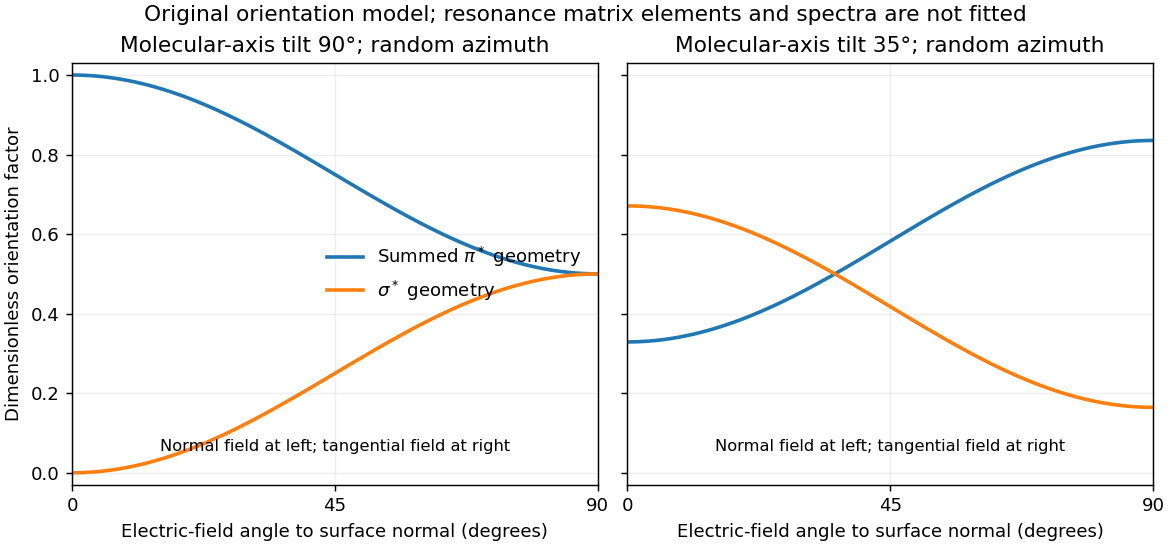

For illustration, a molecular polar tilt and random azimuth give , where is the electric-field angle to the surface normal. The original diagram plots these ideal factors for two chosen tilts; it is not a reconstruction or fit of the supplied spectra. Quantitative tilt extraction would additionally need intensity normalization, polarization purity, azimuthal distribution and substrate-induced changes of the resonances. The spectra alone do not determine unique bond lengths or every adsorption site.
Articles by others on the same topic
There are currently no matching articles.