Type Ia supernovae are standardizable candles. Multi-epoch photometry measures peak brightness, light-curve shape and color; spectroscopy identifies the supernova type and supplies a redshift, preferably also using the host. Correcting the empirical width–luminosity relation and attenuation reduces the spread of absolute magnitudes. A nearby sample fixes a distance-ladder intercept, while distant events test the shape of the Hubble diagram. The observable relation isAn unknown common remains degenerate with the Hubble-constant intercept unless externally calibrated; relative distance-versus-redshift shape can still constrain acceleration.
For a cosmological spacetime described by an FLRW metric, the deceleration parameter is , and the low-redshift luminosity-distance expansion isA range of redshifts therefore tests the expansion history beyond the leading linear Hubble law. Within conventional matter-plus-cosmological-constant models, standardized distant supernovae fainter than a specified decelerating prediction imply larger luminosity distances and can favor . For late-time matter and a cosmological constant, . A flat example has . One brightness residual alone does not establish acceleration across arbitrary expansion histories or arbitrary attenuation models.
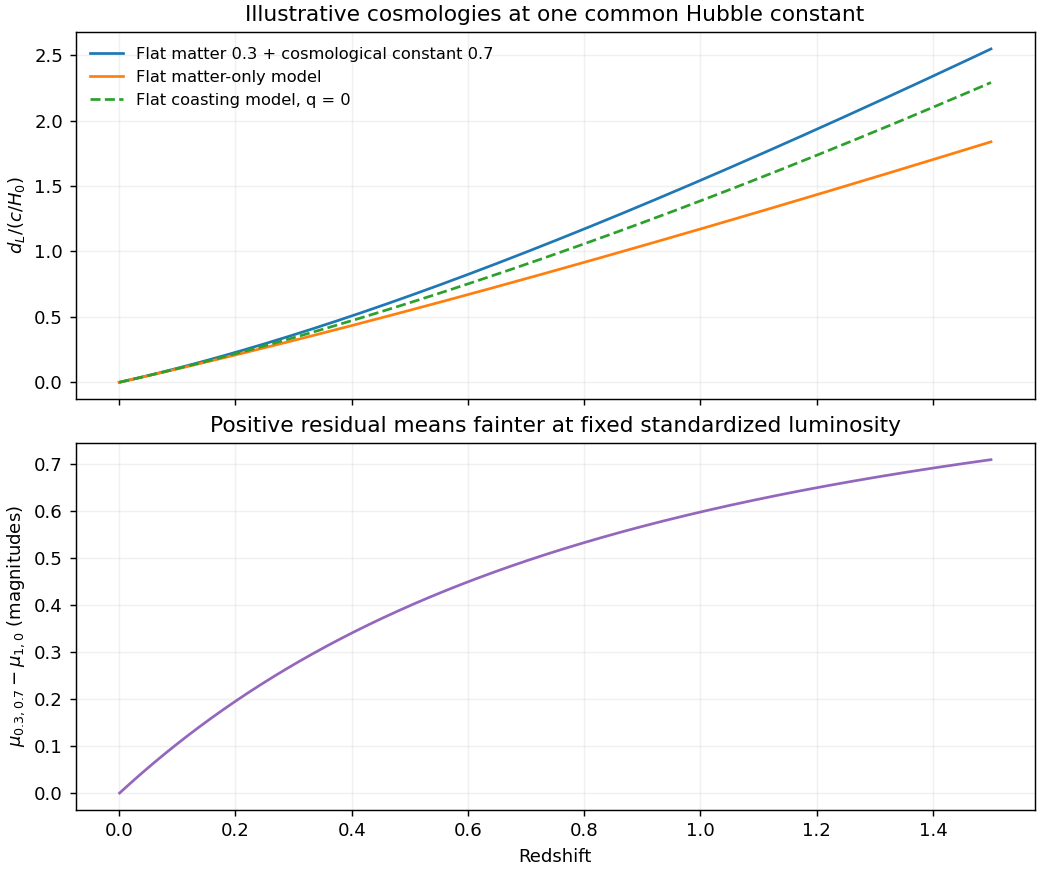
Illustrative luminosity-distance curves: expansion histories change standardized supernova magnitudes
. Details. 
The supernova discovery of accelerating expansion combined repeated imaging, difference-image candidate searches, spectroscopic classification and calibrated light curves. In the High-Z survey, CCD discovery images and later host images separated transient light from its host; point-spread-function fitting and artificial-star recovery tests checked the photometry. The measurements require K corrections between received and emitted passbands and account for the observed stretching of light-curve times.[ref]
Observational Evidence from Supernovae for an Accelerating Universe and a Cosmological Constant by Adam Riess and others. Sections 2.1–2.2, discovery imaging, spectroscopy and photometric controls
Relevant systematic tests include dust and color laws, possible population evolution, flux-limited selection, calibration across filters and telescopes, gravitational lensing and host contamination. An accelerating interpretation is assessed by fitting a specified cosmological family and its nuisance parameters, checking those effects and comparing independent observations. The two principal discovery teams provided independent distant-supernova analyses, including the 42-event Supernova Cosmology Project result.[ref]
Articles by others on the same topic
There are currently no matching articles.