Forbidden emission lines arise from transitions strongly suppressed in the electric-dipole approximation, often between metastable levels. They can radiate in dilute gas because collisions are infrequent enough for a slow radiative decay to occur. In a two-level optically thin approximation, statistical equilibrium givesThe critical density of an atomic transition is . At densities well below it, almost every collisional excitation radiates; above it, collisional de-excitation quenches the line relative to its low-density scaling. Collision coefficients and level populations determine the detailed multi-level diagnostic.
To measure temperature, compare lines of the same ion with significantly different upper-level excitation energies. The excitation coefficient contains a factor roughly times a collision strength. The oxygen forbidden-line temperature diagnostic compares the relatively high-excitation -angstrom line with the strong - and -angstrom lines. Their ratio is sensitive to electron temperature while canceling much of the common ionic abundance and emission measure.
To measure density, use upper levels with similar excitation energies but different radiative lifetimes and critical densities, as in . Their relative collisional quenching changes the ratio over an intermediate density range. At very low and very high densities the ratio approaches limiting values and loses sensitivity. A practical analysis fits density and temperature together, corrects wavelength-dependent extinction and calibration, checks blends and optical-depth assumptions, and uses reliable atomic transition and collision data. A single measured ratio generally constrains an emitting-gas model rather than proving every point of a nonuniform nebula has the same temperature.
The thermal Sunyaev-Zeldovich effect is inverse-Compton scattering of cosmic microwave background photons by hot electrons in the intracluster medium. Electron thermal energy shifts photons toward higher frequencies, changing the spectrum relative to neighboring sky. In the nonrelativistic, small-optical-depth limit its amplitude is controlled by the Compton parameterIt measures line-of-sight electron pressure. At low frequencies the apparent Rayleigh-Jeans temperature changes by . The thermal spectral distortion crosses through zero near for the usual CMB temperature and then becomes an increment; relativistic corrections matter for hot gas. Multi-frequency measurements distinguish this spectrum from dust, radio sources and an ordinary CMB temperature fluctuation.
The surface-brightness contrast has no ordinary dimming for the same cluster pressure integral: the incident CMB temperature and the observation's frequency redshift scale together. Angular extent and integrated flux still depend on distance. This makes the effect useful for selecting distant clusters and mapping their thermal pressure. The solid-angle integral scales with total thermal energy divided by angular-diameter distance squared, providing a mass proxy when its gas-physics calibration is specified.[ref]
Planck 2013 results. XXIX. Planck catalogue of Sunyaev-Zeldovich sources by Planck Collaboration. cluster survey and integrated-SZ selection context
X-ray surface brightness depends roughly on , whereas depends on . Combining X-ray spectra, brightness and resolved SZ data constrains density and line-of-sight depth. With a justified geometry, comparison to angular size gives a distance estimate; clumping and elongation can bias it. Cluster abundances and their redshift evolution test cosmological structure growth after selection and mass calibration are modeled.
The kinetic Sunyaev-Zeldovich effect additionally probes bulk line-of-sight motion, with leading in a stated velocity-sign convention. Its approximately blackbody temperature spectrum differs from the thermal distortion. These are complementary measurements of thermal pressure and gas motion, requiring foreground and instrumental control.
A charge-coupled device converts incident optical photons into collected electrons in pixel potential wells. Exposure accumulates charge; clocked transfers move it to readout amplifiers. Quantum efficiency, gain, read noise, dark current, saturation and charge-transfer behavior determine the usable signal. Bias or overscan estimates remove electronic offsets, dark frames characterize dark signal where needed, and flat fields correct relative response and illumination. Multiple exposures help identify cosmic rays and defective pixels, while astrometric alignment permits stacking.
For aperture photometry, sum the source aperture and subtract an estimated local sky contribution. A point-spread-function fit can instead use the expected spatial shape, particularly in crowded fields. Detector gain converts recorded units to electrons before applying a Poisson noise calculation. Let the aperture contain pixels, total expected source charge , sky charge per pixel, dark charge per pixel and rms read noise per pixel. With a perfectly known background mean,If the background is estimated from independent comparable blank pixels, its subtraction adds approximately , givingThe extra term is uncertainty in the estimated mean; it does not replace the sky shot noise already present in the source aperture. A more exact budget propagates the actual bias, dark and flat calibrations and any pixel correlations. The existing aperture photometry with an estimated background derives this distinction.
For one exposure in the photon-limited regime, signal grows as and its counting noise as , so SNR grows as . Read-noise domination can favor longer individual exposures, but full-well saturation, cosmic rays, tracking and changing sky constrain them. Extraction uses an aperture correction or a calibrated PSF model to recover light outside the measured region. Flat-field errors, nonlinearity, imperfect sky gradients, blending and atmospheric transparency can dominate bright-source accuracy even when the formal photon error is tiny.
Type Ia supernovae are standardizable candles. Multi-epoch photometry measures peak brightness, light-curve shape and color; spectroscopy identifies the supernova type and supplies a redshift, preferably also using the host. Correcting the empirical width–luminosity relation and attenuation reduces the spread of absolute magnitudes. A nearby sample fixes a distance-ladder intercept, while distant events test the shape of the Hubble diagram. The observable relation isAn unknown common remains degenerate with the Hubble-constant intercept unless externally calibrated; relative distance-versus-redshift shape can still constrain acceleration.
For a cosmological spacetime described by an FLRW metric, the deceleration parameter is , and the low-redshift luminosity-distance expansion isA range of redshifts therefore tests the expansion history beyond the leading linear Hubble law. Within conventional matter-plus-cosmological-constant models, standardized distant supernovae fainter than a specified decelerating prediction imply larger luminosity distances and can favor . For late-time matter and a cosmological constant, . A flat example has . One brightness residual alone does not establish acceleration across arbitrary expansion histories or arbitrary attenuation models.
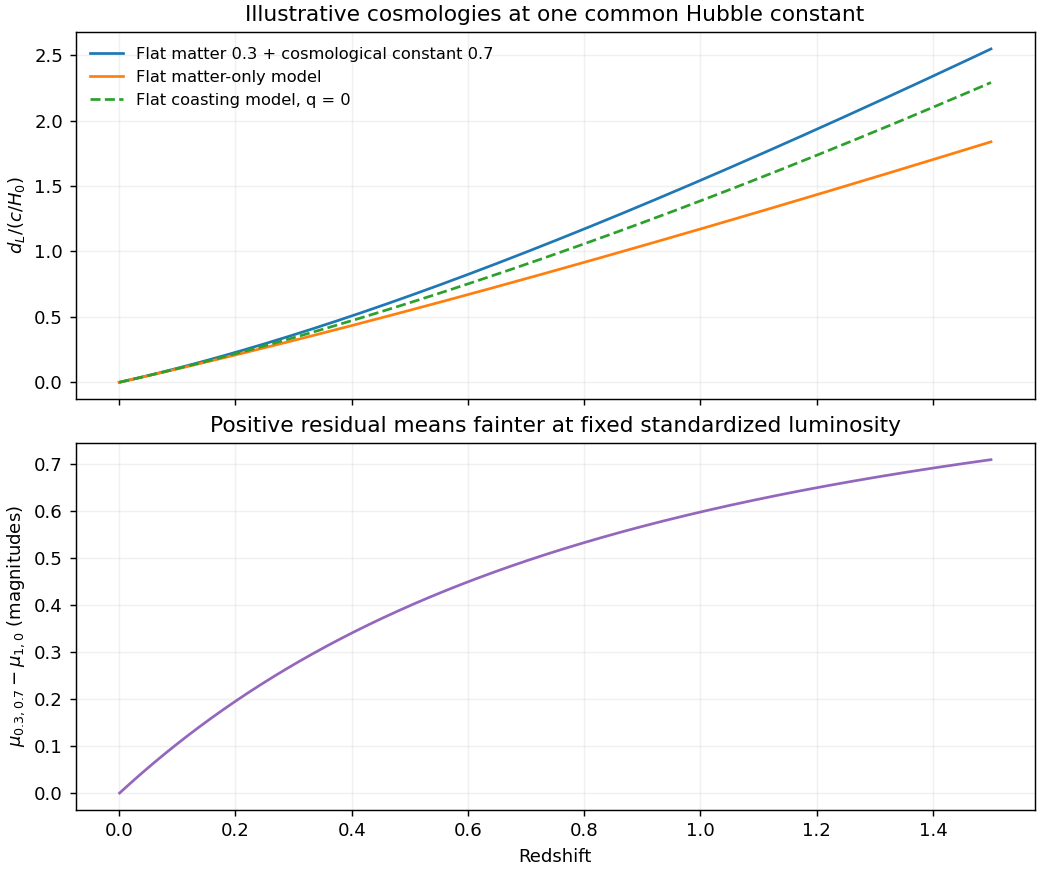
Illustrative luminosity-distance curves: expansion histories change standardized supernova magnitudes
. Details. 
The supernova discovery of accelerating expansion combined repeated imaging, difference-image candidate searches, spectroscopic classification and calibrated light curves. In the High-Z survey, CCD discovery images and later host images separated transient light from its host; point-spread-function fitting and artificial-star recovery tests checked the photometry. The measurements require K corrections between received and emitted passbands and account for the observed stretching of light-curve times.[ref]
Observational Evidence from Supernovae for an Accelerating Universe and a Cosmological Constant by Adam Riess and others. Sections 2.1–2.2, discovery imaging, spectroscopy and photometric controls
Relevant systematic tests include dust and color laws, possible population evolution, flux-limited selection, calibration across filters and telescopes, gravitational lensing and host contamination. An accelerating interpretation is assessed by fitting a specified cosmological family and its nuisance parameters, checking those effects and comparing independent observations. The two principal discovery teams provided independent distant-supernova analyses, including the 42-event Supernova Cosmology Project result.[ref]
Articles by others on the same topic
There are currently no matching articles.