The 1998 High-Z Supernova Search Team paper by Adam Riess, Brian Schmidt and collaborators presented supernova evidence for acceleration.[ref]
The 1999 Supernova Cosmology Project paper by Saul Perlmutter and collaborators independently analysed 42 distant events. Alexei V. Filippenko coauthored both papers.[ref]
The High-Z Supernova Search Team search used the CTIO Blanco 4-m telescope and a charge-coupled device, comparing fields across dark runs. Difference images located rising candidates; Keck, MMT and ESO spectroscopy classified them and measured host redshifts. Follow-up photometry used filters approximating emitted B and V bands. Calibrated field stars transferred the magnitude zero point; late host images removed galaxy light, point spread function fits measured brightness, and inserted artificial stars tested recovery.[ref]
The Supernova Cosmology Project likewise discovered rising events with CTIO 4-m charge-coupled device imaging, then followed their light curves with several telescopes. Keck LRIS and ESO spectroscopy supplied classification and redshift, preferably from narrow host lines. Cross-filter K corrections connected received R/I observations to emitted B/V light.[ref]
Measurements of Omega and Lambda from 42 High-Redshift Supernovae by Saul Perlmutter and others. Section 2, PDF pp.2–3: apparatus and corrections
Why does fainter mean accelerating? First it means a larger inferred luminosity distance only at fixed standardized luminosity and corrected attenuation. Next it favours acceleration only after a comparison family is specified: an FLRW metric, representative propagation of light, common nearby and distant standardization, and controlled measurement calibration and selection. For the usual general relativity models containing nonnegative pressureless matter, spatial curvature of an FLRW universe and a cosmological constant, the shape of the Hubble diagram constrains and thus . A positive residual relative to one decelerating model rejects that prediction; it does not alone prove across arbitrary expansion histories or arbitrary opacity laws.
The essential advance is that a nearby sample fixes an intercept while a range of distant redshifts measures the shape. The two teams supplied independent observations and analysis, although common nearby calibrators and Type Ia supernova physics can produce shared uncertainties. The dark-energy acceleration criterion explains the interpretation within general relativity; the worked supernova distance comparison shows the size and sign of the effect without fitting any survey data.
Stipulate and , so . A megaparsec is parsecs. Neglect radiation in cosmology. Compare an accelerating flat model , an open matter-only model and the Einstein-de Sitter universe . Their present deceleration parameters are respectively , and . For these models,Here is dimensionless; the radial null geodesic in FLRW spacetime supplies its integral and spatial curvature of an FLRW universe supplies . The observer-to-source comoving radial distance is , whereas the transverse distance uses . Omitting the latter distinction would bias the open-model comparison.
At , numerical integration gives for the flat accelerating model and for the open matter-only model. ThusThe accelerating model is mag fainter than the open matter-only prediction at the same redshift and standardized absolute magnitude, corresponding to times the luminosity distance and times the radiative flux. These are model calculations, not observations from either collaboration.
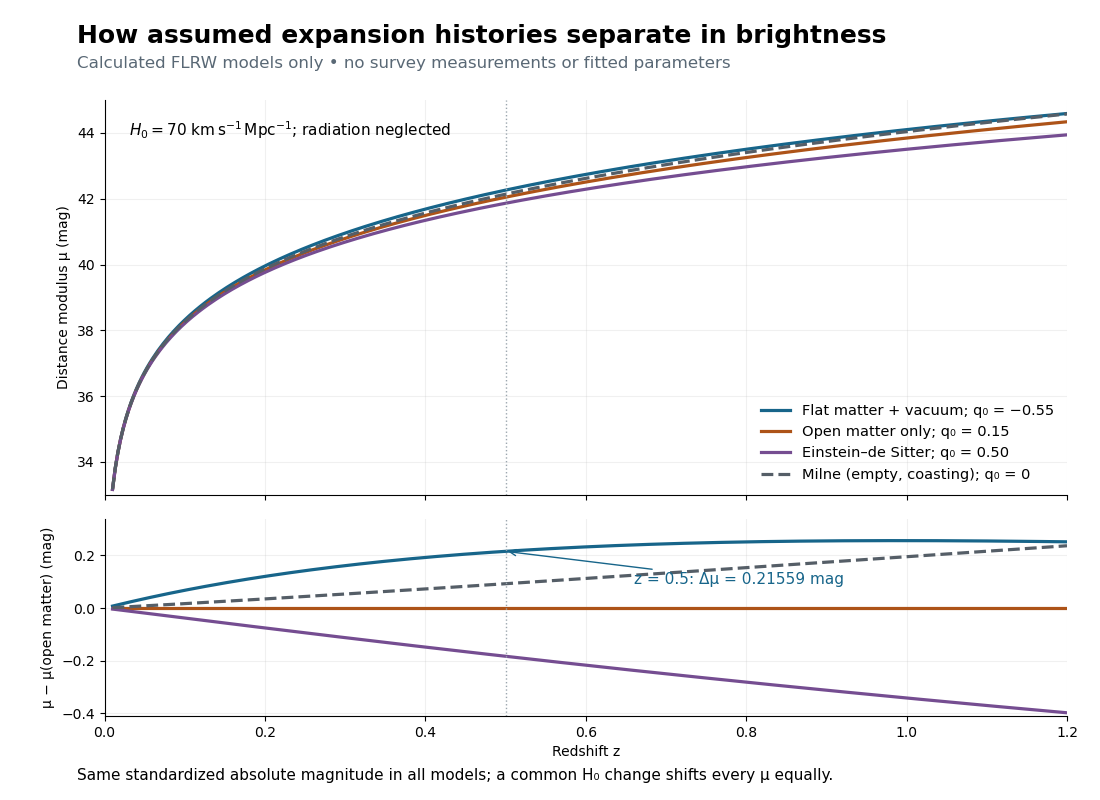

The Milne model has , and , giving and . The Einstein-de Sitter luminosity-distance relation independently checks the flat matter-only integral. At , the accelerating model exceeds the Milne model by only mag, illustrating the dependence of a residual on the chosen reference. Over a longer redshift interval, luminosity distance integrates past deceleration as well as recent acceleration; a residual need not increase forever.
Multiplying by at fixed density fractions divides every by and shifts every distance modulus by . The predicted apparent magnitude is unchanged if simultaneously increases by . This is the absolute magnitude–Hubble constant degeneracy. For example, shifts by mag and by mag. Relative curves at the same retain their separation; determining requires an external absolute magnitude calibration.
A local derivation makes the acceleration sign transparent. Normalize and put . A Taylor series givesThe radial null geodesic in FLRW spacetime gives . Invert the redshift series, use through second order, and obtain the displayed luminosity distance. Spatial curvature of an FLRW universe first changes this relation at third order. Lower therefore means larger at a fixed sufficiently small positive redshift and common .
Articles by others on the same topic
There are currently no matching articles.