Delay-compensated geometry. Choose an east-west baseline vector and let the upward unit vector be . A ray direction at zenith angle in their plane has . Its signed geometric path difference is . Removing the phase-centre delay leaves the residual pathWith the receiver ordering chosen to give positive phase for this path, a complex correlator measuresThe reverse ordering complex-conjugates the expression without changing its information. A single real multiplier supplies its cosine component; the stated exponential represents an in-phase/quadrature correlator. Equal cable lengths to the central correlator remove a fixed instrumental difference but do not remove the changing geometric delay. Pointing the antennas and electronically compensating the path are separate operations.
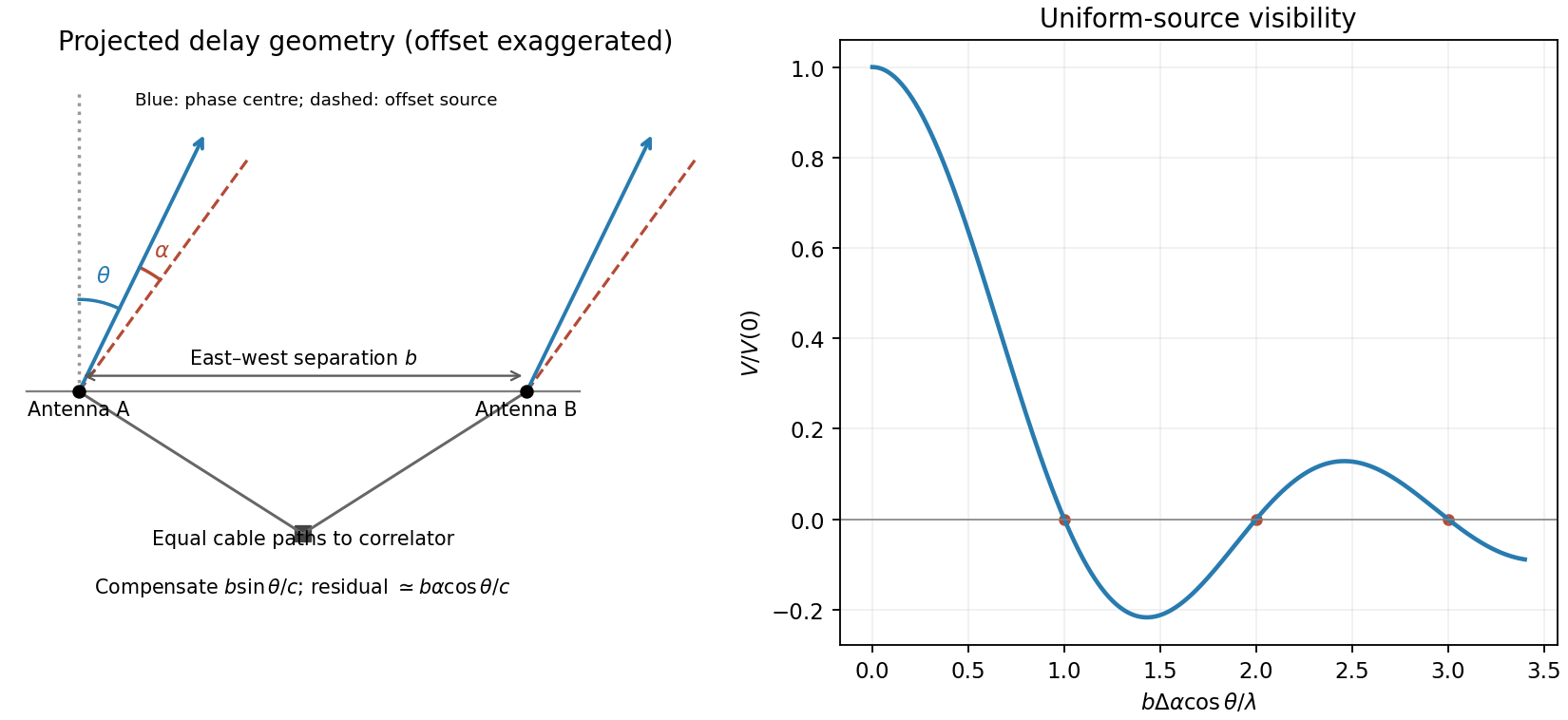
Original east-west interferometer geometry and normalized visibility of a centred one-dimensional uniform source
. Details. 
Resolved uniform source. Contributions from mutually incoherent sky elements add as brightness-weighted complex visibilities. Put over and zero elsewhere, and define . Integrating givesThereforeThe zero-argument value is defined by continuity as one. Normalization by isolates the visibility shape from total flux. The first null occurs when the source spans one fringe period, . A negative real visibility beyond a null is a phase reversal, not negative surface brightness.
Path-compensation precision. A finite observing band sets a coherence envelope. For a rectangular band of width , an uncorrected residual delay multiplies the correlation byCoarse delay steps must leave if decorrelation is to be small. Thus a coarse path-step scale must be well below the coherence length , with the precise bound determined by the tolerated amplitude loss and maximum quantization residual. A digital fine-delay or phase-rotation system can separately correct the central-frequency phase.
If there is no such carrier-phase correction, the steps must also be a small fraction of to avoid large untracked phase jumps or time-averaging loss. For a step rounded to the nearest setting, and the maximum carrier-phase error is . Bandwidth controls coarse group-delay decorrelation; wavelength controls the precision of untracked carrier phase. No numerical delay step can be inferred from the central frequency alone without a bandwidth, loss tolerance and compensation architecture. Earth rotation additionally sets how rapidly the delay setting must be updated.
Largest sampled angular scale. For a near-zenith view take the shortest projected baseline as . At , . The inverse shortest spatial frequency givesThis is an order-of-magnitude largest fringe scale. A convention defining maximum recoverable source size as would instead give about arcminutes; source profile, weighting and projected baseline coverage determine the operational value. The antenna diameter and primary beam can further restrict the usable field but were explicitly neglected in the source's initial idealization. Ten antennas supply pairwise baselines; their number improves sampling and sensitivity, not the inverse-shortest-baseline scale by a factor of ten. The longest baseline is not supplied, so the finest synthesized resolution is not numerically fixed.
A suitable observing programme. A compact centimetre-wave array is well suited to CMB temperature anisotropy on degree to sub-degree scales sampled by its baselines, and, with sufficiently long baselines and suitable foreground control, thermal Sunyaev-Zeldovich structure in galaxy clusters. At the thermal Sunyaev-Zeldovich signal is a decrement relative to the CMB. The compact baselines retain sensitivity to extended brightness features; the spatial frequencies measured by each baseline have a direct statistical interpretation in CMB analysis.
Compared with lower radio frequencies, synchrotron foregrounds are generally reduced, while thermal dust rises toward higher frequencies; observing near this centimetre-wave atmospheric window is therefore useful, although foregrounds are not absent. Correlation and phase switching reject mean uncorrelated receiver offsets and some instrumental drifts. Receiver thermal noise still contributes variance, and atmosphere, ground pickup or cross-talk can be correlated and require control. Additional long baselines can identify compact radio-source contaminants for subtraction, but the question does not specify enough array geometry to guarantee that capability. There is no zero baseline in ordinary pairwise cross-correlation, so the array does not directly measure the sky monopole or arbitrary larger-scale smooth emission.
Articles by others on the same topic
There are currently no matching articles.