Normalize , taking dimensionless and as a length, so the source's curvature constant has units of inverse length squared. With densities in the mass-equivalent convention, the first Friedmann equation isThe sum can include dust, radiation and other material components; vacuum energy must be represented either in that sum or by , without double counting. For physical energy densities , replace by . The companion acceleration equation is , with energy conservation for separately conserved components.
For an empty universe with , . On the expanding branch with ,Equivalently, in the convention where the normalized curvature label is and the scale factor has length units, . A rescaling of comoving coordinates changes the numerical magnitude of but not its negative sign. The degenerate empty case has and a constant scale factor; it does not have a finite age .
For the expanding empty model, in the preceding normalization. If denotes the origin of the expanding slicing,The constant-time spatial slices are negatively curved hyperbolic spaces, with curvature radius and three-dimensional scalar curvature . In the usual simply connected description they are copies of hyperbolic three-space. This is the Milne model: its four-dimensional spacetime is actually flat. Setting and converts the metric to the interior of a future light cone in Minkowski spacetime. Its zero-scale-factor boundary is a slicing boundary, not a curvature singularity.
Add separately conserved pressureless matter, with present mass-equivalent density . Define the cosmological density parametersThenCurvature and dust have equal magnitudes at , givingFor the almost-empty open case , curvature domination begins at positive redshift. Equality is today for and in the future for . With , curvature dominates at all times and there is no finite matter–curvature equality; with , curvature never dominates.
A radial null ray satisfies . Define the present-normalized radial comoving distanceFor , write . Integration gives , so . Two neighboring pulses on the same comoving path obey , hence . For the angular diameter distance in an open dust universe, a transverse source size defines the angular diameter distance . Thus
Since , the dust-plus-curvature expansion givesAt a specified source redshift, the only independent cosmological parameters in this integral are and . The distance necessarily also has a source-position argument; it cannot be a constant for all sources.
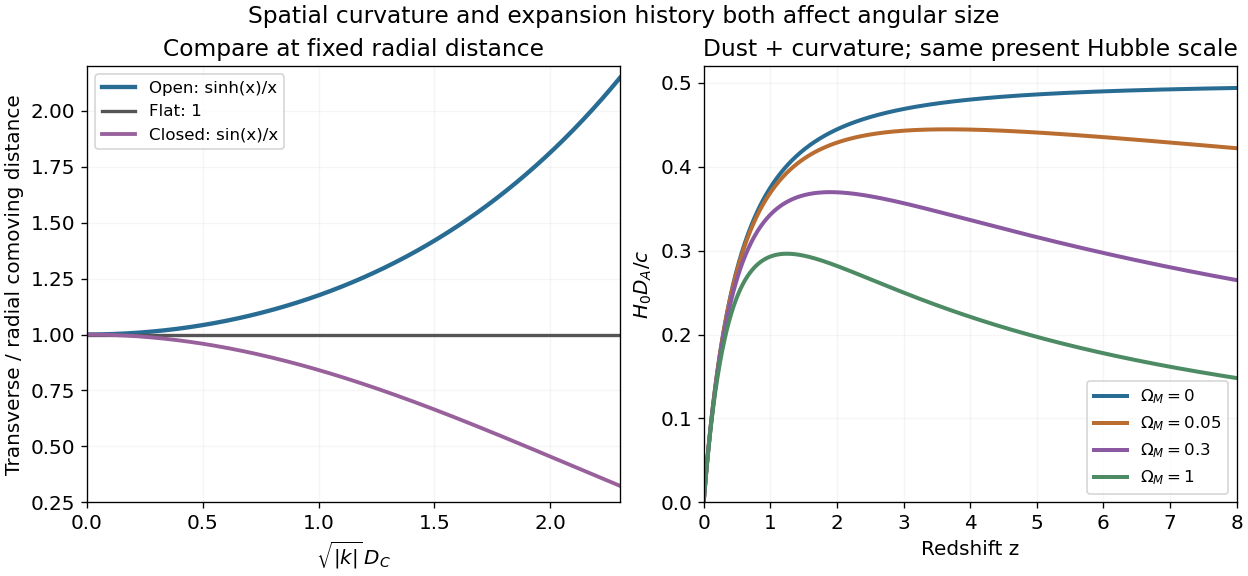
For , the integral can be writtenThe apparently singular parameter endpoints have regular limits: gives , and gives . The flat-curvature distance limit is . For a negative , the transverse distance uses sine with instead of hyperbolic sine; that closed case is outside the almost-empty open model, but explains the convention behind the square root.
At fixed radial comoving distance and fixed emission scale factor, open spatial geometry has transverse radius . Hence its angular diameter distance exceeds the flat value, and a standard object of fixed proper size hasThe same comparison can be expressed at fixed proper radial distance on the emission slice. A comparison at fixed redshift must additionally account for the different expansion histories in ; curvature and expansion effects must not be silently conflated.
Known-size cosmological standard rulers with measured redshifts provide through their angular sizes. The function depends on the spatial-curvature parameter directly and on matter, radiation or dark energy through the expansion history. For a comoving ruler such as a calibrated baryon acoustic oscillation scale, the transverse angular measurement determines . Angular acoustic scales in the cosmic microwave background similarly probe the ratio of a calibrated early-time length to a cosmological distance. A range of redshifts constrains parameter-dependent shapes and the overall distance scale, but one angular measurement cannot uniquely separate all density parameters. Ruler calibration, source evolution and lensing must be modeled, and independent expansion or distance information helps break the degeneracies.

Articles by others on the same topic
There are currently no matching articles.