Source paper: www-thphys.physics.ox.ac.uk/people/AndreiStarinets/TUTORIALS_NOTES_GR/gr_cosmology_exam_paper_2012.pdf
The held cover dates this sitting to 13 June 2012. Lettered scopes index the successive separately marked source blocks; all four question options are answered. The metric signature is . Wherever a cosmological density appears in a Friedmann equation below, denotes mass density or energy density divided by ; the corresponding physical energy density is .
Put , and . For an affinely parametrized geodesic, use the unhalved quadratic Lagrangian . Its Euler-Lagrange equations are unchanged by this overall normalization. Since is a cyclic coordinate, , equivalentlyThe spatial derivatives give and , where . Therefore
For the connection coefficients, take , so and . Substituting the diagonal inverse metric into the Christoffel symbol formula gives all nonzero component types, including lower-index symmetry:All other component types vanish. If the time coordinate is rather than , replace by ; the displayed time–space mixed coefficients are unchanged. Spatial indices in these formulas are raised with the background Euclidean metric.
For the circular orbit let and . Both and are constant along it. The radial spatial equation gives , so, treating the displayed metric coefficients algebraically, . The weak-field approximation securely determines the leading Keplerian orbit resultThe time normalization is , yielding and . One must distinguish the proper-time angular frequency in the supplied path from the coordinate-time angular frequency. The formal factor in the frequency equation comes from treating the truncated metric as exact; a complete relative post-Newtonian correction to the orbital period would also require the omitted higher-order temporal metric terms.
Use the curvature sign conventionwhich has the derivative ordering printed in the source for . A Christoffel symbol is of order , so its derivative is of order , whereas a product of two connections is of order . Their ratio is . The metric is stationary, hence the temporal derivative term vanishes. ConsequentlyHere , and . The weak-field tidal curvature in a stationary metric is
Printed sign inconsistency. The source's positive half-Hessian and its final negative-prefactor expression are the opposites of this result. A concrete check at is , giving , while the printed final expression gives . Thus both printed equalities cannot hold with its stated derivative ordering. Reversing the definition of the Riemann curvature tensor would give the printed final sign, but would also require reversing the curvature term in the geodesic deviation equation. The convention used here and in the next part gives the physical radial stretching and transverse compression.
Geodesic deviation compares neighboring members of a family of freely falling trajectories. Subtracting their geodesic equations to first order in the connecting vector gives a covariant relative-acceleration equation governed by the Riemann curvature tensor. For a slowly moving satellite, dominates the spatial components. Choose simultaneous spatial separation in a locally transported frame, take the weak-field approximation, and neglect terms quadratic in the small separation and higher velocity corrections. The leading spatial equation becomesReplacing the transported covariant derivatives by ordinary derivatives is a leading local or Newtonian approximation; a rotating orbital frame would introduce additional inertial terms. In the convention established above, the instantaneous tidal acceleration stretches radial separations and compresses transverse ones.
The growth expected for nearby different-radius circular orbits is especially transparent from Kepler's third law. If the radii are and , their coordinate angular frequencies differ by . Initially aligned orbits therefore acquire an along-track separation . Over the interval in which the nearby-orbit approximation remains valid, this produces a growing separation without needing to solve the deviation equation.
This growth is not universal or indefinitely unbounded. Equal-radius co-orbiting geodesics with a fixed phase offset have constant separation, and slightly inclined equal-radius circular orbits have bounded, periodically varying separation. Even different-radius circular orbits have bounded exact positions; their relative angle eventually wraps around. The secular drift statement assumes distinct radii and describes the local differential-orbit regime.
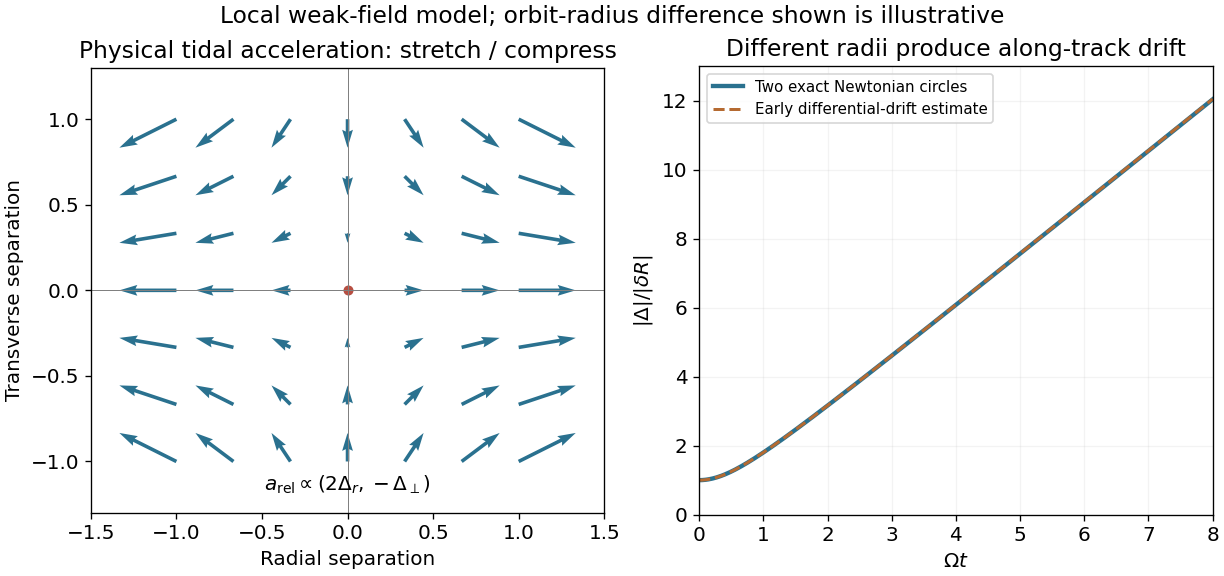
Physical tidal stretching and the early differential drift of neighboring circular orbits
. Details. Take the unhalved geodesic LagrangianThe cyclic coordinates give and . The other two Euler-Lagrange equations areThese reproduce the supplied geodesic equations. Expanding the derivatives and comparing with , in coordinates , gives all nonzero Christoffel symbols:Here . This is the static patch of de Sitter spacetime, with for the stationary observers used below. Apparent divergences at the polar axis, origin or horizon belong to the chosen coordinate chart; they are not themselves evidence of a curvature singularity.
For radial null geodesics in a de Sitter static patch, the conserved time quantity and the stated normalization at the origin give . The null condition then givesThe emitted outgoing ray selects the positive branch, soThe ingoing branch would have instead. Set the affine parameter to zero at emission. Then , and integrating givesThe coordinate time diverges as , although the outgoing affine parameter reaches there. This is a coordinate-horizon effect: a local stationary observer inside the patch measures radial distance and proper time , whose ratio along the ray is still .
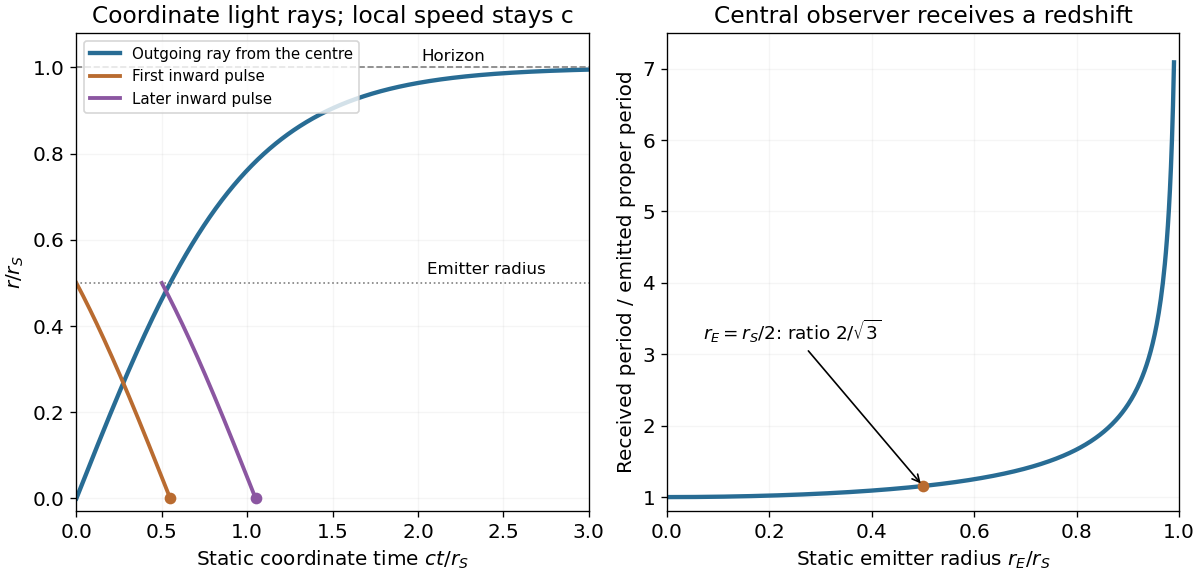
For the static-emitter redshift in a de Sitter patch, a stationary clock at radius satisfies . The geometry is stationary, so successive inward pulses emitted at the same radius have the same coordinate travel delay. Their coordinate arrival interval is therefore . At the central receiver , givingFor , this becomesThe pulses are redshifted at the centre. At fixed proper emission period, taking a stationary emitter toward the horizon gives , and . The inward coordinate travel delay also diverges. A stationary worldline at the horizon itself is not timelike, and the proper acceleration required to hold an emitter static diverges in this limit; the result concerns a sequence of idealized emitters with , not a stationary physical lighthouse exactly on the horizon.
Normalize , taking dimensionless and as a length, so the source's curvature constant has units of inverse length squared. With densities in the mass-equivalent convention, the first Friedmann equation isThe sum can include dust, radiation and other material components; vacuum energy must be represented either in that sum or by , without double counting. For physical energy densities , replace by . The companion acceleration equation is , with energy conservation for separately conserved components.
For an empty universe with , . On the expanding branch with ,Equivalently, in the convention where the normalized curvature label is and the scale factor has length units, . A rescaling of comoving coordinates changes the numerical magnitude of but not its negative sign. The degenerate empty case has and a constant scale factor; it does not have a finite age .
For the expanding empty model, in the preceding normalization. If denotes the origin of the expanding slicing,The constant-time spatial slices are negatively curved hyperbolic spaces, with curvature radius and three-dimensional scalar curvature . In the usual simply connected description they are copies of hyperbolic three-space. This is the Milne model: its four-dimensional spacetime is actually flat. Setting and converts the metric to the interior of a future light cone in Minkowski spacetime. Its zero-scale-factor boundary is a slicing boundary, not a curvature singularity.
Add separately conserved pressureless matter, with present mass-equivalent density . Define the cosmological density parametersThenCurvature and dust have equal magnitudes at , givingFor the almost-empty open case , curvature domination begins at positive redshift. Equality is today for and in the future for . With , curvature dominates at all times and there is no finite matter–curvature equality; with , curvature never dominates.
A radial null ray satisfies . Define the present-normalized radial comoving distanceFor , write . Integration gives , so . Two neighboring pulses on the same comoving path obey , hence . For the angular diameter distance in an open dust universe, a transverse source size defines the angular diameter distance . Thus
Since , the dust-plus-curvature expansion givesAt a specified source redshift, the only independent cosmological parameters in this integral are and . The distance necessarily also has a source-position argument; it cannot be a constant for all sources.
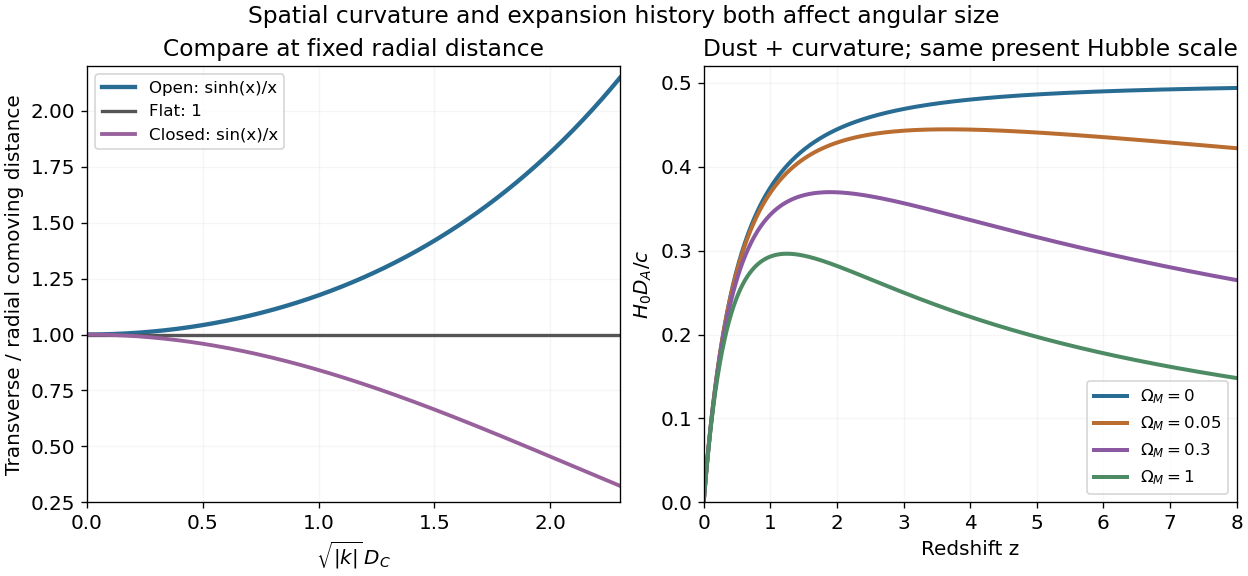
For , the integral can be writtenThe apparently singular parameter endpoints have regular limits: gives , and gives . The flat-curvature distance limit is . For a negative , the transverse distance uses sine with instead of hyperbolic sine; that closed case is outside the almost-empty open model, but explains the convention behind the square root.
At fixed radial comoving distance and fixed emission scale factor, open spatial geometry has transverse radius . Hence its angular diameter distance exceeds the flat value, and a standard object of fixed proper size hasThe same comparison can be expressed at fixed proper radial distance on the emission slice. A comparison at fixed redshift must additionally account for the different expansion histories in ; curvature and expansion effects must not be silently conflated.
Known-size cosmological standard rulers with measured redshifts provide through their angular sizes. The function depends on the spatial-curvature parameter directly and on matter, radiation or dark energy through the expansion history. For a comoving ruler such as a calibrated baryon acoustic oscillation scale, the transverse angular measurement determines . Angular acoustic scales in the cosmic microwave background similarly probe the ratio of a calibrated early-time length to a cosmological distance. A range of redshifts constrains parameter-dependent shapes and the overall distance scale, but one angular measurement cannot uniquely separate all density parameters. Ruler calibration, source evolution and lensing must be modeled, and independent expansion or distance information helps break the degeneracies.


For a separately conserved homogeneous component, energy conservation gives , equivalently . Dust has negligible pressure, while isotropic radiation has . HenceThe matter factor is volume dilution; photons additionally lose energy by cosmological redshift. Nonrelativistic baryons and cold dark matter both contribute to the matter term, so . At equality , givingThis is equality for the source's matter-plus-photon model. Additional relativistic species would contribute to total radiation and shift the equality value. Although the source calls the 's energy densities, its Friedmann equation and later show that their consistent SI meaning is mass-equivalent density.
For thermal photons, the available thermal length is . The number of occupied modes per volume scales as , while their characteristic energy is of order . Thus and . More explicitly, the two photon polarizations and the Bose-Einstein distribution giveconsistent with the rounded coefficients supplied in the source.
Use its definition , with and the mass-equivalent cosmological critical density. Writing , the photon energy formula gives . ThereforeThis photon-to-baryon ratio from density parameters has leading coefficient , as required. For an illustrative estimate, take the stated , and . Then , i.e. of order a billion photons per baryon. The source alone supplies no numerical density parameters, so an estimate must state such additional inputs.
Strictly, this is the photon-to-baryon ratio, rather than the thermodynamic entropy per baryon itself. For a thermal photon gas, with the exact blackbody coefficients. The ratio used in the source is proportional to the radiation entropy per baryon under adiabatic evolution.
Assume an ideal nondegenerate hydrogen gas in thermal equilibrium and chemical equilibrium, with ground-state atoms and charge neutrality. Let and . The ground-state Saha equation, with the usual electron/proton spin factors cancelling the atomic ground-state degeneracy, isInvert it and use . This givessoHere is the electron mass denoted in the source, and . At , the left side is two. At of order , the right side is extremely small because and . A large exponential is needed to compensate, requiring rather than a temperature of order the binding energy.
Physically, there are enormously many photons per baryon, so even a small high-energy tail of the thermal photon distribution can maintain ionization. Recombination is delayed until that tail is sufficiently depleted. This explains the low recombination temperature without solving the equilibrium equation; actual cosmological recombination also eventually requires rate equations once equilibrium fails.
Big Bang nucleosynthesis is a kinetic process in an expanding universe. A common particle temperature does not imply chemical equilibrium for every nuclear reaction: reaction rates must also exceed the expansion rate and connect the required species efficiently. Around , nuclear abundances retain the history of earlier freeze-out and cannot be inferred from equilibrium Boltzmann factors alone.
In particular, weak reactions cease to maintain neutron-proton chemical equilibrium. Subsequent free-neutron decay after freeze-out changes the surviving neutron inventory. The large photon-to-baryon ratio delays deuterium survival through photodissociation; once the deuterium bottleneck opens, reactions rapidly bind many surviving neutrons into helium-4. Coulomb barriers, decreasing density and further freeze-out prevent unrestricted equilibration of all nuclei. The final helium abundance therefore requires a reaction network and expansion history, not just the temperature and nuclear binding energies.
For illustration, if essentially all available neutrons end in helium-4 and the neutron-to-proton ratio at that stage is , simple particle counting gives . The crucial input is itself set by out-of-equilibrium history. Kinetic thermalization of the plasma can remain effective while these composition-changing processes are out of equilibrium.
Articles by others on the same topic
There are currently no matching articles.