For radial motion outside the Schwarzschild event horizon, the equations needed to determine the acceleration components areThey are respectively the four-velocity norm, velocity-acceleration orthogonality, and the maximum proper acceleration norm. Together with part d they give the stated thrust equation; no integration of the trajectory is required. The positive radial sign corresponds to outward thrust.
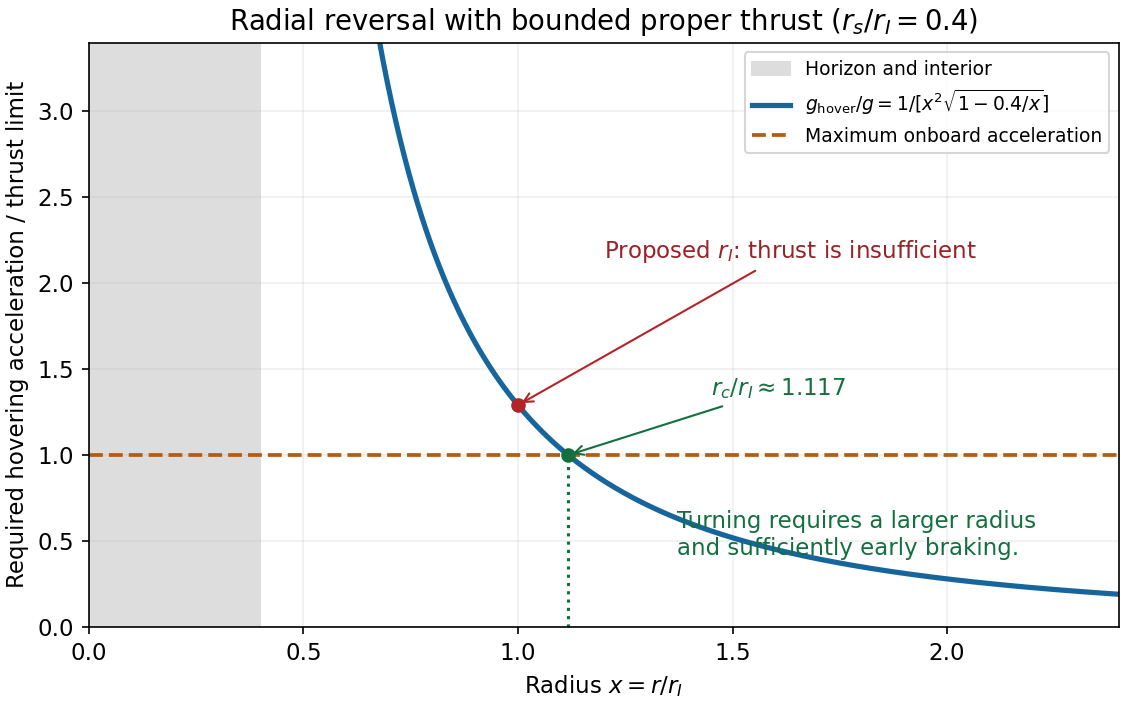
Let . A first transition from inward to outward motion requires at a minimum radius and there. The largest possible radial derivative at such an event isAt , this isThus the ship cannot reverse its inward motion there. It cannot reverse at any smaller exterior radius either: grows while decreases. If it first reaches while falling inward, it cannot return home using the stipulated bounded radial thrust. If , it would instead have reached the black-hole horizon before that radius, which already prevents escape.
The minimum radius for radial turnaround with bounded proper acceleration lies strictly outside the proposed radius. Define byThe right side is the proper acceleration required to hover, decreases monotonically from infinity to zero, and exceeds . A genuine turnaround needs ; equality gives no positive initial outward acceleration at rest. A sufficiently early burn is also needed to remove the pre-existing inward velocity. The failure at follows from the turning-point condition, not from treating the moving ship as static throughout its fall.

Articles by others on the same topic
There are currently no matching articles.