The strong equivalence principle extends universality of free fall to bodies with appreciable gravitational self-energy, and states that the outcome of any local experiment, including a gravitational experiment, in a freely falling laboratory is independent of its location and velocity. In a sufficiently small freely falling laboratory the external gravitational influence can be removed to first order by choosing a local inertial frame.
This does not remove tidal forces or the Riemann curvature tensor. The laboratory must be small compared with the length scale over which the external gravitational field varies. These qualifications distinguish a local equivalence statement from the incorrect assertion that gravity can be transformed away throughout an extended curved region.
In general coordinates the basis changes along the world line. Differentiating only the components of a vector omits that basis change, and does not transform as a vector under a position-dependent coordinate transformation. The appropriate rate is the covariant derivative along a curve:For the metric-compatible torsion-free connection, the Christoffel symbols are determined by the metric tensor and its first derivatives:Thus the ship's four-acceleration isIn Cartesian coordinates of an inertial frame in flat spacetime, the connection coefficients vanish and the ordinary component derivative happens to suffice. In curved spacetime it suffices at a chosen event in a local inertial frame, but not generally along an extended trajectory.
Use metric signature and . At an event in the ship's instantaneous rest local inertial frame, . Since its squared norm is a scalar,in every coordinate system. Equivalently it follows directly from and .
Metric compatibility lets us differentiate this identity covariantly:In the instantaneous rest local inertial frame, the last equation gives . The spatial components are the acceleration recorded by an onboard accelerometer, , whose magnitude is . ThereforeThis proper acceleration is zero in ideal free fall, even when the coordinate position has a nonzero second derivative. A coordinate acceleration and an accelerometer reading are different quantities.
Put and . For radial motion . The given Christoffel symbols implyandThe four-velocity normalization of part c isIts bracketed combination is therefore exactly , independently of the instantaneous velocity or the thrust history. ConsequentlyThe derivative here is with respect to proper time. This expression does not say that the ship measures a gravitational acceleration during free fall; setting gives its radial proper-time equation of motion in Schwarzschild spacetime.
For radial motion outside the Schwarzschild event horizon, the equations needed to determine the acceleration components areThey are respectively the four-velocity norm, velocity-acceleration orthogonality, and the maximum proper acceleration norm. Together with part d they give the stated thrust equation; no integration of the trajectory is required. The positive radial sign corresponds to outward thrust.
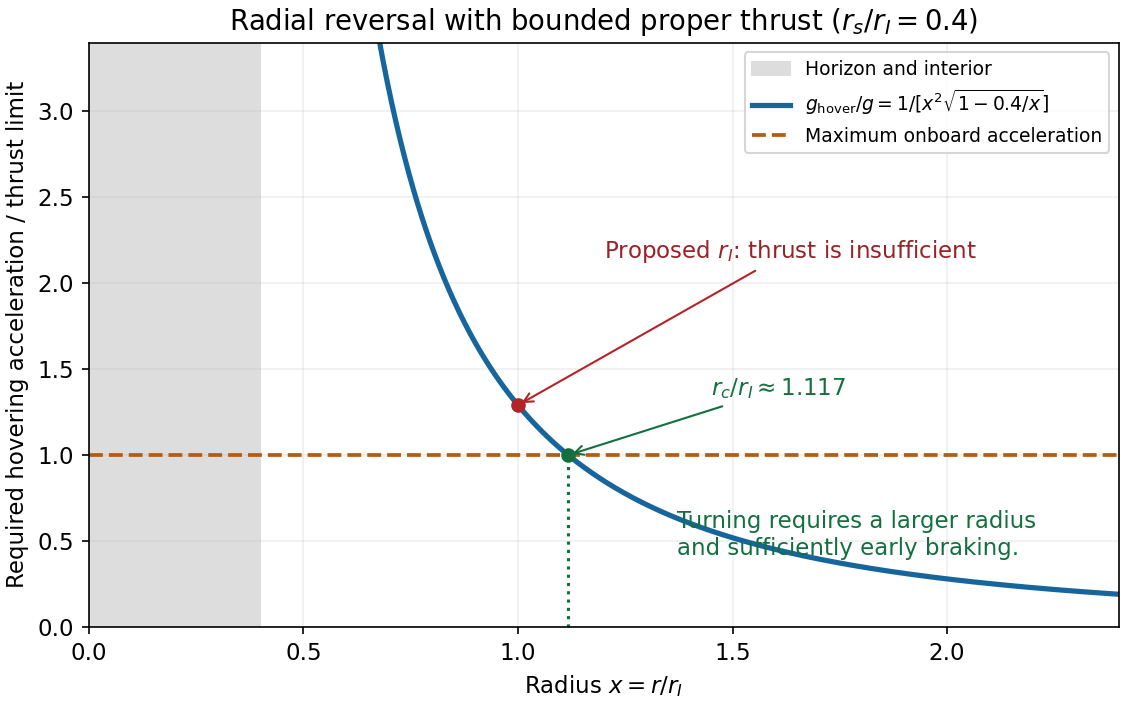
Let . A first transition from inward to outward motion requires at a minimum radius and there. The largest possible radial derivative at such an event isAt , this isThus the ship cannot reverse its inward motion there. It cannot reverse at any smaller exterior radius either: grows while decreases. If it first reaches while falling inward, it cannot return home using the stipulated bounded radial thrust. If , it would instead have reached the black-hole horizon before that radius, which already prevents escape.
The minimum radius for radial turnaround with bounded proper acceleration lies strictly outside the proposed radius. Define byThe right side is the proper acceleration required to hover, decreases monotonically from infinity to zero, and exceeds . A genuine turnaround needs ; equality gives no positive initial outward acceleration at rest. A sufficiently early burn is also needed to remove the pre-existing inward velocity. The failure at follows from the turning-point condition, not from treating the moving ship as static throughout its fall.

Articles by others on the same topic
There are currently no matching articles.