The cosmic distance ladder starts by calibrating a physical baseline. Radar echoes from planets or spacecraft give a round-trip light time and hence a distance , after accounting for orbital motion and propagation delays. Combining this with orbital geometry fixes the Earth-Sun orbital scale; directly timing a reflected pulse from the solar surface is not required.
That baseline supplies annual stellar parallax: for small parallax angle , , or in parsecs equals when is in arcseconds and is one astronomical unit. Nearby parallax distances calibrate stellar absolute magnitudes. Main-sequence fitting extends the scale to star clusters, and the calibrated Cepheid period-luminosity relation gives luminosities for Cepheids visible in nearby galaxies.
Cepheid-host galaxies then calibrate Type Ia supernovae. After light-curve and colour standardization, their high luminosities permit distances to much more remote galaxies. For a source of calibrated luminosity and observed bolometric flux ,with consistent bandpass definitions and corrections. Interstellar extinction, composition, stellar-population differences and calibration uncertainty must be propagated through the steps. Redshift can subsequently provide a distance within a fitted cosmological model; using it alone cannot independently calibrate the Hubble constant.
Normalize the scale factor to , with . Along a radial null geodesic, . Two successive wave crests sent by the same comoving emitter and received by the same comoving observer traverse the same comoving distance, soTo first order, . Frequencies are inverse proper periods for the comoving observers, giving the cosmological redshiftExpansion stretches wavelengths, so a spectral line of known rest wavelength gives .
At small , the light travel time is short compared with the expansion time. Expanding gives and , henceCombine independently calibrated luminosity distances with galaxy spectral redshifts and fit the slope. Nearby peculiar velocities must be allowed for, while high-redshift data require the full distance-redshift relation rather than the linear approximation.
Use standardized Type Ia supernovae as distance indicators and measure their redshifts. The curvature of the luminosity-distance relation constrains the deceleration parameter:Fainter supernovae at a given redshift imply larger distances, and comparison with the predicted curve tests accelerated expansion. In practice one fits the full expansion history over the observed redshift range and controls luminosity evolution, extinction and calibration, rather than relying only on a short low- series.
The cosmological fate from local expansion data is conditional on a matter model. For the spatially flat model of part b, if the only relevant components are pressureless matter and a constant , put . The two Friedmann equations giveHere follows the sign of the supplied Friedmann equations, where positive contributes positive acceleration. These fix the parameters governing subsequent evolution. Positive yields eternal late-time accelerated expansion; zero gives the flat matter solution; negative leads to eventual recollapse in this dust model. If instead one assumes dust and zero while allowing curvature, determines whether the matter universe is closed and recollapsing or expands indefinitely.
Without a fixed equation of state and its future evolution, two present derivatives do not uniquely fix the future. For a concrete counterexample in units with , the positive scale factors and have the same now. The former expands forever; the latter turns around and later reaches zero. Different time-dependent matter stresses can support their different flat expansion histories. Thus the printed sufficiency statement needs the cosmological-model assumption.
In an Einstein-de Sitter universe, take and . The galaxy seen today at emitted the light now reaching us when , so . Its fixed comoving radial distance isPut . A new message sent now reaches the galaxy at , whereAssume an immediate reply and negligible local handling delays. The return consumes the same additional conformal time, giving the Einstein-de Sitter round-trip message timeFor the numerical value supplied later in the paper, and the waiting time is about . The age here belongs to the stipulated matter-only model, not a claim about the actual measured cosmic age.
After one-way legs, . Since , every finite number of messages is possible and there is no finite fundamental upper count. The exchange takes arbitrarily long, with successively longer intervals; infinitely many messages are not completed in finite cosmic time.
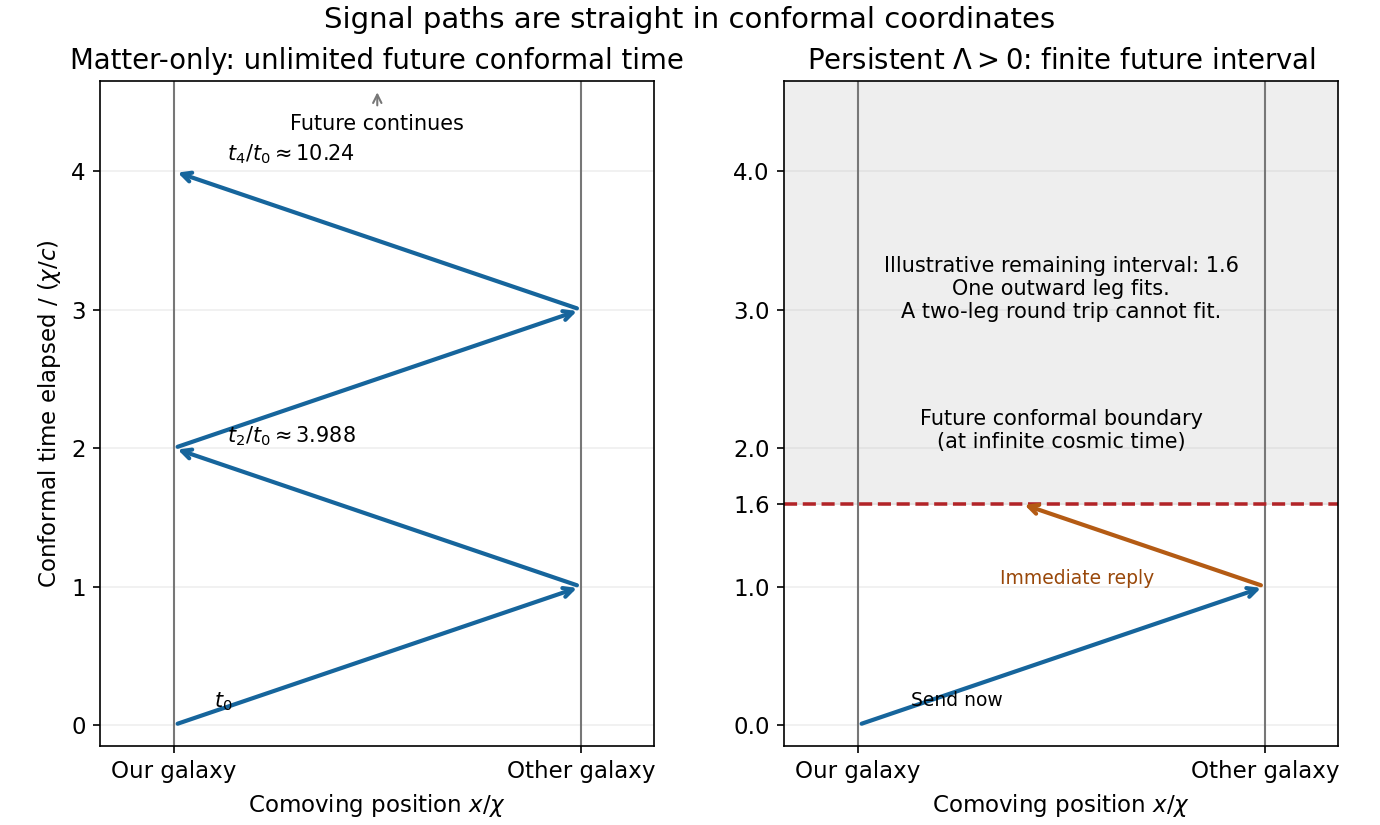
Message exchange depends on the remaining conformal time, not just the present expansion rate
. The left conformal spacetime diagram shows repeated light-signal legs between two comoving galaxies in an Einstein-de Sitter model. The right diagram illustrates a finite future conformal interval: one outward leg fits but a complete round trip does not. The right interval is a schematic example, not a parameter estimate for our Universe. Details.
Spatial flatness constrains the total density, not matter alone. A flat model can havewith a substantial dark energy component. A positive cosmological constant has pressure and does not dilute like matter; it can produce the observed accelerated expansion.
If positive persists, becomes exponential and the future conformal time intervalis finite. For two comoving civilisations separated by , each one-way signal consumes . Thus a message completing legs at finite time requiresOnly finitely many legs, and hence finitely many full exchanges, can then occur. A reply to even the first new message requires , the cosmological round-trip communication horizon condition. Depending on the density parameters, the initial outward message might arrive while its reply can never reach us, as in the right-hand panel of part d.
The source gives no matter and dark-energy fractions, so it does not specify an exact count for the pair in the real Universe. Flatness and lack of matter dominance alone do not prove a finite horizon: a radiation-dominated flat universe, for example, has divergent future conformal time if that power-law expansion persists. The finite-message conclusion uses persistent accelerated expansion such as positive constant .
Articles by others on the same topic
There are currently no matching articles.