Stellar parallax is the apparent change in a star's viewing direction caused by the observer's changing position. Nearby stars shift more against a distant reference background. In an ideal circular Earth orbit, the conventional annual stellar parallax uses a baseline of one astronomical unit, approximately the Earth-Sun distance. Two opposite observing positions, about six months apart, are separated by approximately two astronomical units. Their maximum angular separation is , so is half that excursion, not the full January-to-July shift. The observed excursion depends on the projected baseline and observing dates. [ref].
For the perpendicular baseline in the diagram, a right triangle giveswhere in the final expression is in radians. Combining the small-angle approximation with the parsec convention givesThus arcseconds implies parsecs, while the ideal six-month excursion is arcseconds. Geometry supplies this distance without assuming a luminosity or a particular stellar atmosphere.
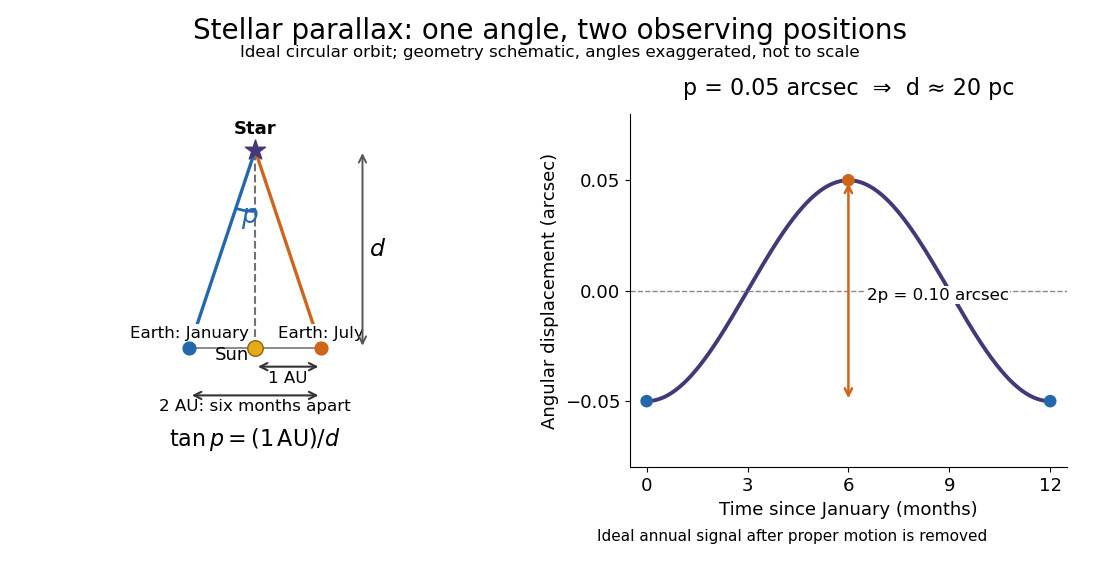
In practical astrometry, many observations separate the annual stellar parallax signal from proper motion, the star's own changing sky position. The Gaia DR3 catalogue reports stellar parallax and its uncertainty in milliarcseconds: arcseconds. A catalogue angle is a fitted measurement with measurement error. [ref].
For a positive stellar parallax with small standard deviation , first-order propagation gives . Thus with gives parsecs with parsecs, assuming systematic offsets are negligible. This linear estimate requires ; a reciprocal is nonlinear and does not generally preserve symmetric uncertainty intervals.
For a Gaussian measured stellar parallax, the likelihood at distance approaches a nonzero constant as . An unbounded spatial-volume prior proportional to therefore gives an improper posterior. A finite survey/population model or a decaying density is needed. The illustrative proper prior displayed has normalizing constant ; its scale is a model choice requiring justification, not a new measured datum. prior sensitivity is especially important at low parallax signal-to-noise.
The classical parallax-calibration problem combines measurement errors with the greater volume available at larger distances. A locally uniform spatial population has , which transforms under to on the valid distance interval. Parallax cuts and the nonlinear conversion to luminosity can bias calibration samples. A correction is not universal: the population model, selection information and inferential target must be specified. Distinguish the repeated-sampling bias of a selected sample from inference for a particular star using a justified prior.[ref]
On the Use of Trigonometric Parallaxes for the Calibration of Luminosity Systems: Theory by T. E. Lutz and D. H. Kelker. PASP 85, 573–578; classical calibration model
Let true parallax have prior density proportional to on the valid finite population range, and let an observation supply a constant likelihood on . The normalized posterior is . Integrating gives cumulative probability , hence the displayed median. A fixed half-width equal to half the observed center gives , and . Parameter-dependent error widths require their own normalized likelihood and support.
The parsec is a distance unit defined by the exact conventionThe astronomical unit is exactly ; one arcsecond is exactly radians. The IAU resolution explicitly records the parsec convention. A megaparsec is one million parsecs. [ref]. [ref].
The familiar description "the distance giving one arcsecond of stellar parallax" uses the small-angle approximation. Exact right triangle geometry instead gives , slightly shorter than the conventional parsec. The relative difference is approximately . This is negligible for the examples here, but distinguishing an exact unit convention from an approximate geometric interpretation prevents a misleading equality.

