For the equation of state , the cosmological continuity equation gives . Hence is constant. First take the physically intended positive energy density and defineThe Friedmann equation and the original Friedmann acceleration equation becomeSolve the second equation as . The first equation then requires . Choosing the time origin separately in each solution gives all positive branches:For , there is also the time reverse on , which contracts to a future zero. For , the cosmological bounce joins contraction to expansion at the positive minimum . Retaining at the minimum excludes a spurious permanently static solution that would satisfy the first-order constraint alone.
These are vacuum-energy FLRW solutions: the expanding flat branch, closed slicing of de Sitter spacetime, and open slicing of de Sitter spacetime. To compare them at the same energy density, the figure sets , takes , and aligns the open boundary and closed minimum at . Thus the three plotted functions are , , and , the last only for .
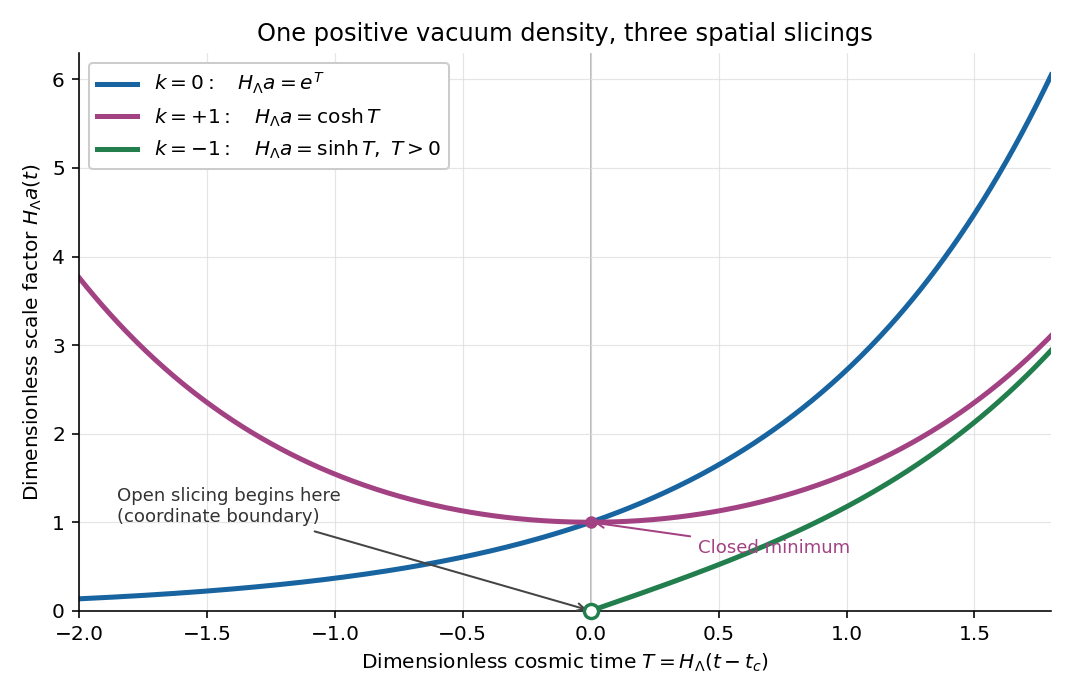
Scale factors for positive vacuum energy: exponential flat expansion, a closed bounce, and open expansion from a finite-time coordinate boundary
. Details. 
Only the expanding branch has a finite past zero. The expanding branch tends to zero only as , and the branch is bounded below. All three describe portions of de Sitter spacetime, with Ricci scalar and Kretschmann scalar . In particular the zero is a boundary of that slicing, not a curvature singularity. The inequality in part (d) does not apply, because .
For zero energy density, the remaining solutions are for , and the expanding or contracting Milne model for ; no positive real solution exists for . If negative energy density is admitted mathematically, write . Only is possible, with for , an open slicing of anti-de Sitter spacetime. These limiting and negative-density cases do not alter the positive-density comparison above.
Take the expanding flat branch , with . A radial null geodesic in FLRW spacetime satisfies . For the incoming past light cone of the spacetime event , integration giveswith arbitrary angular direction. Equivalently, conformal time gives .
Let the reception time tend to infinity. The largest comoving radial distance from which a signal emitted at time can reach the central comoving observer isThus the cosmological event horizon has constant proper distance in cosmology:An emitted spacetime event is seen at a finite time if and only if . Equality would require , while an event with never reaches the observer. This is a bound on events at their emission time; a fixed comoving observer can have earlier visible events and later invisible ones.
The boundary really is a null hypersurface. For , its normal has components and , soThe finite future integral, and hence this observer event horizon, uses the expanding branch. For the contracting flat solution , the same integral diverges and there is no future observer event horizon of this kind; the static zero-density solution likewise has none.
Articles by others on the same topic
There are currently no matching articles.