The scale factor specifies the common time dependence of proper distance in cosmology between comoving observers. Their comoving coordinates remain fixed, while their separation is multiplied by . Thus means expansion and means contraction. The coordinate is cosmic time, measured by the proper time of a comoving observer.
The parameter fixes the sign of the spatial curvature of an FLRW universe. More precisely, the spatial sectional curvature and three-dimensional scalar curvature areThe cases have locally spherical geometry, Euclidean geometry, and hyperbolic geometry, respectively. For , is the curvature radius of a constant-curvature space in the displayed normalization. Local curvature alone does not fix the global topology.
The Friedmann-Lemaître-Robertson-Walker metric implements the cosmological principle: on the scales being modelled, the spatial slices have spatial homogeneity and cosmological isotropy. There is a family of comoving observers whose orthogonal slices share one cosmic time and one scale factor. Each spatial slice is a locally maximally symmetric space, with time-independent normalized .
The matter is represented by a perfect fluid in general relativity, at rest relative to the comoving observers, with energy density and pressure depending only on cosmic time. Its stress-energy tensor isThere is no preferred spatial direction, so there is no anisotropic stress or spatial heat flux in that rest frame. Gravity obeys the Einstein field equations; the equations in this paper contain no separate cosmological constant, although a component with can represent one. An equation of state relating and closes the evolution equations. Spatial homogeneity and cosmological isotropy are idealizations of the cosmological background; they do not assert that individual local structures are uniform.
Set , the Hubble parameter. The first supplied component of the Einstein field equations gives the Friedmann acceleration equationSubstitution into the second supplied equation givesTherefore the first Friedmann equation isDifferentiate this equation with respect to cosmic time:Insert the Friedmann acceleration equation on the left and cancel , which is nonzero for . This givesThis is the cosmological continuity equation, expressing stress-energy conservation for the perfect fluid in general relativity. No division by was made, so the derivation remains valid at a cosmological bounce or an instant of maximum expansion.
For , the assumed inequality and the Friedmann acceleration equation imply . Thus is a concave function. Let and . At every earlier time in the same regular expanding interval, . Integration gives the concavity bound on past FLRW evolution:The right-hand side reaches zero at . Hence an everywhere regular positive scale factor cannot extend arbitrarily far into the past. With the usual implicit continuation assumption that the cosmological solution remains regular while , it reaches at a finite past boundary satisfyingPast expansion lasts at most the present inverse Hubble parameter. The inequality is the essential argument, and equality is attained by a linearly growing scale factor.
There is a literal qualification to the claim that must reach zero: the printed hypothesis alone does not exclude an earlier curvature singularity with positive limiting . In arbitrary fixed units, take and for , and define using the two Friedmann equations and the Friedmann acceleration equation. Then , , and , but while the energy density and pressure diverge as . Thus the rigorous unconditional conclusion is the finite bound on a regular past interval; reaching zero additionally requires the stated continuation assumption. Nor does a zero of alone prove a curvature singularity, as the Milne model illustrates.
For the equation of state , the cosmological continuity equation gives . Hence is constant. First take the physically intended positive energy density and defineThe Friedmann equation and the original Friedmann acceleration equation becomeSolve the second equation as . The first equation then requires . Choosing the time origin separately in each solution gives all positive branches:For , there is also the time reverse on , which contracts to a future zero. For , the cosmological bounce joins contraction to expansion at the positive minimum . Retaining at the minimum excludes a spurious permanently static solution that would satisfy the first-order constraint alone.
These are vacuum-energy FLRW solutions: the expanding flat branch, closed slicing of de Sitter spacetime, and open slicing of de Sitter spacetime. To compare them at the same energy density, the figure sets , takes , and aligns the open boundary and closed minimum at . Thus the three plotted functions are , , and , the last only for .
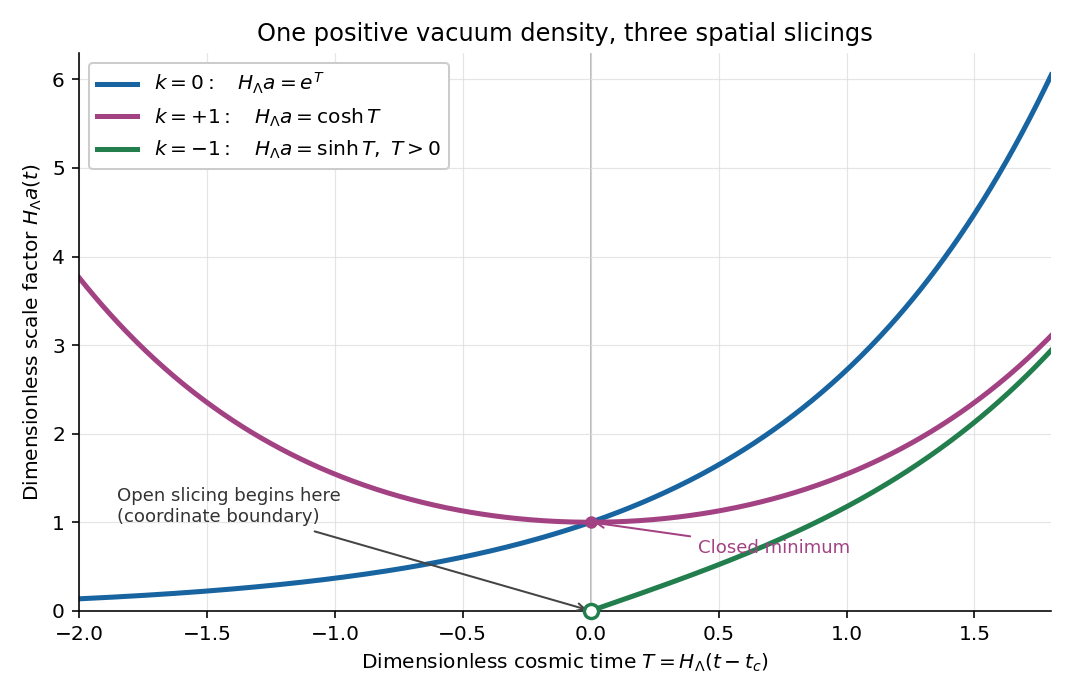
Scale factors for positive vacuum energy: exponential flat expansion, a closed bounce, and open expansion from a finite-time coordinate boundary
. Details. 
Only the expanding branch has a finite past zero. The expanding branch tends to zero only as , and the branch is bounded below. All three describe portions of de Sitter spacetime, with Ricci scalar and Kretschmann scalar . In particular the zero is a boundary of that slicing, not a curvature singularity. The inequality in part (d) does not apply, because .
For zero energy density, the remaining solutions are for , and the expanding or contracting Milne model for ; no positive real solution exists for . If negative energy density is admitted mathematically, write . Only is possible, with for , an open slicing of anti-de Sitter spacetime. These limiting and negative-density cases do not alter the positive-density comparison above.
Take the expanding flat branch , with . A radial null geodesic in FLRW spacetime satisfies . For the incoming past light cone of the spacetime event , integration giveswith arbitrary angular direction. Equivalently, conformal time gives .
Let the reception time tend to infinity. The largest comoving radial distance from which a signal emitted at time can reach the central comoving observer isThus the cosmological event horizon has constant proper distance in cosmology:An emitted spacetime event is seen at a finite time if and only if . Equality would require , while an event with never reaches the observer. This is a bound on events at their emission time; a fixed comoving observer can have earlier visible events and later invisible ones.
The boundary really is a null hypersurface. For , its normal has components and , soThe finite future integral, and hence this observer event horizon, uses the expanding branch. For the contracting flat solution , the same integral diverges and there is no future observer event horizon of this kind; the static zero-density solution likewise has none.
Articles by others on the same topic
There are currently no matching articles.