Use a plane wave with phase , and take , . The positive-frequency branch of the given hydrostatic dispersion relation is . The wavevector is . Differentiating with respect to its components gives the group velocity, which carries the wave packet and its energy:The normal phase velocity, which follows a crest in its normal direction, isConsequently,Thus the group velocity lies along the constant-phase lines , perpendicular to the phase velocity. For , crests move upward and rightward, whereas energy moves downward and rightward. Choosing gives upward and rightward energy propagation and downward and rightward normal phase propagation. Conjugate or oppositely directed components supply the other outgoing directions from a localized source.
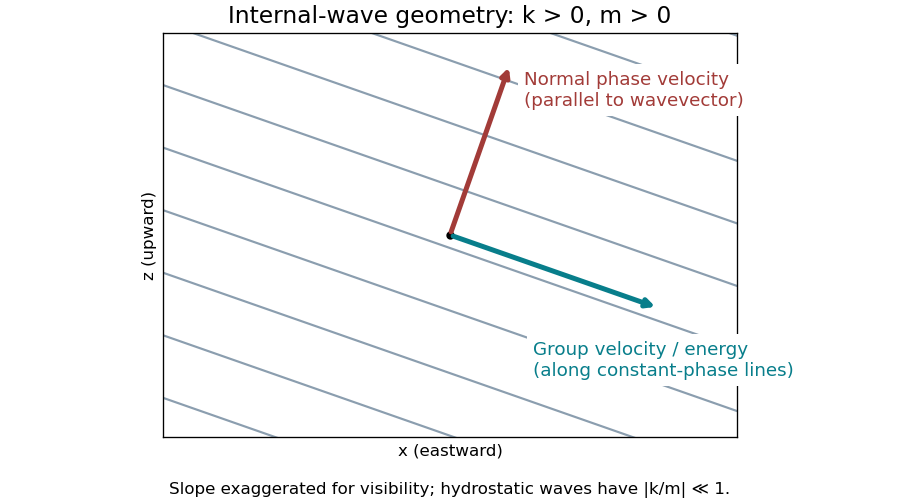
Internal-wave crests, normal phase propagation, and perpendicular energy propagation for positive horizontal and vertical wavenumbers
. Details. 
The speeds areThe hydrostatic limit is . In that limit energy propagates almost horizontally, with and , while normal phase propagation is almost vertical and has speed approximately . The horizontal speed at which a crest intersects a fixed height is ; this is not the horizontal component of the normal phase velocity vector. For example, , vertical wavelength and horizontal wavelength give and .
These are local speeds in a uniform medium, without a background current. The non-rotating approximation requires , while the hydrostatic approximation requires . At lower frequencies, rotation changes the dispersion relation to that of inertia-gravity waves.
Articles by others on the same topic
There are currently no matching articles.