Take eastward, northward and upward. In a rotating reference frame, the horizontal Cauchy momentum equation isHere represents other accelerations, such as friction, and is the Coriolis parameter. When the Rossby number and the ratio are small, and friction is weak, both advective and local acceleration can be neglected. The Coriolis force then balances the pressure gradient force: this is geostrophic balance, with and . The geostrophic wind runs along atmospheric isobars, with low pressure on its left in the northern hemisphere.
A rapid change of pressure need not bring the corresponding geostrophic wind into existence at once. An initially weak wind therefore leaves an inward pressure gradient force around the new low. For a smoothed anomaly of horizontal scale , geostrophic balance would requireFor the illustrative midlatitude value , the implied Rossby number is already about , so curved-flow acceleration matters. With a small tropical value , the inferred speed is and the Rossby number about : the assumed geostrophic balance is untenable. Geostrophic adjustment redistributes the anomaly and emits internal gravity waves, leaving a weaker balanced component.
For a target speed on the same scale, the required scale estimate isThus , or of the initial magnitude, is the midlatitude estimate; at the illustrative tropical it is , or of the initial magnitude. The paper gives no latitude, so there is no unique numerical reduction. At the equator itself one must use equatorial dynamics rather than divide by . Even the tropical estimate has Rossby number , so it describes the scale permitted by the stated balance, rather than a controlled tropical geostrophic balance.
There are two qualifications to “unstable”. A literal top-hat pressure anomaly has a discontinuous edge, where no finite classical geostrophic wind can balance its distributional pressure gradient. The estimate assumes a smoothed edge; a thinner edge requires stronger winds. More generally a large low is not, by its amplitude alone, proved to have an exponentially growing instability. For a concrete counterexample to the claim that such an amplitude cannot be stationary, set , with cylindrical radius , constant and . The cyclonic gradient windis real and satisfies for every , with a regular limit at the centre. This is a stationary axisymmetric flow; no claim about its perturbation stability is needed. Here the physically justified conclusion is that a rapidly imposed anomaly without its balancing wind is unbalanced.
Small tropical Coriolis parameter allows only weak horizontal pressure gradients to coexist with ordinary large-scale winds. Hydrostatic balance connects the vertical variation of these pressure gradients to horizontal temperature gradients; equivalently the approximate thermal wind relation gives . For comparable vertical wind shear, small means smaller . Internal gravity waves can spread heating-induced buoyancy anomalies efficiently before rotation arrests the adjustment. This motivates the weak temperature gradient approximation for the tropical free troposphere; it does not require the land surface or atmospheric boundary layer to have uniform temperature.
Use a plane wave with phase , and take , . The positive-frequency branch of the given hydrostatic dispersion relation is . The wavevector is . Differentiating with respect to its components gives the group velocity, which carries the wave packet and its energy:The normal phase velocity, which follows a crest in its normal direction, isConsequently,Thus the group velocity lies along the constant-phase lines , perpendicular to the phase velocity. For , crests move upward and rightward, whereas energy moves downward and rightward. Choosing gives upward and rightward energy propagation and downward and rightward normal phase propagation. Conjugate or oppositely directed components supply the other outgoing directions from a localized source.
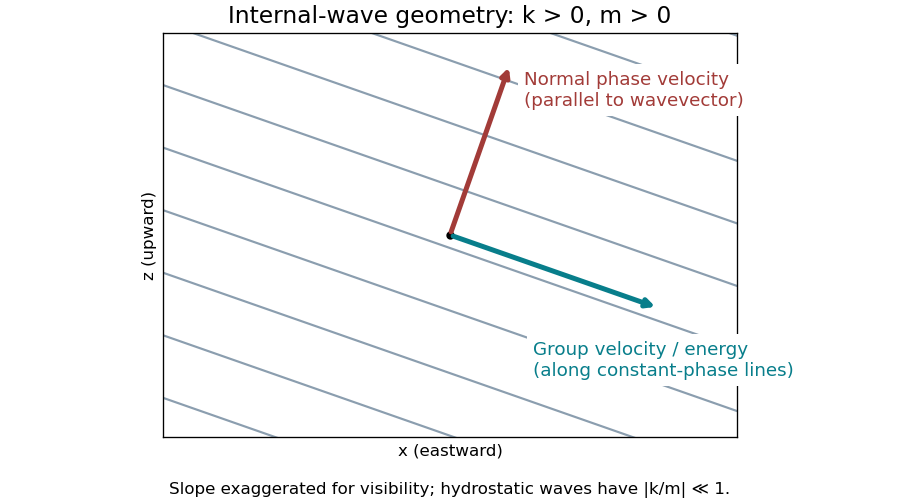
Internal-wave crests, normal phase propagation, and perpendicular energy propagation for positive horizontal and vertical wavenumbers
. Details. 
The speeds areThe hydrostatic limit is . In that limit energy propagates almost horizontally, with and , while normal phase propagation is almost vertical and has speed approximately . The horizontal speed at which a crest intersects a fixed height is ; this is not the horizontal component of the normal phase velocity vector. For example, , vertical wavelength and horizontal wavelength give and .
These are local speeds in a uniform medium, without a background current. The non-rotating approximation requires , while the hydrostatic approximation requires . At lower frequencies, rotation changes the dispersion relation to that of inertia-gravity waves.
The equations describe the linear reduced gravity shallow water equations for a uniform upper layer over a deep, resting lower layer, or equivalently one separated internal vertical mode. The layer is shallow compared with its horizontal scales, permitting hydrostatic balance, and its horizontal velocity is independent of depth. The Boussinesq approximation retains the small density contrast through . We neglect friction, external forcing, background currents, and quadratic perturbation terms. On an equatorial beta plane, with , and the equatorial Kelvin wave branch imposes . The meridional Cauchy momentum equation then reduces exactly within this linear model to a balance between the Coriolis force and pressure gradient force.
Strictly, the printed must denote the thickness perturbation , with total thickness and . A signed oscillation around zero cannot represent the total positive layer thickness. Define . For a nonzero zonal wavenumber , the zonal Cauchy momentum equation and conservation of mass giveOn the eastward branch , the wave polarization is . Meridional geostrophic balance givesThe branch instead grows as and is excluded by decay away from the equator. Matching the paper's Gaussian function therefore givesThe usual equatorial deformation radius is , with the envelope written . Thus the printed exponent uses . Calling that width a deformation radius is a convention; using the standard radius without the factor would fail the printed meridional equation.
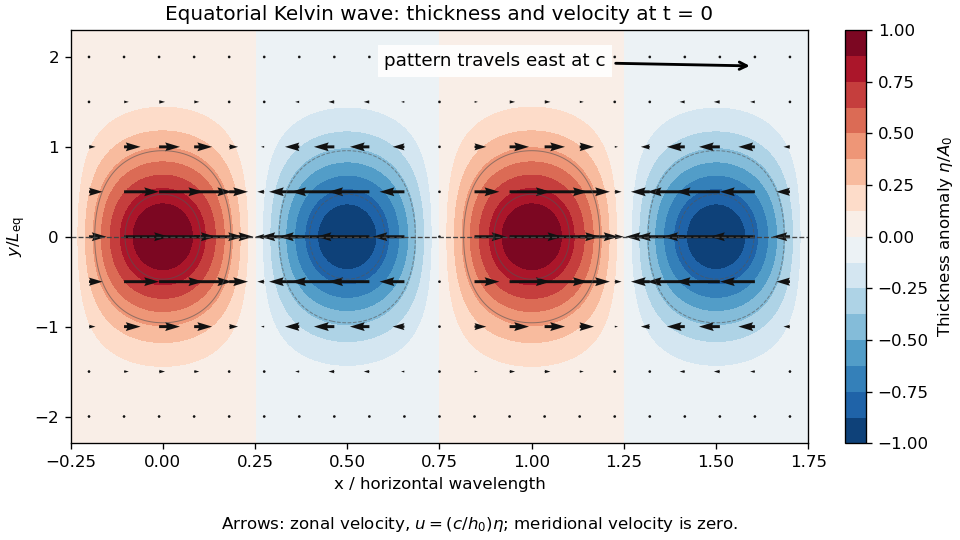
Equatorial Kelvin-wave thickness anomaly and zonal velocity at one instant, using the paper's Gaussian-width convention
. Details. 
At an instant, alternating positive and negative thickness anomalies have their largest magnitudes on the equator and decay symmetrically away from it. Eastward arrows occupy the positive anomalies, westward arrows the negative anomalies; the velocity vanishes at the nodes and weakens away from the equator. The whole pattern travels eastward at speed . Meridionally, is geostrophic balance. For a positive anomaly north of the equator, the northward pressure gradient force balances the southward Coriolis force; both directions reverse south of the equator. Zonally, and : the zonal pressure gradient force accelerates the flow, so it is not in zonal geostrophic balance. On the equator the meridional terms both vanish smoothly.
Hold fixed when differentiating the dispersion relation of Rossby waves, so that is independent of . For , stationary zonal phase requiresThe zonal group velocity measured relative to the ground isUsing the stationarity condition,Here on the ordinary midlatitude beta plane, so the stationary Rossby wave requires an eastward background current and carries its wave packet eastward. If , a real nonzero stationary exists only for . The restriction matters: a zonally uniform disturbance with has identically, but its zonal phase velocity is undefined, so it is not a counterexample within the stated meaning of stationary waves.
Kelvin waves: weakened trade winds, or a westerly wind burst, excite a downwelling equatorial Kelvin wave. Its positive upper-layer thickness anomaly travels eastward and deepens the eastern Pacific thermocline. Upwelling then entrains warmer water, favouring eastern Pacific surface warming and the development of El Niño. This is a propagating adjustment of the thermocline, rather than transport of an unchanged parcel of warm water across the entire basin.[ref]
El Niño and La Niña: Causes and Global Consequences by Michael J. McPhaden. Box 2, “Equatorial Waves”, and the adjoining discussion of eastern thermocline depression, printed page 358
Gravity waves: changed tropical convection and its latent heat release force atmospheric internal gravity waves. Their rapid propagation spreads the associated pressure and buoyancy disturbances, allowing the tropical terrestrial atmosphere to adjust to the shifted heating and contributing to the divergent circulation and surface wind response coupled to the ocean. This is one atmospheric adjustment mechanism; it does not assert that all wind variability during a particular El Niño is caused by this wave family.
Rossby waves: wind forcing during El Niño also launches westward equatorial Rossby waves with a shoaling thermocline signal. Reflection at the western Pacific boundary can produce an eastward upwelling equatorial Kelvin wave, which shoals the eastern thermocline and promotes cooling. This supplies a delayed negative feedback that can help terminate the event.[ref]
El Niño and La Niña: Causes and Global Consequences by Michael J. McPhaden. Printed pages 358–359, reflection of the western thermocline-elevation signal and the return of surface cooling
These examples describe mechanisms relevant to events such as 2023/24, rather than claiming an event-specific attribution from the exam data. Articles by others on the same topic
There are currently no matching articles.