For each cyclic starting position , let indicate that the next entries are all one. Then and , hence .
For two starts separated by along either direction, their runs overlap in positions, so . All other distinct starts use disjoint entries and are independent. Since , the two directions' overlap ranges do not intersect. Summing the variances and covariances givesIn particular, dropping negative terms and summing a geometric series yieldswhen . The formula also covers with an empty covariance sum.
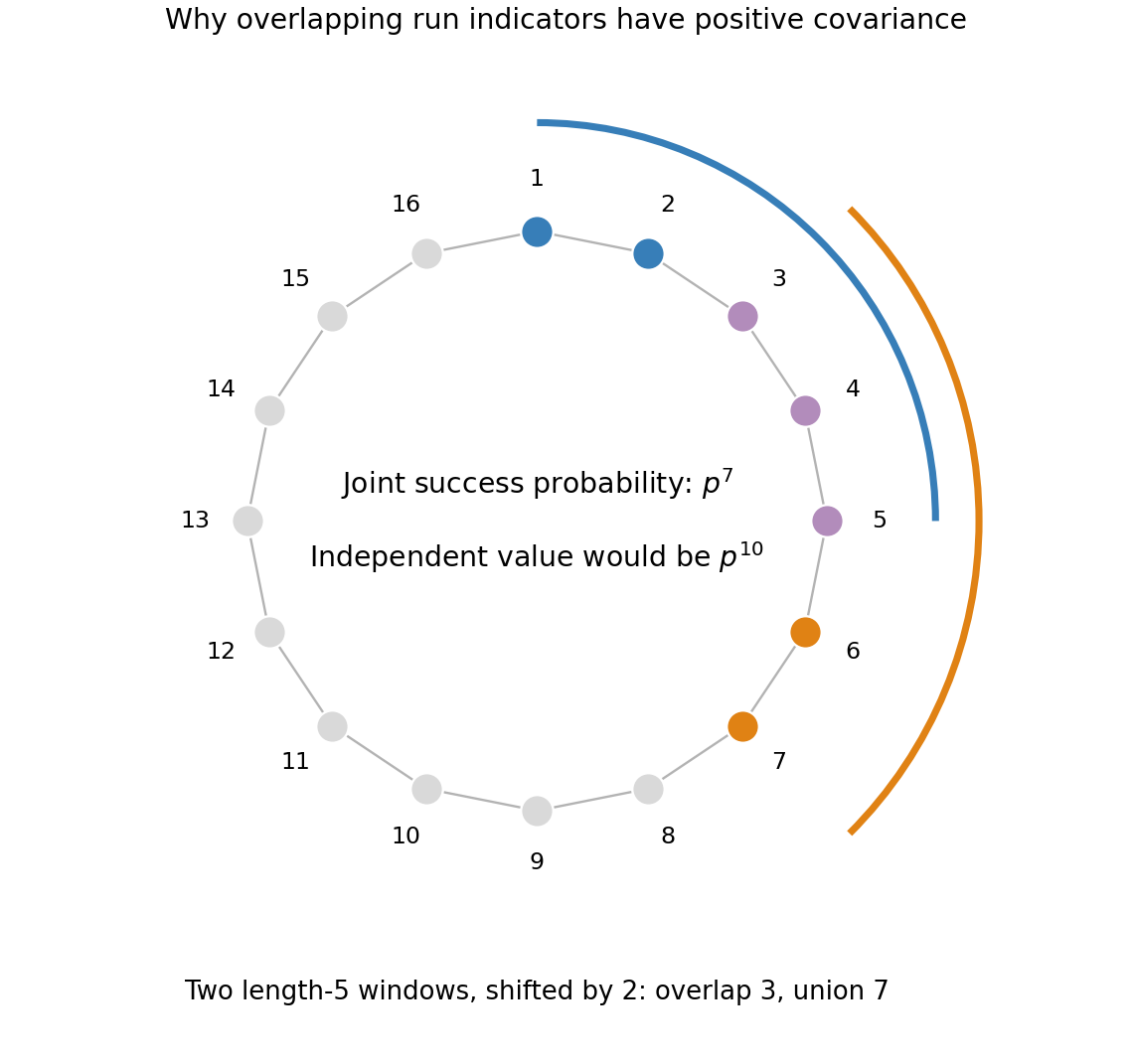
Overlap controls the joint success probability
. An original illustrative pair of length-five windows shifted by two on a sixteen-position circle. Their union has seven positions, so both succeed with probability p to the seventh power. Details.
Now makes . Chebyshev's inequality and the variance bound giveFor every fixed , they likewise giveThus the count is concentrated about its growing mean, despite the overlapping runs.
For , use . Then , so its limits are exactly those needed for the same two arguments.
For , a convenient definition that also accounts for the varying probability isIt makes . Thus gives no runs with high probability, and gives runs and relative concentration. For sufficiently large , , so the same uniform variance bound applies. Definitions are made from the actual integer ; no continuous rounding assumption is required. These conclusions retain the stipulated range .
Articles by others on the same topic
There are currently no matching articles.