Source extract: users.physics.ox.ac.uk/~Foot/C2/pdf/C22007Q5.pdf
The year is attributed from the preserved Oxford support-page record; it is not printed on the held page.
Represent the single-photon state by its two path probability amplitudes. The first Hadamard gate sends to . With for the lower-arm phase shifter, the complete Mach-Zehnder interferometer givesThe global phase has no effect on detection. By the Born rule,They sum to one. At , port 1 is a dark port; at , the roles reverse. The result uses coherent addition of the path amplitudes, rather than addition of separate path probabilities.
Write and , using the Pauli operators. The Hadamard gate obeys , so unitary conjugation of the matrix exponential gives . Therefore the symmetric z-x-z beam splitter factorization isThe rightmost operator acts first. Each factor is unitary, which also proves the given matrix is unitary. Choosinggives , so it is exactly a Hadamard gate up to global phase.
For the specified identical splitters with , put and . Here , and direct multiplication givesThus the upper-port probability iswith . These identical beam splitters in a two-path interferometer give a nonconstant interference fringe whenever . With this matrix and port convention, two identical balanced splitters swap the bright and dark ports relative to the two-Hadamard model: at , . The reflection phases must remain in the calculation.
The upper-port maximum and minimum are and . Hence the peak-to-peak modulation is and its normalized interferometric visibility isBoth measures of contrast are maximal precisely forThese are balanced beam splitters, with equal single-input transmission and reflection probabilities. When , only one route contributes to the output and the fringes disappear.
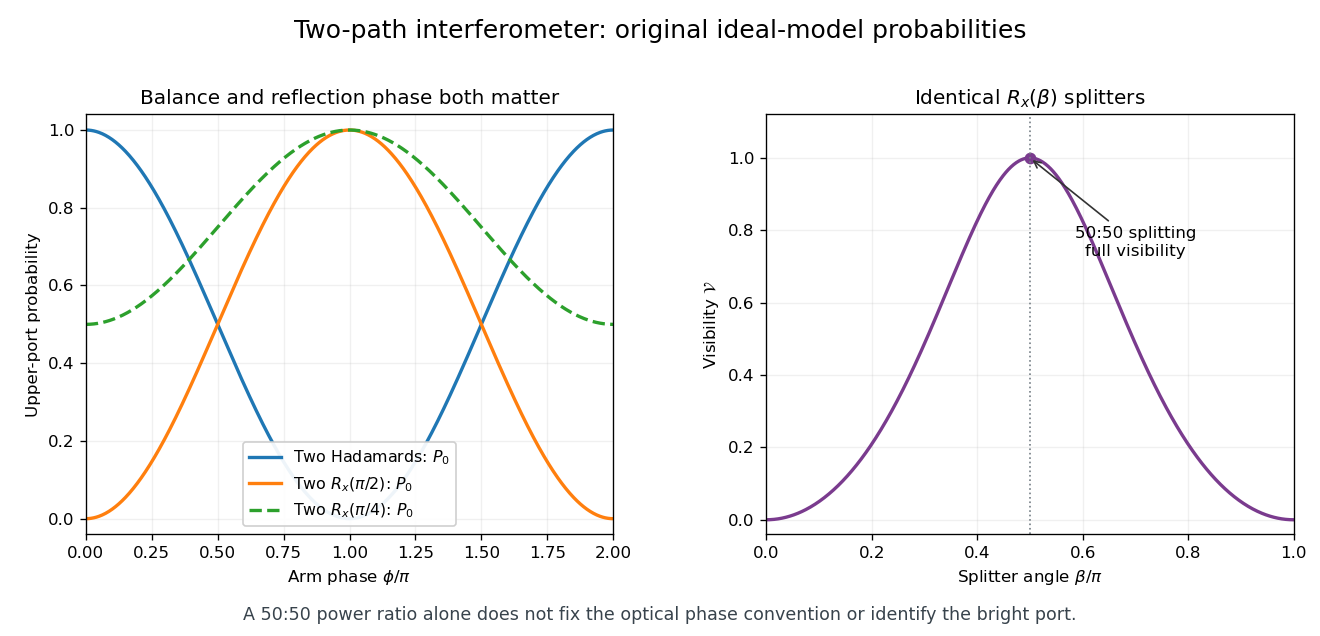
Interferometer fringes with explicit beam-splitter phases and the balance condition for full visibility
. Original ideal-model calculations, not measured data. The first panel compares the Hadamard convention with two identical splitters; the output-port phase shift remains visible even at 50:50 balance. The second panel shows the normalized upper-port visibility. Details.
Calibrate the two-Hadamard Mach-Zehnder interferometer so that the passive box leaves no relative wave phase or path disturbance. Then , and port 1 is dark. A photon at port 1 is therefore impossible for the passive box under these assumptions.
For an active ideal detector in arm 1, the first Hadamard gate prepares . Absorption, which triggers the detector, has probability . On a no-absorption outcome, the surviving unnormalized state is . Applying the second Hadamard givesIts squared norm is , the survival probability; normalizing it earlier and forgetting that probability would overcount successful trials. The unconditional outcomes for an active detector areThus a port-1 click identifies an active detector without triggering it, with single-pass success probability , conditional on testing an active device. A port-0 click is inconclusive. Among trials in which the photon survives, half are successful, but that conditional fraction is not the single-pass success probability.
This is the balanced Hadamard interaction-free measurement version of the Elitzur-Vaidman bomb tester. Conditioning on no absorption changes the quantum coherence available for recombination; a calibrated dark-port click reveals that change. An uncontrolled phase shift in the passive arm could also brighten the port, so the inference depends on the stated optical calibration. It does not assign an observed classical trajectory to the photon before detection. If the same active device is retested after inconclusive clicks, the repeated weak-rotation bomb-test efficiency gives eventual success ; the requested single pass remains .
Articles by others on the same topic
There are currently no matching articles.