Use a classical target bit and initialized auxiliary bits. The NOT gate maps , the CNOT gate maps , and the Toffoli gate maps . They are bijections and are their own inverses. Explicit circuits with their retained input wires are:
- AND: a Toffoli gate on produces .
- OR: apply NOT to both controls, a Toffoli gate with target initialized to , then restore both controls. The target becomes .
- CLONE: a CNOT gate on gives .
- SWAP: apply , and . The successive pairs are , , then .
These maps also give the truth tables for all input combinations. AND and OR are not themselves reversible maps if the inputs are discarded; the retained inputs are what make their implementations reversible. Classical CLONE copies a known orthogonal computational basis alphabet; the no-cloning theorem forbids interpreting it as a copier of arbitrary quantum superpositions.
A Boolean circuit can express any finite Boolean function using AND, OR and NOT. Replace its operations by the reversible versions, keeping inputs and intermediate bits. Copy the final output into a fresh answer register with CNOT gates, then run the entire computing network backward. Intermediate auxiliary bits return to zero, yieldingThis compute-copy-uncompute construction proves universality in the usual model with initialized auxiliary bits. If is a reversible permutation, compute , use a reversible implementation of to clear , and swap registers, leaving with clean auxiliaries. The ancillary-resource qualification matters; a blanket claim about all permutations on an arbitrary fixed number of unassisted wires has parity restrictions.
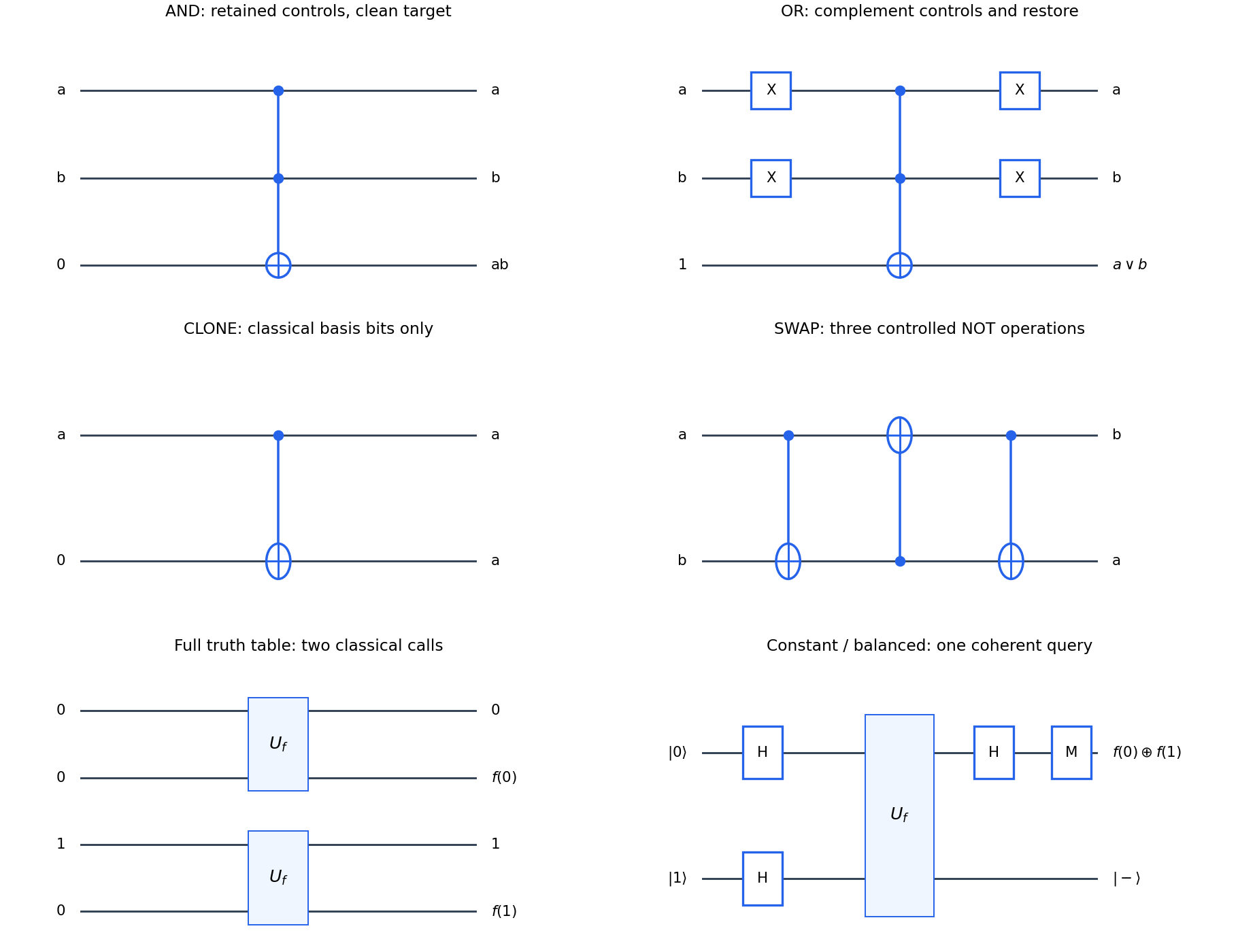
Reversible Boolean constructions and a one-query Deutsch algorithm
. Original circuits for AND, OR, copying a classical bit and SWAP, with retained inputs and initialized targets shown explicitly. The lower panels show two classical oracle queries for the truth table and the phase-kickback quantum network that obtains only its parity in one query. Circuit operations run from left to right. Details.
Articles by others on the same topic
There are currently no matching articles.