A forward-biased p-n junction injects electrons from its n-type semiconductor and electron holes from its p-type semiconductor into an active region. A direct band gap allows radiative transitions without a compensating phonon, so stimulated emission can compete effectively with nonradiative processes. At thermal equilibrium there is one Fermi level; forward injection instead establishes separate electron and valence-electron quasi-Fermi levels and . Sufficient injection makes conduction states more occupied than the corresponding valence states, producing optical gain.
Two parallel cleaved facets supply an optical resonator. At normal incidence their approximate intensity reflectance follows the Fresnel equations:A resonant normal mode grows when its round-trip amplification exceeds its losses. For length , material optical gain , overlap factor , internal intensity loss and facet reflectances ,The pump supplies the emitted energy; the facets provide feedback and let some output escape. Positive optical gain alone does not establish laser threshold.
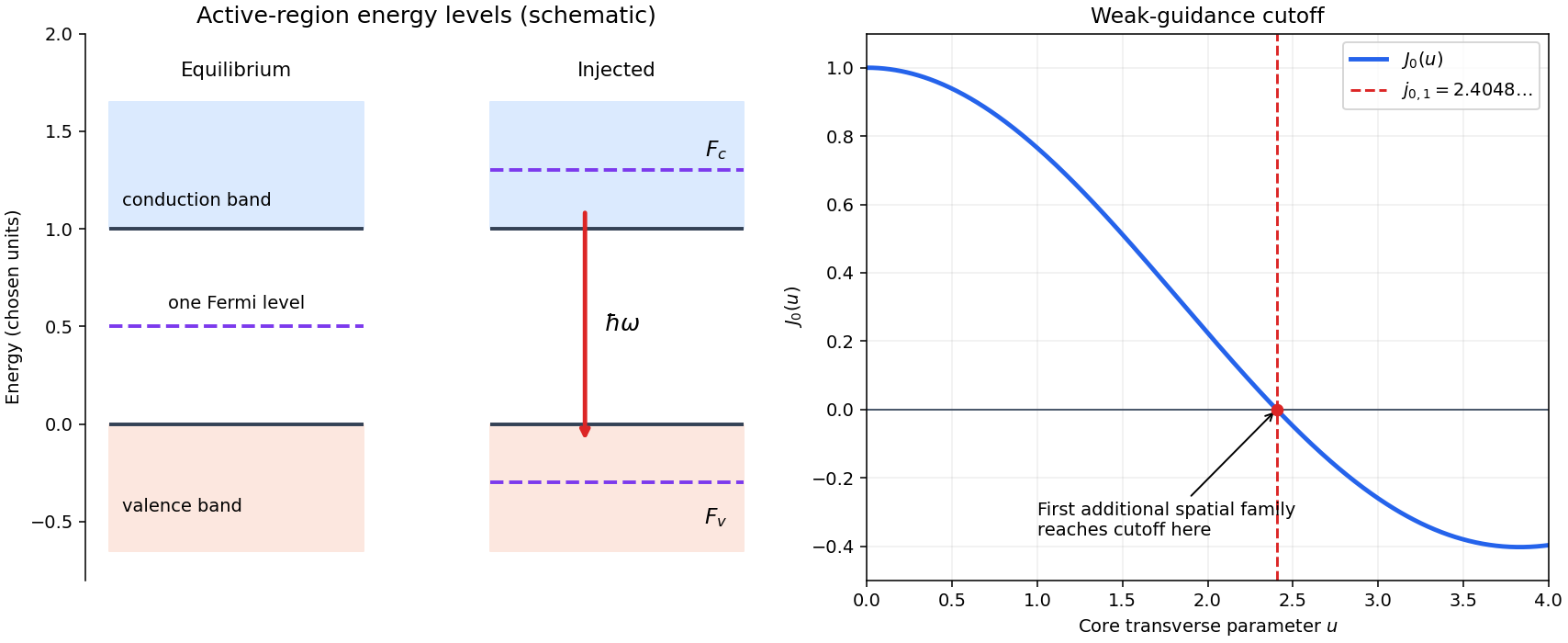
Injected laser diode levels and the first additional guided spatial mode
. Original schematic: the left panel uses stipulated energy units to distinguish equilibrium and injected quasi-Fermi levels, with an allowed downward optical transition. The right panel plots , whose first zero fixes the weak-guidance spatial-mode cutoff. The separate panels do not represent a shared spatial coordinate. Details.
For a vertical interband transition, the crystal momentum is effectively unchanged because the photon momentum is small. A stimulated downward transition needs an occupied upper state and an empty lower state, with factor ; upward photon absorption has factor . The two matrix elements agree by microscopic reversibility. Their difference is thereforeA common slowly varying transition-strength factor is implicit. Broadening replaces the sharp transition by a convolution; multiple valence bands contribute separate terms.
For one isotropic pair of parabolic energy bands, writeThus . Including the usual twofold spin degeneracy, the number of paired states per volume inside a sphere of radius is . Differentiating with respect to transition energy gives the three-dimensional parabolic interband joint density of statesFor density per angular frequency, . Stating the density convention avoids a missing factor of ; other degeneracies multiply the formula.
At a common carrier temperature, the Fermi-Dirac distribution is a strictly decreasing function of . The direct-gap semiconductor gain condition follows:The lower inequality denotes a transition above the ideal band edge, where the displayed joint density of states is nonzero. Thus quasi-Fermi-level splitting must exceed the transition photon energy. Equality is transparency, rather than net amplification; at zero temperature an allowed transition must also lie within the occupied-electron and empty-valence windows.
Adjacent longitudinal cavity modes obey . Neglecting optical dispersion in estimating their spacing,Hence the gain interval accommodatespossible longitudinal cavity modes. The exact integer depends on the positions of the interval endpoints and resonances. This counts available resonances; mode competition and actual laser threshold can reduce the number that oscillates. More accurately, the spacing uses the group refractive index instead of .
A broad multimode spectrum suffers differential delay through optical fiber group velocity dispersion, broadening transmitted pulses. Near , ordinary silica optical fiber attenuation is also larger than in the long-distance windows near and . These limitations concern this short-wavelength, simple multimode device: suitably engineered single-frequency semiconductor lasers at telecommunications wavelengths are useful communication sources.
A double heterostructure laser places a lower-band gap active layer between wider-band gap layers with suitable type-I band alignment. The band offsets confine injected electrons and electron holes in the same small volume, increasing their overlap and reducing escape. Usually the active layer also has larger refractive index, so the same sandwich forms an optical waveguide. Optical confinement increases the gain-overlap factor , while carrier confinement lowers the injection needed to reach the required quasi-Fermi-level splitting. These two distinct mechanisms reduce threshold current and heating. A band gap difference alone does not establish the sign of both confinement barriers; suitable band offsets are essential.
Put , allowing to be complex. The Hermitian electric field is . The annihilation operator and creation operator change photon number, so their diagonal matrix elements in a Fock state vanish. Since and ,The terms containing or connect orthogonal number states and contribute zero. Even as grows, there is no definite oscillating mean electric field; its quadrature fluctuations grow instead. A Fock state can represent fixed field energy, but not a classical sinusoidal wave of prescribed wave phase. This is distinct from representing a classical field with a randomly averaged phase.
Orthogonality of the number states makes the coherent state norm an exponential series:Using and reindexing ,It is not an eigenstate of the creation operator. Indeed its supposed eigenvalue would have to be , from its expectation, whereasThis nonzero residual holds even at .
The photon number probabilities of a coherent state form a Poisson distribution with mean . Alternatively normal ordering gives . ThusThe last ratio is defined only for nonzero . At large the absolute fluctuation grows but its size relative to the mean becomes negligible. This is the deterministic intensity limit within quantum optics; it does not assert the disappearance of vacuum-scale quadrature noise.
The annihilation operator eigenvalue property givesThis is a classical monochromatic electric field: the modulus of fixes the wave amplitude, while its argument fixes the wave phase relative to the chosen mode convention. Direct normal ordering also gives , independent of . Hence the fluctuation divided by the peak mean-field amplitude is , small in the bright coherent state limit. A relative fluctuation evaluated exactly at a field zero is not a useful classicality test.
Use mode locking to phase-lock many longitudinal cavity modes; their repeated constructive interference produces short optical pulses. A saturable absorber can select this pulsed operation. A fundamental repetition rate corresponds to a round trip, or an optical round-trip length ; a linear air-filled cavity would therefore be about long. A compact alternative is a faster mode-locked oscillator followed by pulse selection and, if required, amplification. Ordinary Q-switching alone generally does not provide pulses.[ref]
Fundamentals of Photonics and Quantum Electronics lecture notes by Franz X. Kärtner. Chapter 7, mode locking: phase-related resonator modes and ultrashort pulses
The incident intensity radius is , half the quoted diameter. For an ideal collimated Gaussian beam focused by a thin lens, the diffraction-limited waist isThe incident Rayleigh range is much larger than , justifying this approximation. The pulse energy is . Taking its duration as an effective energy-to-peak-power width gives . Since has integrated power ,If denotes the temporal intensity full width at half maximum of a Gaussian pulse, the time integral instead gives , and . The pulse shape is unspecified, so the estimate's order-one convention is explicit. Aberration, clipping and propagation through glass were excluded from this calculation as stipulated.
The contrast is weak: . Use a scalar weak-guidance Helmholtz equation for a transverse field component, with longitudinal wave number and vacuum wave number . Separating variables as givesA bound mode requires . DefineThe step-index fiber normalized frequency is ; is a dimensionless core transverse wave number. Regularity at selects the Bessel function of the first kind, while decay at infinity selects the Modified Bessel function of the second kind:In this scalar approximation, continuity of the field and its radial derivative givesAt cutoff the evanescent wave extends arbitrarily far into the cladding, so , and . For the first azimuthally varying family , the recurrence relations reduce the last equality toAs , and , making the right side tend to zero. Thus the onset is at the first positive zero of :The scalar fundamental family has no positive cutoff. The first additional spatial family is the family just found; the next radial and first families require the larger zero . This establishes the first multimode boundary rather than merely finding one possible cutoff. The two polarizations of the fundamental family are not counted as two spatial modes. Exact vector interface conditions split some higher-mode degeneracies at finite contrast; the displayed condition is the weak-guidance result intended by the supplied scalar equations.
The raised-index region has , whereas . Therefore its numerical aperture factor is . With the printed rounded cutoff,ThusSlower scanning increases the written radius and makes the guide multimode; faster scanning makes it single-spatial-mode in this idealization, provided a physically meaningful positive core radius remains. Using gives . This numerical threshold extrapolates the supplied empirical radius law; its experimental range is not given.
For bulk electric-dipole second-harmonic generation, the crystal must lack inversion symmetry and have a nonzero relevant component of its second-order nonlinear optical susceptibility. It should transmit both pump and harmonic, tolerate the required intensity, and allow phase matching by suitable birefringence or another phase-compensation mechanism. A large nonlinear coefficient, low optical loss and good optical quality are desirable. Noncentrosymmetry permits a response but does not guarantee one in every chosen geometry.
In the undepleted plane wave limit, contributions from successive layers give a harmonic amplitude proportional to , where . HenceTune orientation, temperature and pump polarization to maximize the nonlinear coupling and cancel phase mismatch. For continuous operation, an impedance-matched enhancement optical resonator, or intracavity doubling, raises the circulating intensity. Focus the Gaussian beam to balance intensity against diffraction and spatial walk-off; arbitrarily tight focusing shortens the useful overlap. Antireflection surfaces, stable resonance locking and efficient heat removal reduce avoidable loss and drift.
For a fundamental electric field in the plane, . The specified tensor then givesWriting and yieldsThe source electric polarization is therefore along and is largest along the in-plane diagonals. A radiated wave also needs a transverse component of this source: propagation along would not generate a propagating -polarized output. Propagation in the plane provides the simple strictly transverse example. For a tilted extraordinary wave, the electric displacement, rather than generally the entire electric field, is perpendicular to the wave vector; the tensor source must be projected onto that wave's allowed polarization. This distinction matters when using the type-I geometry below.
Type-I phase matching requires , because both pump photons are ordinary and the harmonic is extraordinary. Apply the direction-dependent index equation to the harmonic, not to the pump. Solving givesFor the ruby-laser data this is , whereas the shorter-wavelength data give . ThereforeThe second calculation uses the supplied indices as rounded harmonic data: the exact half-wavelength of is . The index dispersion between those two ultraviolet values was not supplied.
For an extraordinary wave, its Poynting vector makes an angle with the optic axis satisfying . Thus the spatial walk-off angle relative to the wave vector isBoth angles refer to the harmonic. The ordinary pump does not have this angular walk-off. For beam radius , the approximate overlap length is , so the shorter-wavelength geometry has about times the walk-off-limited interaction length.[ref]
Fundamentals of Photonics and Quantum Electronics lecture notes by Franz X. Kärtner. §§2.8.2–2.8.3, printed pp. 156–158: extraordinary index and energy-flux direction
To compare coupling, take propagation azimuth and ordinary unit polarization . Its quadratic source is . Projection onto an extraordinary displacement direction with component proportional to gives , up to the small anisotropic normalization correction. The optimal azimuth is . At equal beam area, interaction length, input power and approximately equal nonlinear coefficients, the shorter pump has both stronger angular coupling and the favorable frequency-squared factor:Here in the small-conversion, equal-area model, with harmonic index phase-matched to the pump. Its smaller spatial walk-off further favors the pump in a walk-off-limited geometry. Equal input power alone does not determine an absolute efficiency ranking: ultraviolet absorption, wavelength-dependent , beam size, crystal length and coatings are unspecified. For example, a sufficiently strongly absorbing output can reverse the ideal ranking. The stated preference is conditional on comparable transparent crystals and comparable focusing, not a prediction independent of those parameters.
The normalized input density operator isA quantum measurement in the computational basis has projectors . Discarding its recorded outcome gives the dephasing channelThe original off-diagonal coherence disappears. If the outcome is retained instead, the conditional state is or and the record carries information about which occurred. Thus discarding the record is an essential part of this channel specification.
A random Pauli Z gate with equal application and nonapplication probabilities givesThis is exactly the same dephasing channel as the unrecorded measurement, for every input density operator, including one entangled with an auxiliary system. Individual trials differ: conditioned on the classical random choice, the state is the pure state or , generally neither a computational basis vector. Knowledge of that choice permits recovery by the same Pauli Z gate; a measurement outcome does not restore an unknown destroyed superposition.
Use the rotation convention . For uniform modulo ,because the off-diagonal entry acquires with zero average. Each trial retains a pure state with a randomly rotated relative phase, reversible if is known. All three procedures therefore give identical statistics for every measurement on the unconditioned system, but their records and conditional ensembles differ. A density operator does not identify its preparation ensemble uniquely; access to a record changes which information is available.
For short times, survival under unitary time evolution is . Dividing a fixed time into intervals and projecting back after each gives survival approaching one as . This suppression of departure by repeated projective measurements is the quantum Zeno effect.
For measurement-guided Zeno transfer, rotate the measured basis gradually to transport a known state. LetMeasure in these orthonormal bases successively for . Starting in , the probability to follow the outcome at every step isIts final state is . If every outcome is retained without postselection, the final probability for is , also approaching one; histories with two switches can return to that branch. These two finite- probabilities should not be confused.
For a general unknown input, the same slowly turning measurements first resolve its amplitudes into the two branches, then drag each branch separately. In the large- limit, after discarding the records,The first basis approaches the computational one as grows. Inserting an initial computational measurement makes this branch decomposition exact at the outset, without changing the limiting result. Relative phase is lost, so this procedure transports a known basis state with high probability rather than implementing a coherent Pauli X gate on an arbitrary qubit.
Quantum error correction detects an error syndrome and actively restores a logical state within a correctable error set. A decoherence-free subspace instead encodes into a subspace on which every allowed noise operator acts as the same scalar; no relative logical phase or mixing is produced by that noise. It relies on the specified correlation structure, and does not protect against arbitrary independent errors.
For collective rotations ,Thus every encoded superposition is invariant. Equivalently it lies in the zero-eigenvalue subspace of .
By contrast,The relative phase changes by , although acts as on both basis states. Invariance under one discrete operation does not establish invariance under its continuous rotation family. A concrete counterexample is : the equally weighted encoded plus state becomes the encoded minus state, up to a global phase, and is orthogonal to its original state.
Let be the Pauli X eigenstates. EncodeBoth have zero total eigenvalue, so is the identity on their span. This is the decoherence-free subspace obtained from the previous code by applying a Hadamard gate to each physical qubit.
Since and , a correlated error exchanges the codewords. It acts as logical , not as harmless identity. The Pauli Y gate obeys and , soThe phases cancel within each codeword. Thus either unknown correlated gate gives a logical bit error on a general encoded state, though a logical eigenstate is unchanged as a physical ray. The code prevents collective rotations, not every possible correlated error.
Use a classical target bit and initialized auxiliary bits. The NOT gate maps , the CNOT gate maps , and the Toffoli gate maps . They are bijections and are their own inverses. Explicit circuits with their retained input wires are:
- AND: a Toffoli gate on produces .
- OR: apply NOT to both controls, a Toffoli gate with target initialized to , then restore both controls. The target becomes .
- CLONE: a CNOT gate on gives .
- SWAP: apply , and . The successive pairs are , , then .
These maps also give the truth tables for all input combinations. AND and OR are not themselves reversible maps if the inputs are discarded; the retained inputs are what make their implementations reversible. Classical CLONE copies a known orthogonal computational basis alphabet; the no-cloning theorem forbids interpreting it as a copier of arbitrary quantum superpositions.
A Boolean circuit can express any finite Boolean function using AND, OR and NOT. Replace its operations by the reversible versions, keeping inputs and intermediate bits. Copy the final output into a fresh answer register with CNOT gates, then run the entire computing network backward. Intermediate auxiliary bits return to zero, yieldingThis compute-copy-uncompute construction proves universality in the usual model with initialized auxiliary bits. If is a reversible permutation, compute , use a reversible implementation of to clear , and swap registers, leaving with clean auxiliaries. The ancillary-resource qualification matters; a blanket claim about all permutations on an arbitrary fixed number of unassisted wires has parity restrictions.
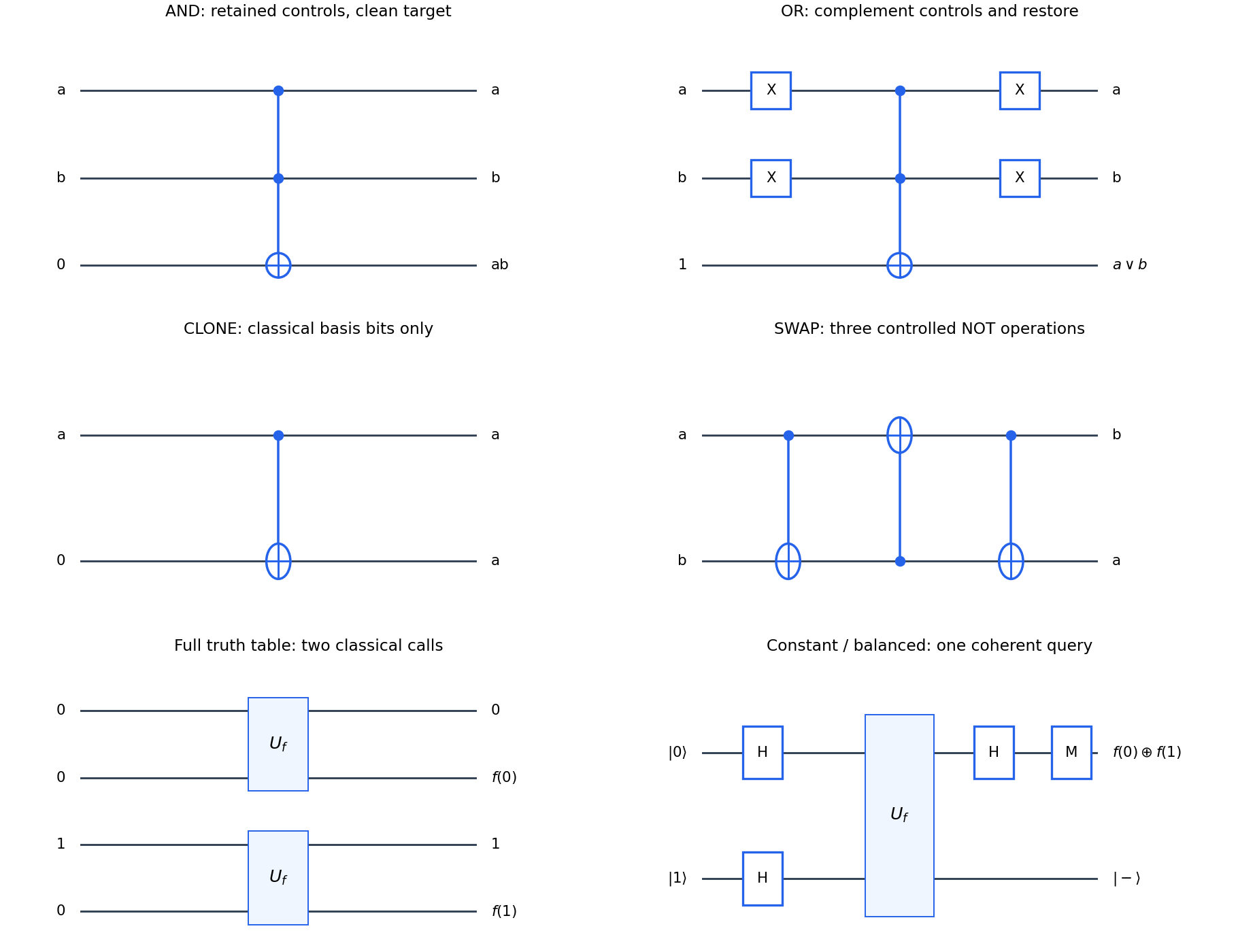
Reversible Boolean constructions and a one-query Deutsch algorithm
. Original circuits for AND, OR, copying a classical bit and SWAP, with retained inputs and initialized targets shown explicitly. The lower panels show two classical oracle queries for the truth table and the phase-kickback quantum network that obtains only its parity in one query. Circuit operations run from left to right. Details.
In the oracle machine model, a function is accessed through a black box whose internal gate cost is excluded; the resource counted is the number of calls. A reversible classical oracle maps basis inputs as . Its quantum oracle extension applies the same permutation coherently to arbitrary superpositions, without measuring its input. A classical random mixture of inputs is not that coherent extension.
Write the two truth-table entries as , . Then , with the four casesTwo classical query circuits, and , recover the whole function with certainty. One call fixes only one entry, leaving two compatible functions; hence two are necessary classically. Randomization cannot remove this obstruction to certainty.
The minimum for full exact function identification remains two even with coherent quantum queries. To see this, expand the oracle target into its eigenstates: it is identity on , and gives phases on . Any one-query input, including an auxiliary system, has orthogonal sector weights , and summing to one. The output overlap between functions differing only at is , so perfect distinction requires ; differing only at likewise requires . Then , but functions differing at both entries have overlap . They are the same ray rather than distinguishable states. Thus one query cannot identify all four functions. The following one-query task recovers only whether the entries agree.
A constant function has , whereas a balanced one has one zero and one one, so . The four oracles require only the following circuits:Prepare , apply a Hadamard gate to each qubit, apply the oracle once, apply another Hadamard gate to the first qubit, and measure that first wire in the computational basis. Immediately before the oracle the state is . The identity gives phase kickback:The output is certainly zero for constant and one for balanced. In circuit terms the target contributes only a global sign, and a controlled with target acts as on the control; then turns that phase into a measured bit. These identities prove the network for all four explicit oracles. The unused sign contains only as a global phase, consistent with the full-identification lower bound.
The quantum bit-flip channel has Kraus operatorsThusThe orthonormal diagonal linear polarizations and are the Pauli X eigenstates. Each is transmitted perfectly as a density operator for every ; the possible minus sign on is global. Encode a classical zero and one as and , then measure in that basis at the receiver. This sends one classical bit per transmitted qubit without error. General superpositions of and need not be preserved, because their relative phase is randomized.
Label the unknown input , Alice's resource photon , and Bob's resource photon . First distribute photon through the channel while keeping photon with Alice; at this leaves the perfect shared Bell state . When the input arrives, the three-qubit state isAlice applies , givingShe next applies , producingThese two gates followed by computational measurement implement a perfect Bell state analyzer. For outcome the normalized conditional state is , with probability . Alice sends the two classical bits ; Bob applies , recovering exactly. Averaging before reception of the bits gives Bob , independent of the input, so this protocol provides no faster-than-light communication.
For , directly sending the original qubit is already perfect. Quantum teleportation therefore has no fidelity advantage in this ideal case and consumes a shared entangled pair plus classical communication. Its operational advantage is that entanglement can be distributed beforehand: once the unknown input appears, only classical information need travel, and the original input photon need not itself propagate to Bob. The Bell measurement consumes the input; it does not create a second copy.
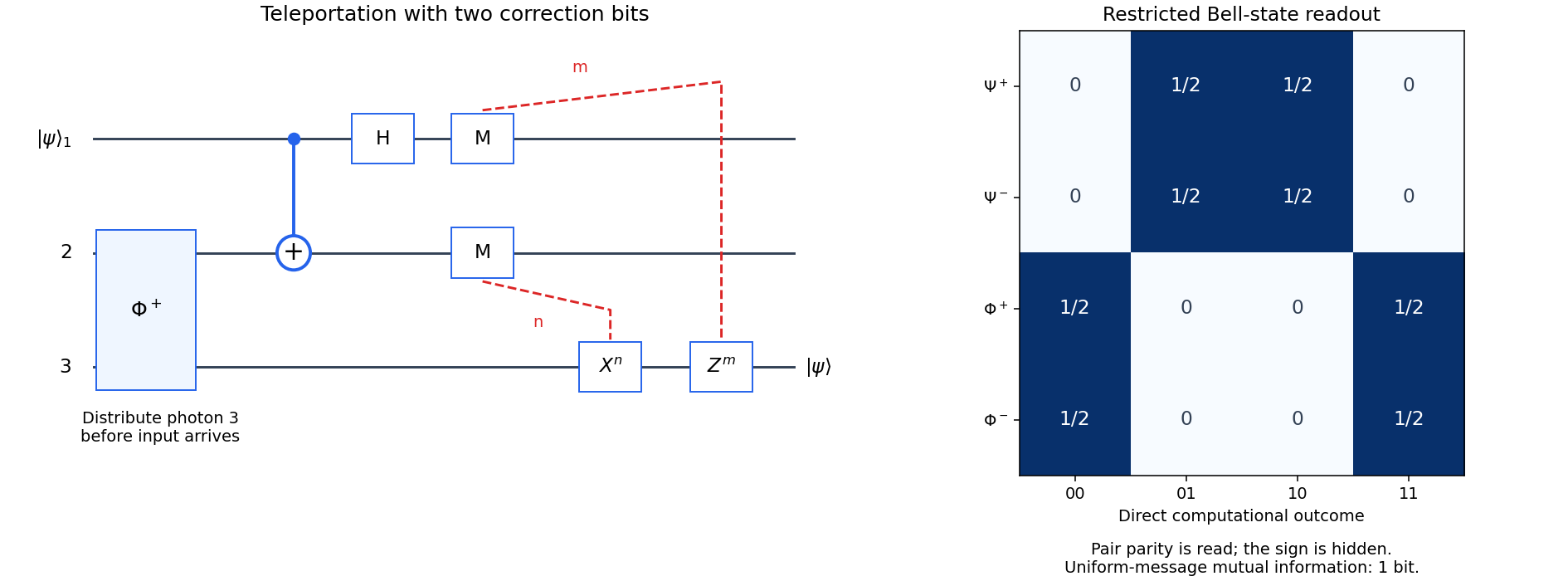
Quantum teleportation corrections and restricted superdense coding readout
. Original teleportation circuit with the distributed resource, two measurement bits and conditional corrections, beside the four Bell-state computational-basis outcome probabilities. The right panel describes direct measurement without a two-qubit Bell decoder, not measurement after an unrestricted decoding circuit. Details.
Use the same protocol: distribute one resource photon through , and send Alice's two classical bits error-free in the alphabet from part a. At the distributed resource isFor the second component Bob has an extra before his conditional correction. Conjugation by that correction changes at most by a sign, which cancels in the density operator. This bit-flipped Bell resource teleportation therefore induces the bit-flip map,Using the squared pure-target quantum fidelity convention,The maximum is precisely for the Pauli X eigenstates . The minimum is whenever , the great circle with zero component of the Bloch vector, including and both circular polarizations. Uniform averaging over pure qubits gives .
The resource-distribution and classical-encoding assumptions are essential. If a perfect shared pair had already been supplied independently and this channel were used only for the robustly encoded classical bits, teleportation would remain perfect even at . Conversely, unprotected transmission of Alice's correction bits would add classical errors. The stated expression applies to the resource sent through the given channel and the error-free classical encoding explicitly available in part a.
Normalization requires , so and . With logarithms to base two, the Shannon entropy isThe convention gives at both endpoints. In the interior,Hence the unique maximum is bits at . The curve is concave and symmetric about .
Choose the message assignment , , and . Starting from , apply respectively to the first qubit. This produces those four orthonormal Bell states, up to a physically irrelevant overall sign in the last case. The ensemble density operator isin computational order , where . The cancellation of off-diagonal terms follows from the equal probabilities within each sign pair; the individual encoded states remain entangled.
A Bell basis measurement reads the label perfectly because the four code states are orthogonal. Thus this is equivalent to a classical error-free encoding when unrestricted joint measurement is allowed. Each conditional encoded state is pure, soThe second formula is the classical-quantum mutual information, here equal to attainable classical information. The first says there is no uncertainty about the joint pure code state once the message is known; it does not say that measuring its individual qubits has deterministic outcomes.
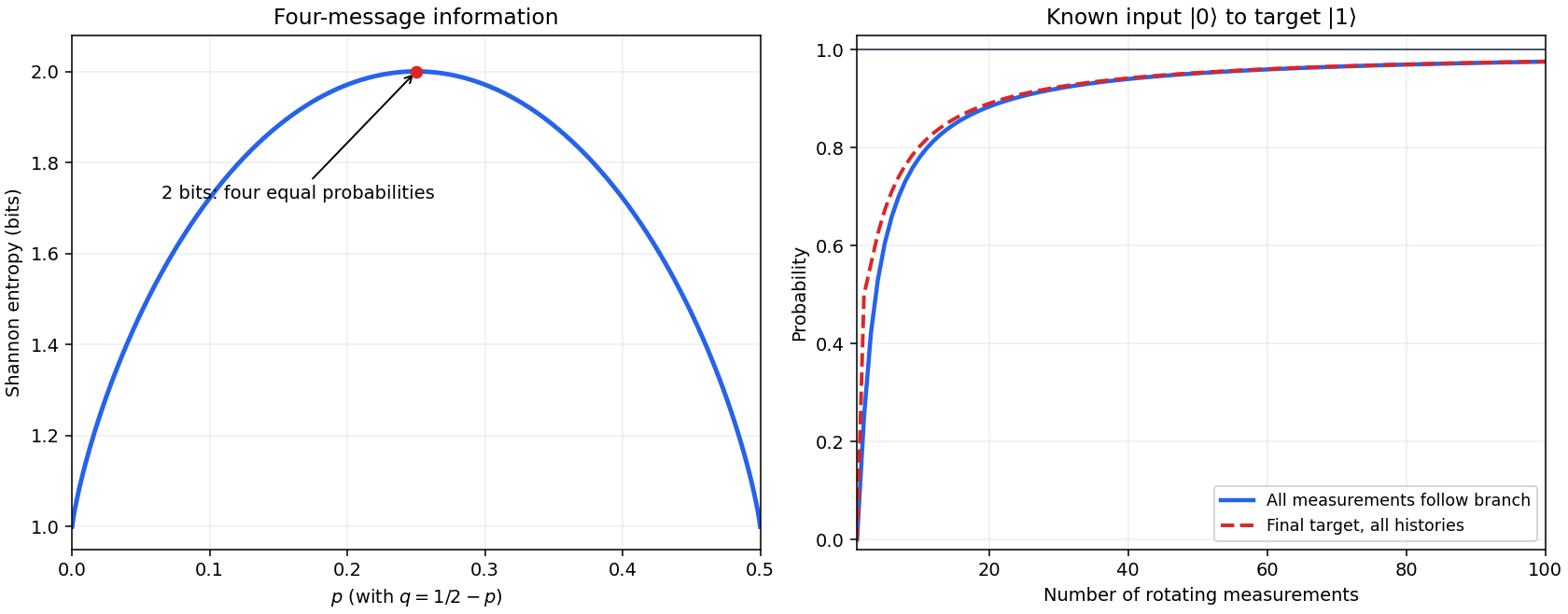
Message Shannon entropy and measurement-guided state transfer
. Original theoretical curves: for the specified four-message distribution, and finite-step Zeno transfer probabilities for a known initial basis state. The conditioned all-following probability and the unconditioned final-target probability differ at finite step count but both tend to one. Details.
In superdense coding, Alice and Bob initially share . Alice selects the same one-qubit Pauli gate according to her message and sends her single encoded qubit to Bob. He now has both halves and measures in the Bell basis. For the chosen assignment,which reaches two bits for the uniform distribution. A circuit implementation first converts the resource convention with , then applies and , and measures both in the computational basis. The four outcomes are distinct; relabeling them restores the selected message order.
Before Alice's transmission, Bob's reduced density operator is for every choice of her local operation. Thus distributing the message-independent entangled resource has transmitted no information about the subsequently chosen message. It is nevertheless a real physical resource: the two-bit rate counts the one additional transmitted qubit after entanglement has been shared, not a free initial distribution. The deterministic conditional probabilities above establish perfect correlation rather than merely matching output and input entropies.
Interpret the imposed measurement restriction as direct measurement of the encoded two-qubit Bell state in the computational basis, without a preceding entangling Bell decoder. For the uniform messages the conditional probabilities areEach outcome has probability , so bits, while bit. ThereforeThe outcome reveals even versus odd parity, but none of the plus/minus label. Each outcome is compatible with two equally probable messages.
Now insert an arbitrary single-qubit unitary operator on one wire immediately before measurement. Measuring that wire is equivalent to measuring along a Bloch vector , with the other wire still measured along . All four Bell states have zero local means, and , whereas for and for . HenceThe sign within each pair is still inaccessible, andIt stays one for a computational-axis measurement, but a Hadamard gate makes and reduces it to zero. Thus a single local gate can change the information, by reducing it, and cannot increase it above one bit.
There is an important scope qualification: if Bob is allowed the full two-qubit decoder from part b before his final computational measurement, those measurements already identify all four messages and give two bits. The one-bit result refers to restricting the Bell readout itself to product computational measurements. Merely specifying the final detector basis without restricting the decoder would not impose that one-bit limit.
Articles by others on the same topic
There are currently no matching articles.