Label the unknown input , Alice's resource photon , and Bob's resource photon . First distribute photon through the channel while keeping photon with Alice; at this leaves the perfect shared Bell state . When the input arrives, the three-qubit state isAlice applies , givingShe next applies , producingThese two gates followed by computational measurement implement a perfect Bell state analyzer. For outcome the normalized conditional state is , with probability . Alice sends the two classical bits ; Bob applies , recovering exactly. Averaging before reception of the bits gives Bob , independent of the input, so this protocol provides no faster-than-light communication.
For , directly sending the original qubit is already perfect. Quantum teleportation therefore has no fidelity advantage in this ideal case and consumes a shared entangled pair plus classical communication. Its operational advantage is that entanglement can be distributed beforehand: once the unknown input appears, only classical information need travel, and the original input photon need not itself propagate to Bob. The Bell measurement consumes the input; it does not create a second copy.
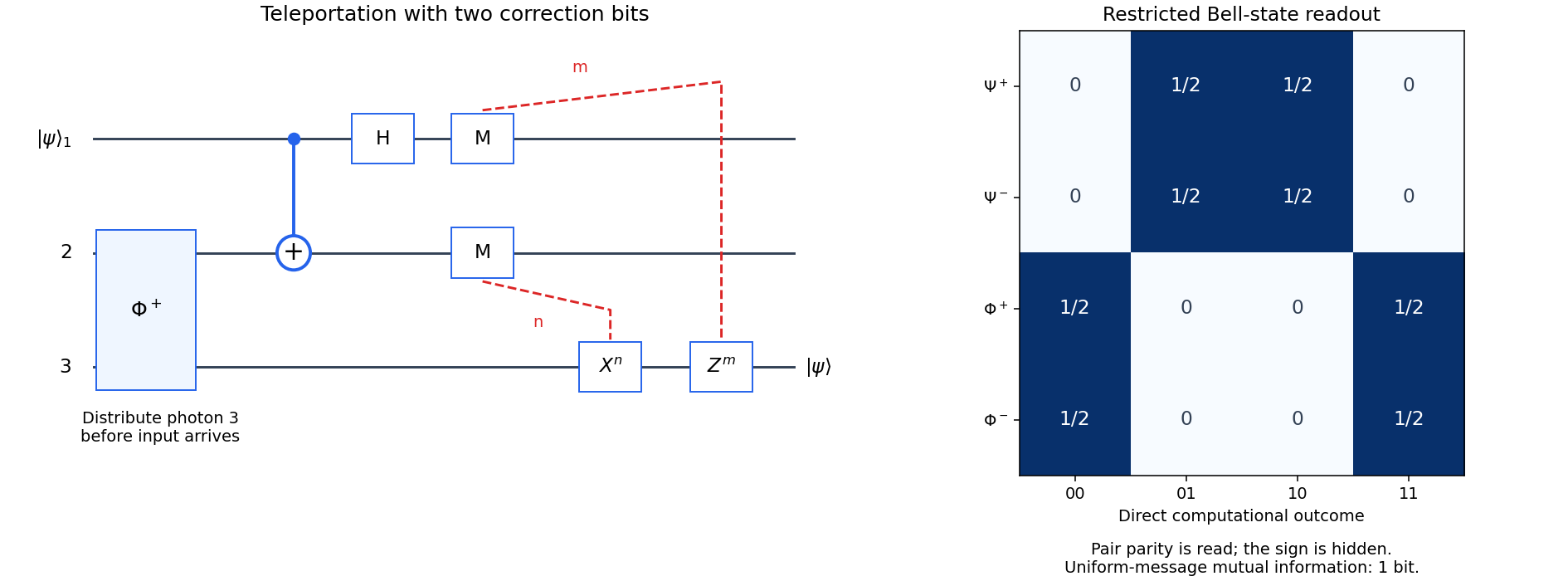
Quantum teleportation corrections and restricted superdense coding readout
. Original teleportation circuit with the distributed resource, two measurement bits and conditional corrections, beside the four Bell-state computational-basis outcome probabilities. The right panel describes direct measurement without a two-qubit Bell decoder, not measurement after an unrestricted decoding circuit. Details.
Articles by others on the same topic
There are currently no matching articles.