The quantum bit-flip channel has Kraus operatorsThusThe orthonormal diagonal linear polarizations and are the Pauli X eigenstates. Each is transmitted perfectly as a density operator for every ; the possible minus sign on is global. Encode a classical zero and one as and , then measure in that basis at the receiver. This sends one classical bit per transmitted qubit without error. General superpositions of and need not be preserved, because their relative phase is randomized.
Label the unknown input , Alice's resource photon , and Bob's resource photon . First distribute photon through the channel while keeping photon with Alice; at this leaves the perfect shared Bell state . When the input arrives, the three-qubit state isAlice applies , givingShe next applies , producingThese two gates followed by computational measurement implement a perfect Bell state analyzer. For outcome the normalized conditional state is , with probability . Alice sends the two classical bits ; Bob applies , recovering exactly. Averaging before reception of the bits gives Bob , independent of the input, so this protocol provides no faster-than-light communication.
For , directly sending the original qubit is already perfect. Quantum teleportation therefore has no fidelity advantage in this ideal case and consumes a shared entangled pair plus classical communication. Its operational advantage is that entanglement can be distributed beforehand: once the unknown input appears, only classical information need travel, and the original input photon need not itself propagate to Bob. The Bell measurement consumes the input; it does not create a second copy.
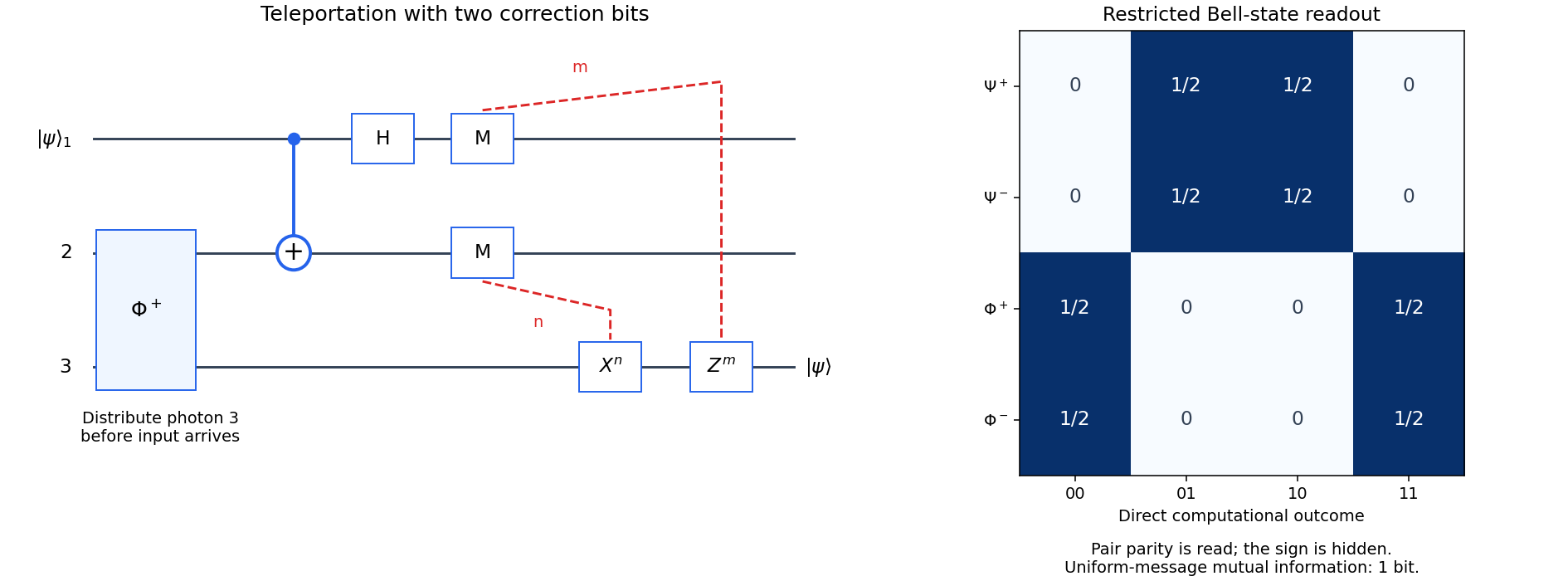
Quantum teleportation corrections and restricted superdense coding readout
. Original teleportation circuit with the distributed resource, two measurement bits and conditional corrections, beside the four Bell-state computational-basis outcome probabilities. The right panel describes direct measurement without a two-qubit Bell decoder, not measurement after an unrestricted decoding circuit. Details.
Use the same protocol: distribute one resource photon through , and send Alice's two classical bits error-free in the alphabet from part a. At the distributed resource isFor the second component Bob has an extra before his conditional correction. Conjugation by that correction changes at most by a sign, which cancels in the density operator. This bit-flipped Bell resource teleportation therefore induces the bit-flip map,Using the squared pure-target quantum fidelity convention,The maximum is precisely for the Pauli X eigenstates . The minimum is whenever , the great circle with zero component of the Bloch vector, including and both circular polarizations. Uniform averaging over pure qubits gives .
The resource-distribution and classical-encoding assumptions are essential. If a perfect shared pair had already been supplied independently and this channel were used only for the robustly encoded classical bits, teleportation would remain perfect even at . Conversely, unprotected transmission of Alice's correction bits would add classical errors. The stated expression applies to the resource sent through the given channel and the error-free classical encoding explicitly available in part a.
Articles by others on the same topic
There are currently no matching articles.