A longitudinal mode makes an integer round-trip phase accumulation. For the same transverse mode and an empty nondispersive cavity, increasing that integer by one changes the optical frequency by the free spectral rangeFrequency-dependent mirror phases or a dispersive intracavity medium would change the round-trip group delay used here.
For a paraxial ray, use the height-slope column . Free propagation and reflection from a concave mirror are represented, in unfolded coordinates, byThe reflection changes the slope by . Because the mirrors are identical, the same half-round-trip matrix is applied repeatedly:Its two eigenvalues are reciprocal. They lie on the unit circle without a growing component when , whereas gives a real eigenvalue of modulus greater than one. At , the repeated eigenvalue has a nontrivial Jordan block and generic rays drift out. Thus the nondegenerate stable interval isThe confocal value is included: there , so the repeated round trip is bounded. Applying a strict trace inequality to the full-round-trip matrix without checking this exact matrix would incorrectly discard that point. These are the paraxial conditions for a symmetric concave-mirror resonator.
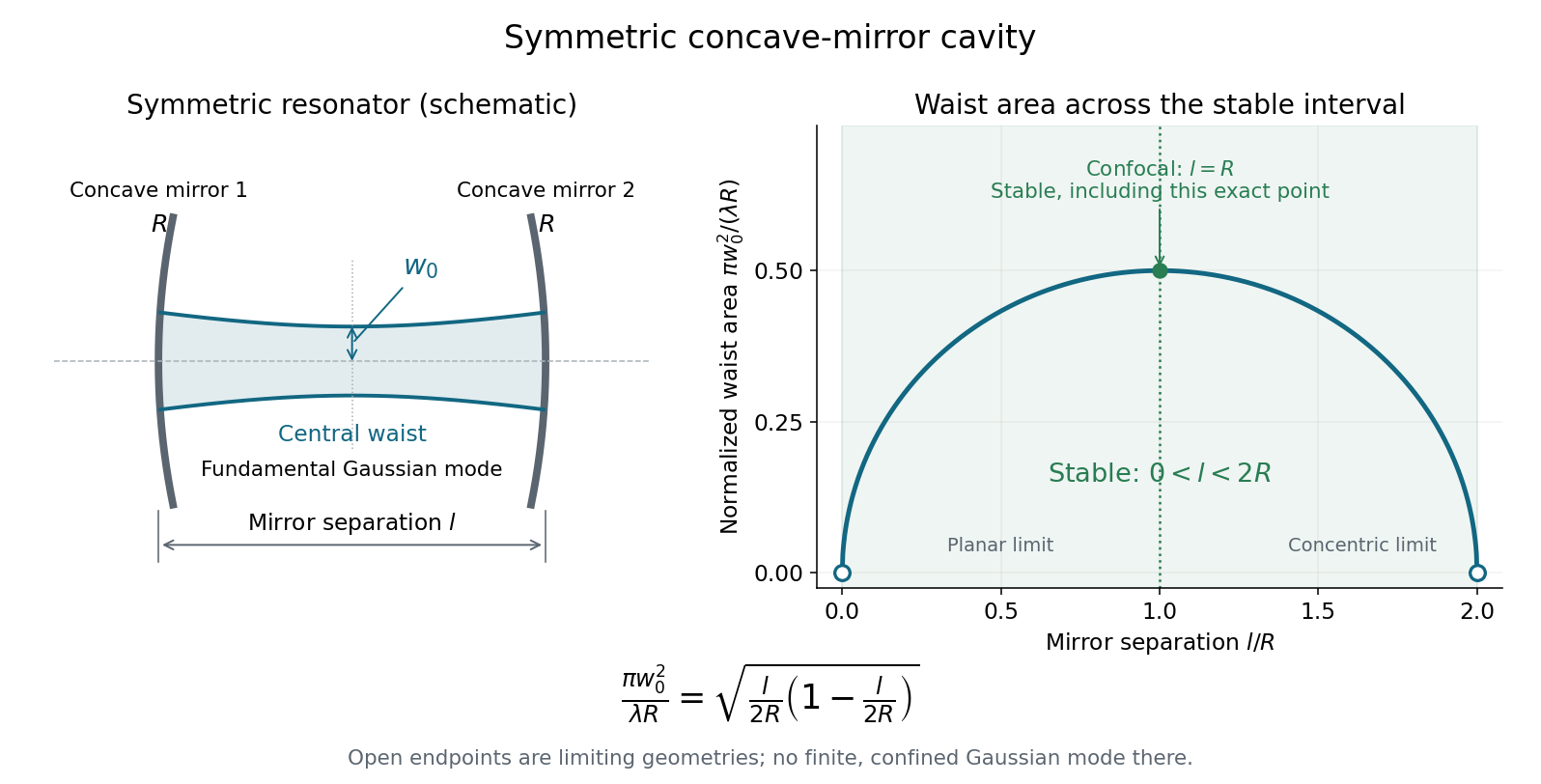
Symmetry places the Gaussian beam waist halfway between the mirrors. Its Rayleigh range is , and its wavefront radius at distance from the waist is . Matching that wavefront to the mirror at givesHenceA real positive Rayleigh range requires the same stable interval. At its limiting geometries the finite confined Gaussian mode degenerates; the formula is not a way to realize an arbitrarily small physical waist without leaving the paraxial model.

Articles by others on the same topic
There are currently no matching articles.