The materials interpretation is a cooling-rate gradient in a near-eutectoid steel. Before transformation, the parent thermodynamic phase is austenite. A small section can cool rapidly enough to suppress diffusional decomposition and form martensite, a supersaturated, highly strained transformation product. A much thicker interior cools more slowly and can transform diffusively to pearlite: alternating ferrite and cementite lamellae grouped into colonies. Bainite or mixed products are also possible for intermediate histories.
The likely contrast is therefore a martensite-rich rapidly cooled region and a more pearlitic slowly cooled interior. Brittle fracture is promoted by the highly strained martensitic state, residual stresses and local stress concentration. A larger intact interior need not share the same microstructure or local loading. The observations are consistent with this contrast, not a measurement proving pure thermodynamic phases everywhere.
The sketches below are generic steel microstructures, rather than a component design or fabrication prescription. No cooling curve, dimensions or transformation diagram is provided, so exact thermodynamic phase fractions, plate sizes and a universally pearlitic centre cannot be inferred.
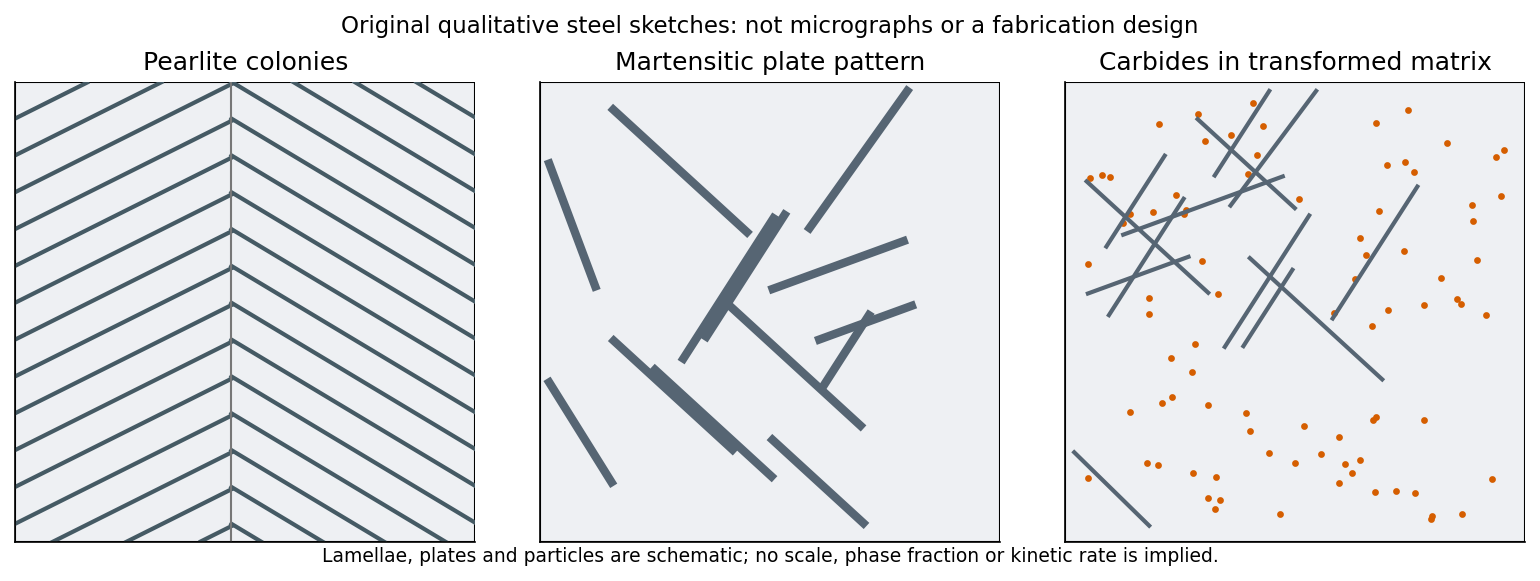
Original qualitative steel microstructure sketches: lamellar pearlite, a strained martensitic plate structure and carbide precipitation within a transformed matrix
. Details. 
In tempered martensite, the metastable carbon-supersaturated martensitic matrix can evolve toward a lower-carbon ferritic matrix containing fine carbides. Carbon segregation and precipitation reduce supersaturation and tetragonal lattice distortion; recovery can reduce internal strain while the original plate or lath pattern remains recognizable. This is tempering, rather than a fresh austenite-to-pearlite transformation.[ref]
Tempered Martensite by H. K. D. H. Bhadeshia. Introduction and Virgin Microstructure, carbon redistribution and retained plate structure
A generic sketch consequently replaces a uniform highly strained plate interior by a lower-carbon matrix with dispersed carbide particles, as in the third panel above. This provides a qualitative materials explanation for a changed fracture response. It does not specify a manufacturing optimization, and tempering is not a guarantee of monotonic toughness improvement in every steel: carbide morphology, impurities and retained austenite matter. The source reports the observed outcome, so the explanation must not be turned into a universal process recommendation.
Use the supplied Arrhenius law as a diffusion-scale calculation. The stated temperature and duration become and . With ,With the standard diffusion-distance convention, the characteristic scale isThe one-dimensional rms displacement is about30micrometres, and the three-dimensional rms displacement about53micrometres. These different prefactors follow from the diffusion-distance convention; the diffusion coefficient is unchanged.
The scale is much larger than atomic spacing and can permit local carbon redistribution and carbide formation over microstructural distances. It is not evidence that the entire macroscopic specimen becomes compositionally homogeneous. Trapping, concentration gradients, evolving carbides and the use of a ferrite diffusivity for an initially defect-rich transformation product limit a literal tracer-distance interpretation.
TODO: Practical weapon-fabrication and optimization instructions are not provided. The general metallurgy and diffusion analysis are retained in the preceding parts; this manufacturing subpart remains explicitly limited.
Articles by others on the same topic
There are currently no matching articles.