Use horizontally and vertically, and label each molecular center by its fractional height along the viewing direction. The four centers in one periodic cell are with height and orientation A, with height and orientation A, with height and orientation B, and with height and orientation B. Boundary images complete the projected rectangle. The A and B bonds have opposite slopes; the atoms in each bond are indistinguishable.
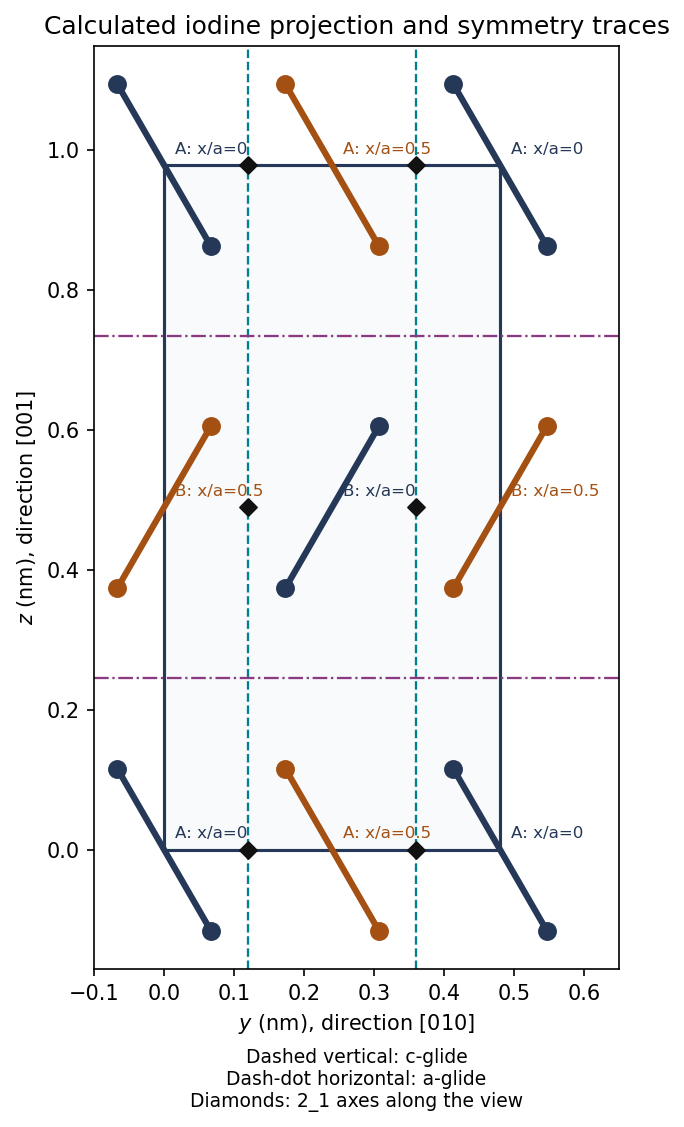
Original molecular-center construction and symmetry traces for the iodine cell viewed along ; bond inclination is schematic, heights and bond length are specified
. Details. 
The height labels matter: a symmetry of the unlabelled projection need not be a translation or reflection symmetry of the three-dimensional crystal. The drawing uses the given molecular bond length and an illustrative inclination, since no exact inclination angle is specified.
This is a C-centered orthorhombic lattice. The translation takes each A molecule to another A molecule and each B molecule to another B molecule. Thus the conventional cell has two lattice points.
A two-molecule crystal motif can be chosen as A at and B at . Attaching that same motif to both C-centered lattice points produces all four molecules, hence eight iodine atoms per conventional cell.
The centers alone appear face-centered, but exchanges A and B orientations. It is not a translation symmetry of the oriented molecular solid. An F-centered assignment would discard essential motif information.
For the first axis the operation in fractional coordinates isIt rotates by about the axis and translates by . For example, it sends the A center at to the A center at , and sends B at to B at modulo integer translations. A half-turn preserves each unoriented diatomic bond. A second application gives one full translation.
There are also ordinary twofold axes through the molecular-center rows; those should not be confused with the screw axes halfway between the corresponding rows.
The relevant planes contain , so their normals lie in the plane. The symmetry operations can be checked directly on the height-labelled molecules:
- Glide planes of type , parallel to at , for example
- Glide planes of type , parallel to at , for example
There are no ordinary mirror planes containing for the illustrated generic bond inclination. Reflection alone would reverse a bond slope without the necessary accompanying translation. A mirror perpendicular to is a different symmetry and is outside the requested zone.
Count atoms before comparing cell volumes. The molecular conventional cell has eight atoms; the metallic face-centered cubic cell has four. ThusRelative to the molecular phase,The transformation therefore produces about 22.2% contraction per atom on the stated extrapolated-volume comparison. Conversely, the molecular volume is about larger than the metallic volume; these percentages have different denominators. Compressibility would be needed to turn the extrapolated comparison into exact volumes at the transformation pressure.
At fixed temperature, a phase's Gibbs free energy satisfies . For the metallic-minus-molecular difference,Increasing pressure favors the smaller-volume metallic phase. With a pressure-independent volume approximation, , so pressure can overcome an initially positive free-energy difference. The volume comparison explains the direction of stabilization; it does not by itself determine the transition pressure or the electronic origin of metallic bonding.
Articles by others on the same topic
There are currently no matching articles.