Take for the unresolved iron doublet. The underlying tabulated and wavelengths are approximately and .[ref]
X-ray wavelengths and X-ray atomic energy levels by J. A. Bearden. Table V, iron entries; physical PDF page17
Using the inferred , Bragg's law gives the following approximate cone angles:The exact angles inherit the lattice-parameter uncertainty. Five reflection families are kinematically possible with this longer wavelength: . The next FCC family, 400, cannot satisfy Bragg's law.
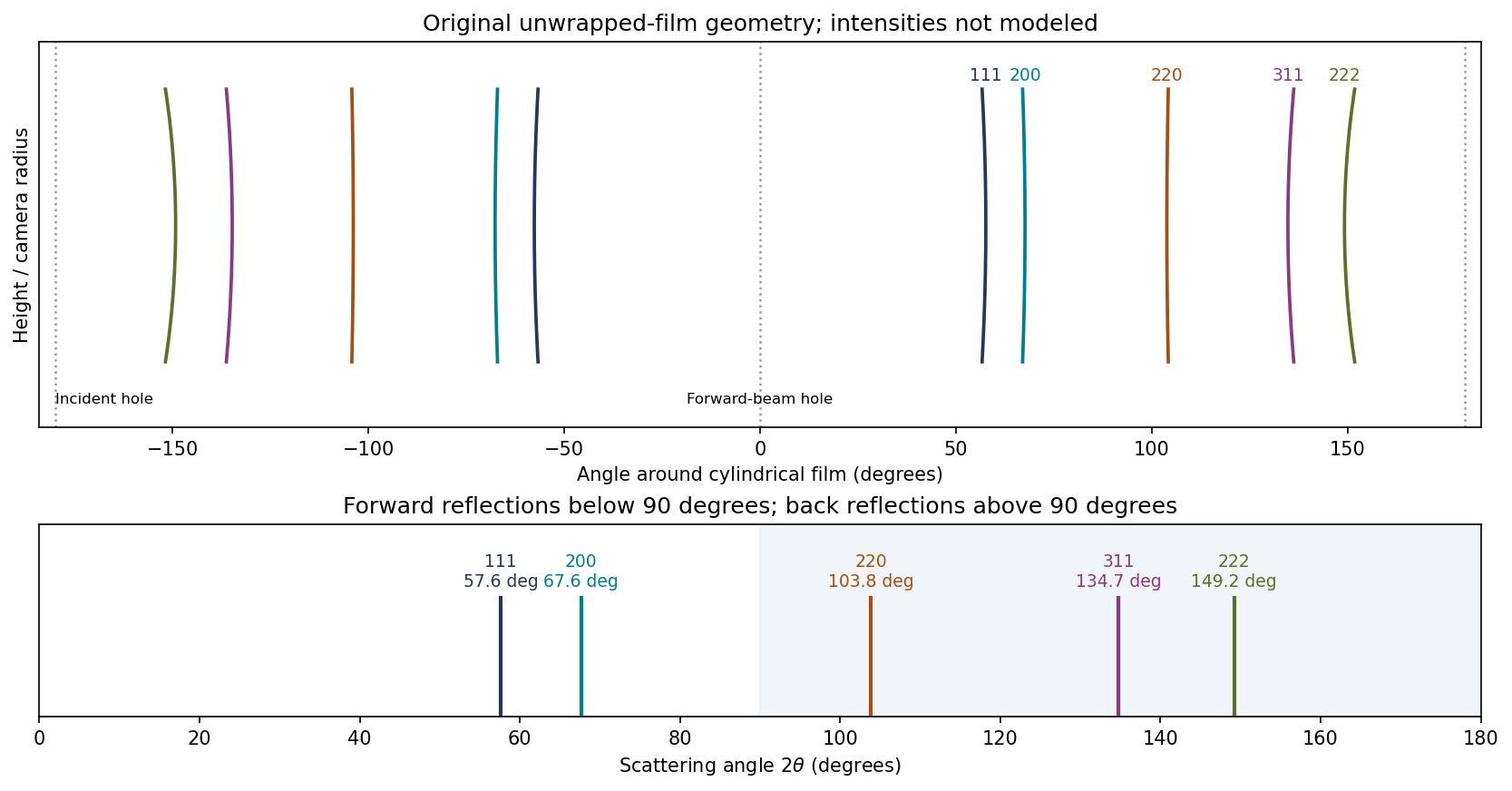
Original calculated Fe cone intersections on unwrapped cylindrical film; angular positions use the measured lattice estimate, line intensities are schematic
. Details. 
A cylindrical Debye-Scherrer camera records paired curved lines where each diffraction cone intersects the film. Both forward and backward cones can be intercepted. The last three families are back reflections here, unlike the rings recorded on the original forward flat plate. Film position is proportional to camera angle along the equatorial circumference, rather than to ; the incident and transmitted beam holes must also be distinguished from reflections. A sufficiently resolved exposure may separate the characteristic doublet, but the schematic does not claim to predict line intensities.
Articles by others on the same topic
There are currently no matching articles.