Measure ring centers and radii against the printed scale, rather than comparing raw squared radii. A representative reading of the four rings is , with broad photographic lines. For a flat plate at distance ,With the ratios are approximately , givingFor identical atoms at the four conventional FCC positions,The structure factor is for indices all even or all odd, and zero for mixed parity. Thus, for example, 100, 110 and 210 are systematic absences. The allowed squared-index sums begin . Only the first four rings fit within the displayed field; 222 and later allowed reflections are not forbidden merely because they are outside the image. The central shadow and its holder are not extra diffraction peaks.
Take for the unresolved iron doublet. The underlying tabulated and wavelengths are approximately and .[ref]
X-ray wavelengths and X-ray atomic energy levels by J. A. Bearden. Table V, iron entries; physical PDF page17
Using the inferred , Bragg's law gives the following approximate cone angles:The exact angles inherit the lattice-parameter uncertainty. Five reflection families are kinematically possible with this longer wavelength: . The next FCC family, 400, cannot satisfy Bragg's law.
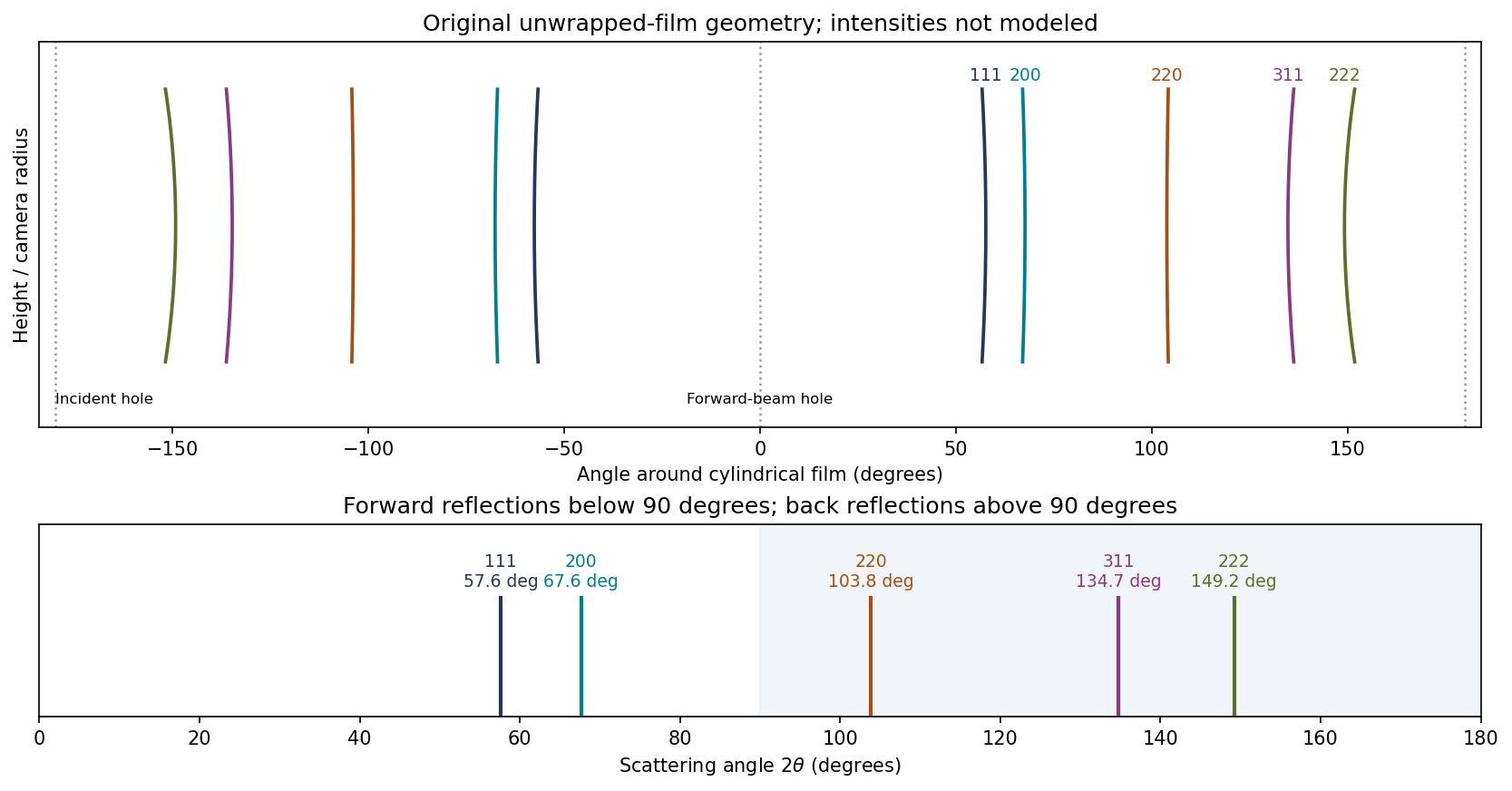
Original calculated Fe cone intersections on unwrapped cylindrical film; angular positions use the measured lattice estimate, line intensities are schematic
. Details. 
A cylindrical Debye-Scherrer camera records paired curved lines where each diffraction cone intersects the film. Both forward and backward cones can be intercepted. The last three families are back reflections here, unlike the rings recorded on the original forward flat plate. Film position is proportional to camera angle along the equatorial circumference, rather than to ; the incident and transmitted beam holes must also be distinguished from reflections. A sufficiently resolved exposure may separate the characteristic doublet, but the schematic does not claim to predict line intensities.
For any indexed cubic reflection,Use for the unresolved molybdenum doublet; the tabulated components are approximately and . These are external spectral constants, not an assertion about the unavailable historical Data Book.[ref]
X-ray wavelengths and X-ray atomic energy levels by J. A. Bearden. Table V, molybdenum entries; physical PDF page19
Reading broad ring centers in the supplied image more closely gives representative radii . Their corresponding estimates are about . Their small scatter understates possible common scale and camera-distance errors. In particular,for a first-order signed perturbation; independent uncertainties are combined in quadrature instead. A reading uncertainty of order , plus the printed-scale and setup uncertainty, justifies a deliberately modest precision:Nickel is a plausible identification, since it is FCC with room-temperature edge about .[ref]
Thermal expansion of nickel and iron, and the influence of nitrogen on the lattice parameter of iron at the Curie temperature by Jinn-Wen Hwang. Abstract, pure-nickel lattice parameter at25°C
The source photograph alone does not chemically identify the specimen; nearby elemental lattice constants and the scale uncertainty preclude a rigorous unique assignment. The estimate is not reported with artificial precision inherited from pixel fitting. Articles by others on the same topic
There are currently no matching articles.