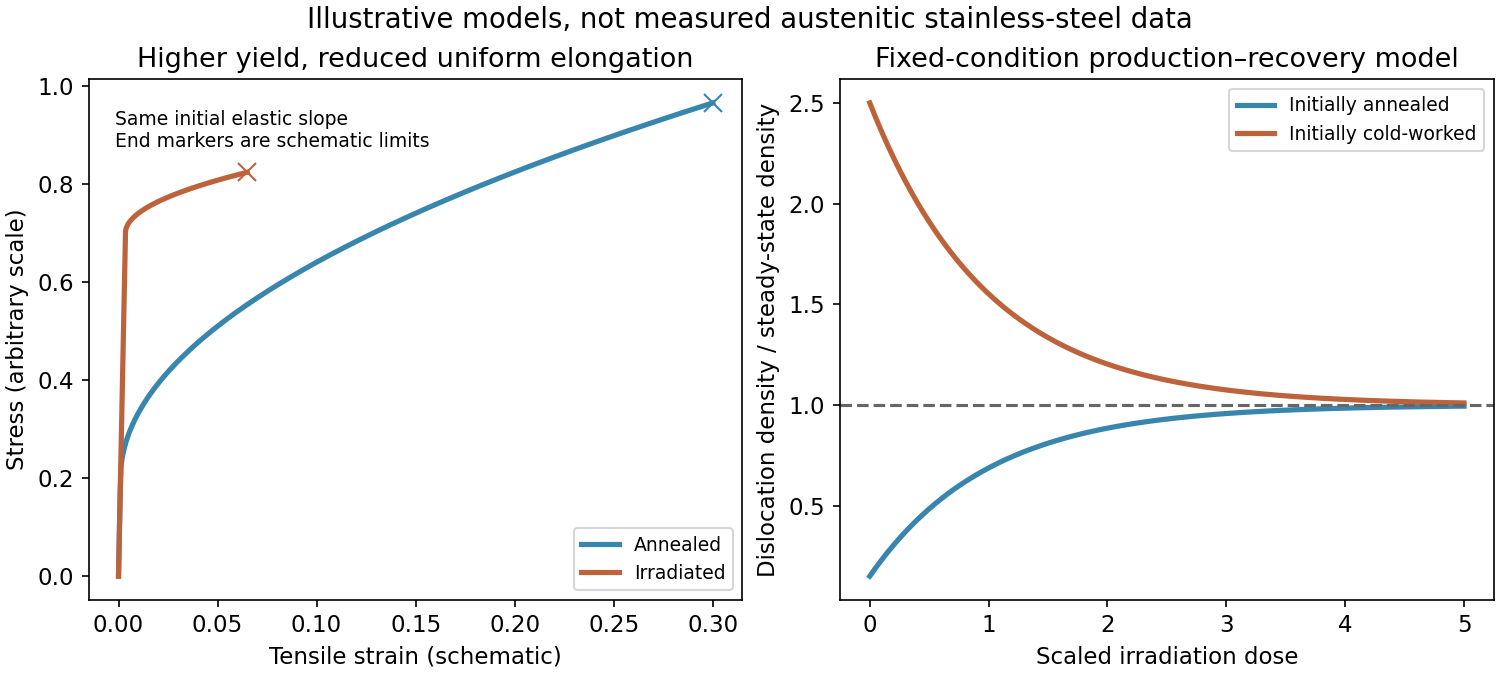
The annealed sample initially has relatively few obstacles to dislocation glide. After its elastic response it yields, undergoes appreciable plastic deformation and develops strain hardening. Irradiation produces dislocation loops and defect clusters that obstruct gliding dislocations, usually raising the yield strength. In a simple dispersed-obstacle model the strengthening scales as , with obstacle density and diameter .
Irradiated material often has less uniform plastic elongation and weaker subsequent hardening because slip localizes into channels that have cleared irradiation obstacles. Earlier necking or fracture can then reduce ductility. The elastic slope is much less affected than the yield stress in this schematic comparison; the exact strength and elongation depend on dose and temperature.

Articles by others on the same topic
There are currently no matching articles.