The nuclear fuel supplies nuclei whose nuclear fission releases energy. Most of that energy becomes heat in the fuel and neighbouring material. The reactor transfers this heat to a working fluid; the fuel's chemical form and geometry must also remain compatible with its thermal and irradiation environment.
Nuclear fuel cladding separates the fuel and most fission products from the coolant, provides mechanical containment, and transfers heat across the fuel boundary. It must retain useful mechanical integrity and corrosion resistance during irradiation while avoiding excessive neutron absorption.
Control rods absorb neutrons. Changing their insertion changes the neutron balance and hence reactor reactivity; sufficiently strong insertion makes the chain reaction subcritical. They provide control and shutdown functions. Continued decay heat means that shutdown does not remove the need for cooling.
The coolant removes heat from the fuel region and carries it to a heat exchanger or directly to a turbine system. It can also act as a neutron moderator in some reactor types, but cooling and moderation are distinct functions and need not be performed by the same material.
Energetic neutron collisions create displacement cascades and Frenkel pairs: displaced atoms become self-interstitials, leaving vacancies. During migration, some opposite defects recombine, while others cluster or reach sinks. Interstitials can condense into extra atomic planes bounded by dislocation loops; vacancy clustering can instead give missing-plane loops. Their subsequent growth is driven by defect absorption and dislocation climb.
Randomly oriented loops do not select a macroscopic shear direction in an initially isotropic polycrystal. That does not prove that every external dimension remains unchanged: interstitial and vacancy loops have opposite relaxation-volume contributions, and an imbalance can change the volume. Macroscopic void swelling requires the additional vacancy-cavity mechanism; it must not be identified automatically with the mere presence of loops. Texture, stress-biased absorption and unequal loop populations can also give anisotropic dimensional change.
The annealed sample initially has relatively few obstacles to dislocation glide. After its elastic response it yields, undergoes appreciable plastic deformation and develops strain hardening. Irradiation produces dislocation loops and defect clusters that obstruct gliding dislocations, usually raising the yield strength. In a simple dispersed-obstacle model the strengthening scales as , with obstacle density and diameter .
Irradiated material often has less uniform plastic elongation and weaker subsequent hardening because slip localizes into channels that have cleared irradiation obstacles. Earlier necking or fracture can then reduce ductility. The elastic slope is much less affected than the yield stress in this schematic comparison; the exact strength and elongation depend on dose and temperature.
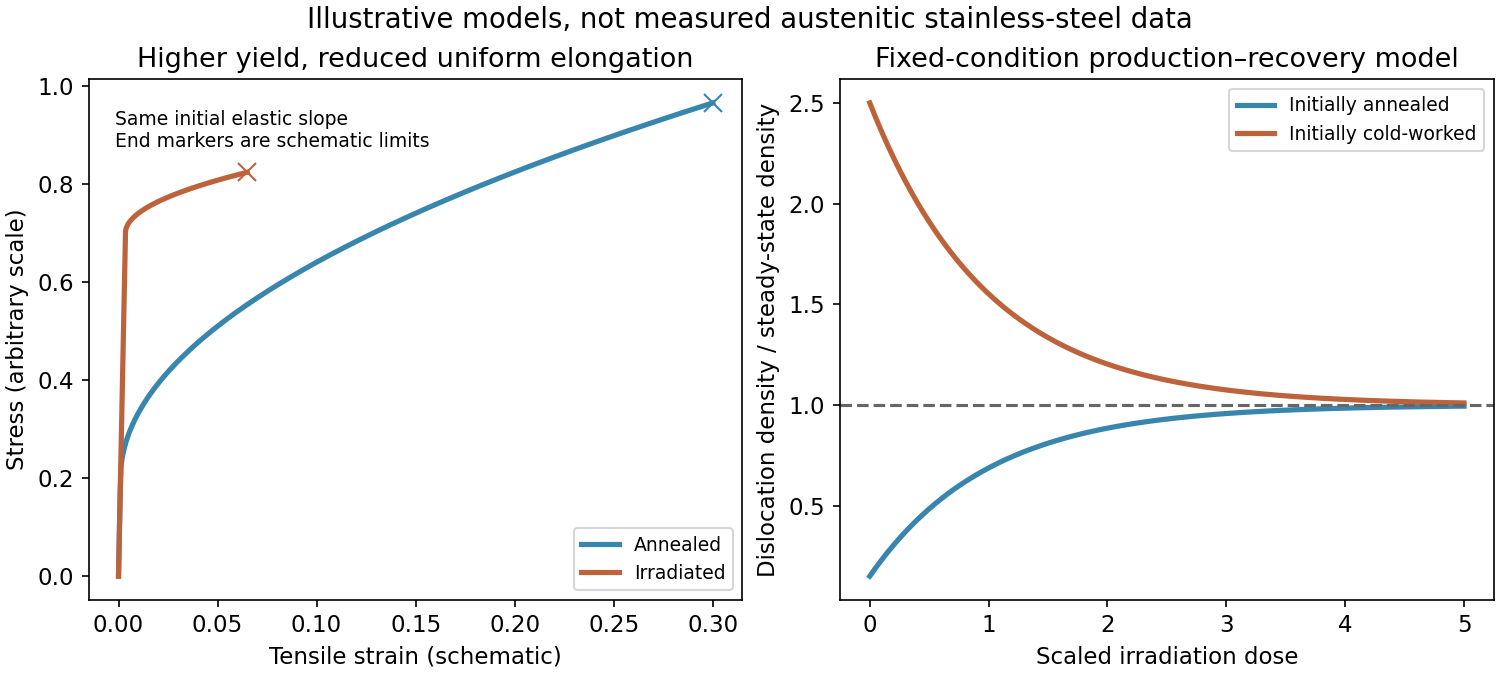

Irradiation both creates dislocation loops and supplies mobile point defects that allow existing dislocations to climb, rearrange and annihilate. At low initial dislocation density, net production can dominate; at high initial density, sink absorption and recovery can dominate. A simple illustrative rate equation isThus both initial states approach in this fixed-condition model. Here is irradiation dose, not a diffusion coefficient. The asymptote reflects a dynamic balance, not the cessation of damage. It need not be the same for different alloys, temperatures, dose rates or applied stresses.
Articles by others on the same topic
There are currently no matching articles.