The original printed labels are retained; biological question 7 is deferred.
In crystal polymorphism, the same chemical composition has different crystal structures; for an chemical element, this is a form of allotropy. Diamond has a three-dimensional tetrahedral network of covalent bonds, giving high hardness and a wide band gap. Graphite has strongly bonded planar sheets, with weaker interactions between sheets. Sliding between sheets makes it a useful solid lubricant; mobile electronic states give good electrical conduction within the sheets. Their different properties come from different bonding and structures, despite both being carbon.
Barium titanate has a high-temperature cubic perovskite structure, with Ti centred in its oxygen octahedron on average. This phase is paraelectric. Near room temperature the structure is tetragonal, with relative ionic displacements that give a spontaneous electric polarization. This phase is ferroelectric: an applied electric field can switch between differently polarized domains. Both phases have the same composition, BaTiO; the transition near changes crystal symmetry and electrical response.
The zinc blende structure has an FCC sulfur sublattice and zinc on half its tetrahedral sites. One conventional unit cell uses S at and Zn at those positions displaced by , reduced modulo one. The wurtzite structure has ABAB sulfur layers, instead of ABCABC layers. One hexagonal-cell convention uses S at and Zn at , with ideal . Looking along superposes S and Zn in that latter coordinate convention; the height labels distinguish them.
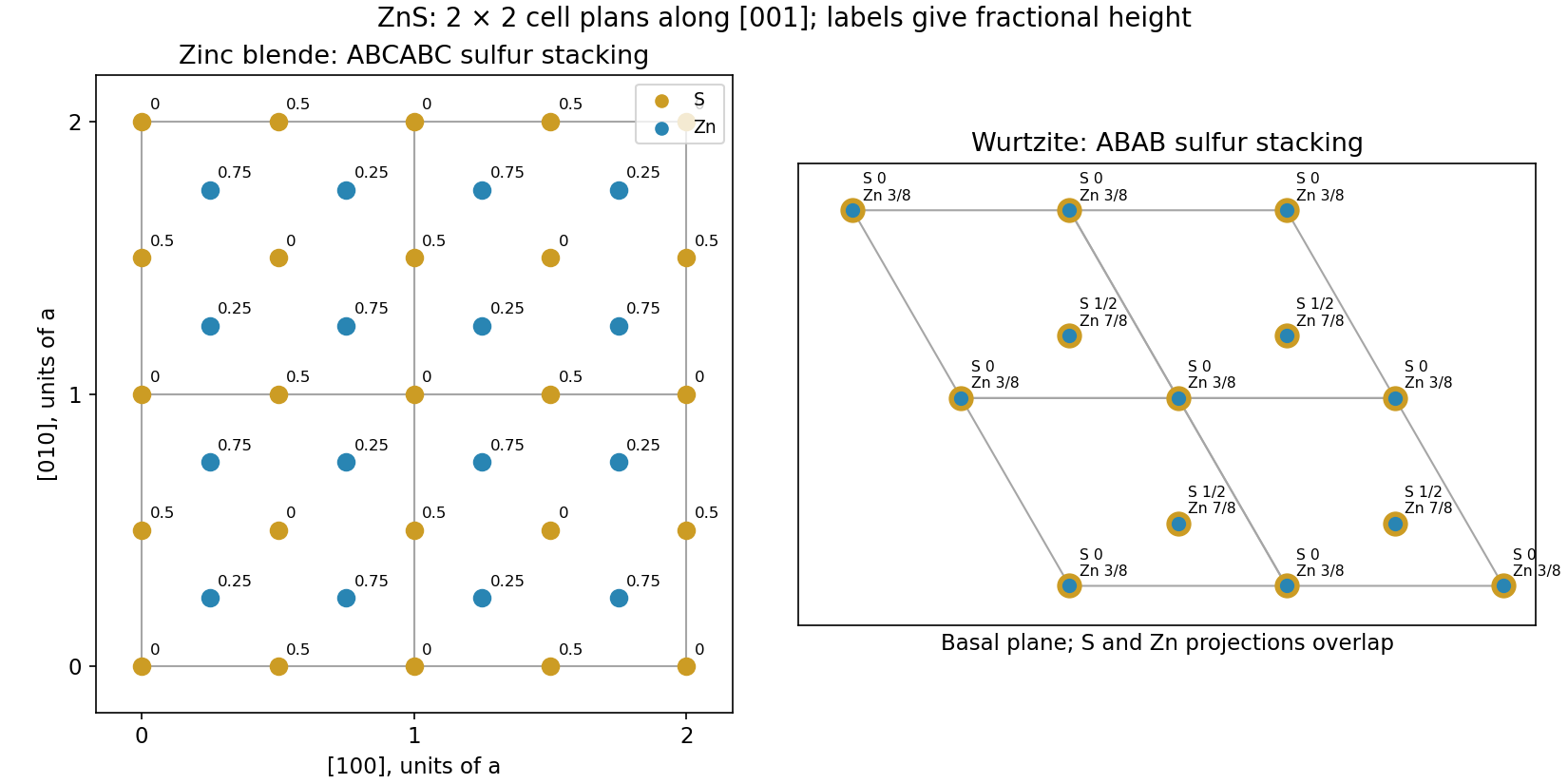
Two-by-two zinc sulfide unit-cell projections along the stacking axes
. Original coordinate constructions. Heights are fractional coordinates along the viewing axis. The hexagonal plan uses basal vectors at 120 degrees. Details.
The closest-packed sulfur planes are , with four distinct plane orientations, for zinc blende structure, and , with one orientation, for wurtzite structure. Opposite normals describe the same unoriented plane orientation. Hexagonal four-index notation writes the latter basal family as .
The solid trace is wurtzite; the dashed trace is zinc blende. The isolated strong dashed peak is the cubic reflection. The solid trace has hexagonal , and reflections in this angular interval; its central peak is the one at , while cubic occurs at . These assignments are consistent with the absence of lower-angle reflections.
In the ideal close-packed model, the cubic and hexagonal reflections probe the same local alternating layer geometry. Their scattering strength per suitably normalized amount of material and their angular factors are therefore very similar, but powder diffraction multiplicity differs: the cubic family has eight directed normals, while hexagonal has two. This explains the approximately fourfold greater intensity of the dashed peak. Comparing unnormalized conventional-cell structure factors alone would be misleading because the cells contain different numbers of formula units. Peak heights additionally depend on line widths; the multiplicity argument applies most directly to integrated intensities.
Taking Cu K wavelength , Bragg's law gives . For cubic , and the nearest Zn–S separation is . For ideal wurtzite structure, and the nearest separation is . ThereforeBoth have tetrahedral nearest-neighbour coordination number four, but different further-neighbour stacking and lattice relaxation can shift their equilibrium bond lengths. The hexagonal value assumes ideal and ; a real distorted wurtzite structure can have unequal axial and inclined bonds. One measured spacing alone does not determine every bond length without that structural assumption.
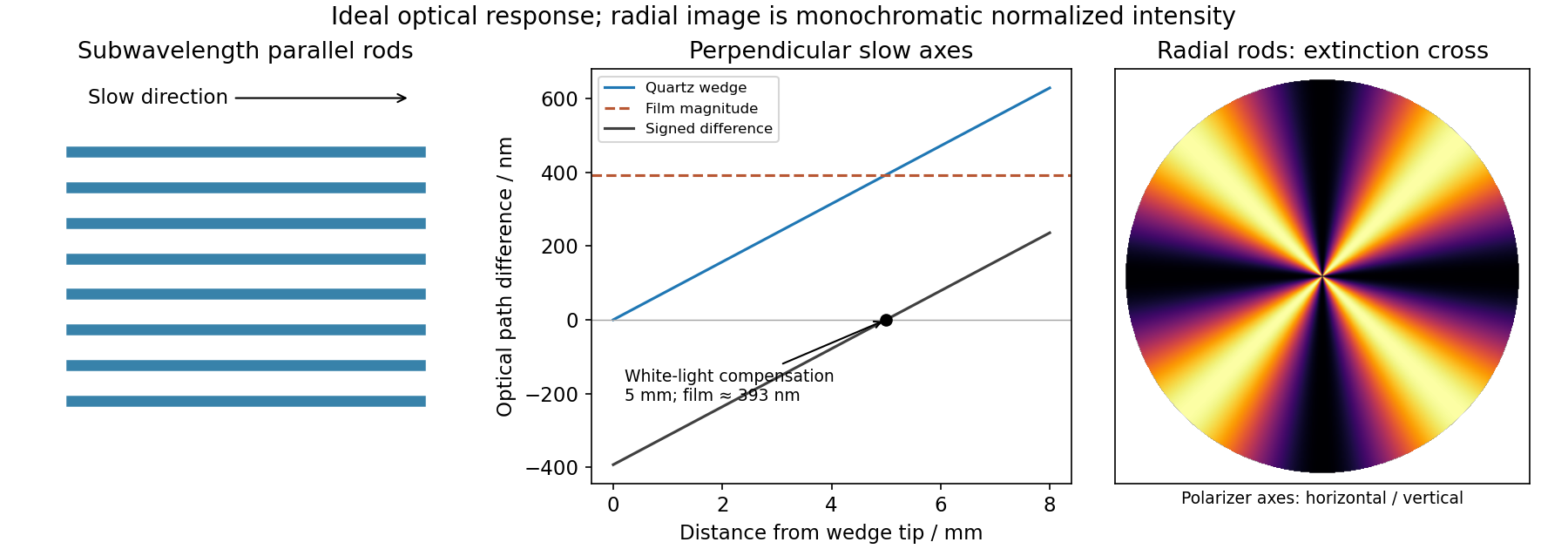
Features only a few tens of nanometres wide lie below the ordinary visible-light diffraction limit, approximately . The microscope cannot resolve individual rods, and unpolarized illumination does not directly reveal the orientation-dependent optical response. Scanning electron microscopy and atomic force microscopy can resolve the surface pattern. Transmission electron microscopy is another possible choice if a suitably thin specimen can be prepared.
An optically isotropic film changes the phase of both transverse polarization components equally, so crossed polarizers still extinguish the transmitted light. The etched rod-and-gap composite has form birefringence: its effective permittivity depends on the direction of the electric field, even when the constituent material is intrinsically isotropic. In a simple subwavelength lamellar model,The precise effective-medium formula changes with rod geometry, but the anisotropy remains. Resolving incident light along the two principal directions produces a phase retardation. An ideal lossless specimen between crossed polarizers transmitswhere is the intensity after the first polarizer. Extinction occurs when a principal direction follows either polarizer; transmission is strongest near .
At distance from its tip, the wedge thickness is . Its optical path difference is thereforeThe perpendicular slow directions make the two retardances subtract. A white-light black compensation fringe is the zero-order cancellation, so the film retardance has magnitude approximately , with its slow direction along the rods. This interpretation assumes the observed fringe is the white-light compensation fringe; a single monochromatic dark fringe alone would have an integer-order ambiguity. Without the wedge, the wavelength dependence of selectively transmits visible wavelengths and gives the film its interference colour.
The local slow direction follows the radial rods. Between crossed polarizers, the angular factor is , so radial directions parallel to either polarizer are dark. The pattern is a Maltese cross in polarized-light microscopy, with four bright sectors separated by dark arms parallel to the polarizer directions. Its colours depend on the local optical path difference; tapering rods or changing fill fraction can make this vary with radius. The cross belongs to the local radial-axis pattern and does not imply a conoscopic interference figure.

For a disordered face-centered cubic lattice, equal average scattering factors on the four sites give reflections only when are all even or all odd. Bragg's law also requires . With Fe K wavelength , the upper bound is . The allowed sums are , givingThe next allowed family, , has squared-index sum and cannot satisfy the diffraction condition for this wavelength. This list assumes the full geometrically accessible angular range, rather than an instrument-specific cutoff.
Successive planes normal to are chemically ordered Au and Cu layers. The supplied four-site cell is a convenient doubled description of the primitive tetragonal lattice: valid primitive translations areThey give a square basal cell of side , containing an Au basis atom at the origin and Cu at fractional . That last vector exchanges chemical species and is not a Bravais translation. Thus a face-centred-looking atomic arrangement does not make the chemically ordered material an FCC Bravais lattice. This is the L10 crystal structure; the following indices retain the larger cell specified in the question.
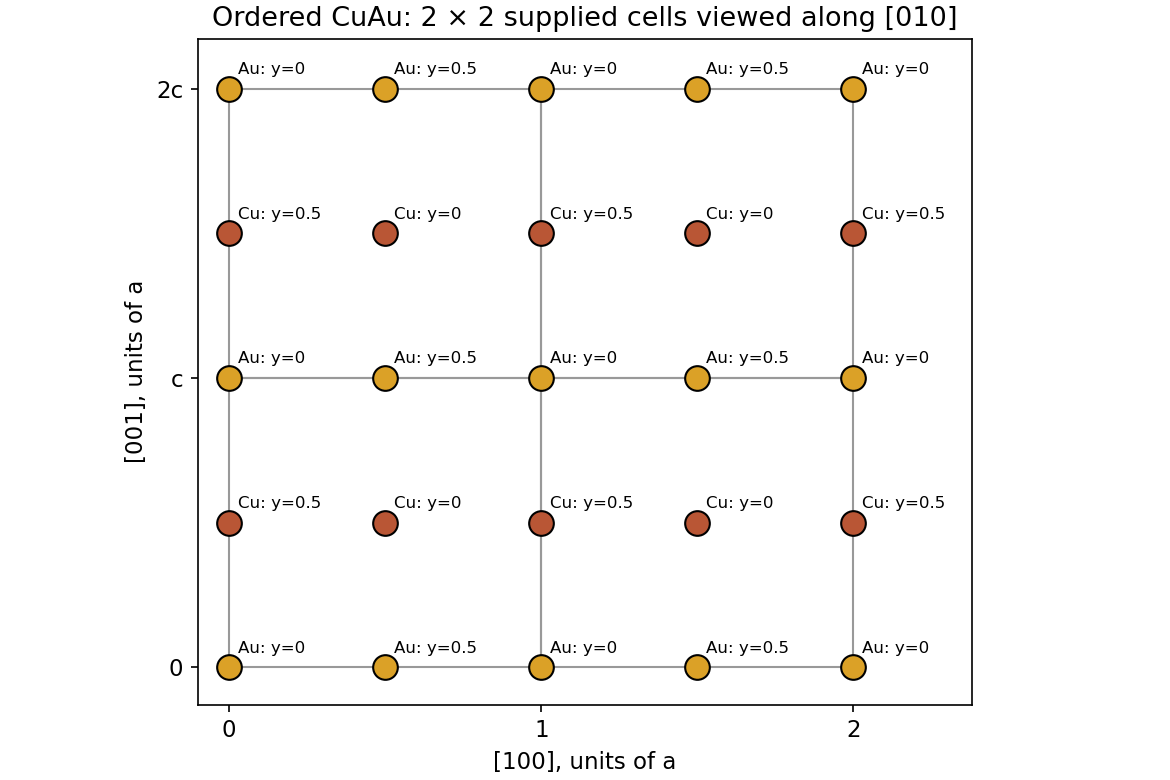

Summing phase-weighted atomic scattering factors over the four positions givesIf have different parity, the reflection vanishes. If they have equal parity, this becomes . The difference reflections reveal chemical order; they disappear when all sites instead have the same average scattering factor.
Ordering reflections by with , the first three nonzero families are , and . The family is extinct. Their structure factors areThe atomic scattering factors in each expression are evaluated at that reflection's scattering vector, so equal symbolic forms need not mean equal numerical amplitudes at different angles. In particular, the low-angle superlattice peaks need not be the strongest peaks.
The first peak is , with ; the second is , with . Applying Bragg's law with givesThus , consistent with the approximate ratio used to order the reflections. These are the lengths of the supplied larger basal cell; the primitive basal lattice parameter is .
At a common test temperature and otherwise comparable microstructure, chemical order generally raises the yield strength. An ordinary FCC dislocation displaced by can interchange Au and Cu sublattices, creating an antiphase boundary behind it. This additional energy resists slip; paired dislocations can restore the order after the second member passes. The disordered phase does not pay the same ordering penalty. Comparing specimens actually tested at their different phase-stability temperatures also includes temperature-dependent mobility and recovery, so the ordering argument alone does not predict a unique measured strength ratio.
(Bi) and are Bi-rich and Sn-rich terminal solid solutions, not intermetallic compounds. At the eutectic composition, cooling through givesThe two solids grow together as a fine eutectic microstructure, commonly lamellar or rod-like. Below about , the tin-rich component has an equilibrium tendency to transform from metallic tetragonal white tin to diamond-cubic grey tin, with a substantial volume increase. This is tin pest, which can disrupt the microstructure mechanically. The dashed transition does not transform the Bi-rich phase into tin. Actual transformation can be slow and depend strongly on impurities and nucleation; crossing the line does not guarantee immediate disintegration.
For a mixture with phase compositions , its molar Gibbs free energy is the straight-line combination at overall . Minimizing over phase compositions gives equal slopes and equal tangent intercepts: the common-tangent construction expresses equality of both component chemical potentials. The equilibrium curve is the lower convex envelope of the candidate phase curves. Phase fractions follow the lever rule.
At , moving from Bi-rich to Sn-rich composition gives , , , , . Approximate liquid coexistence compositions read from the diagram are on the left and on the right; the coexisting solids lie near their respective pure ends. The stable Gibbs free energy follows solid curves near the endpoints, two common-tangent constructions in the coexistence intervals, and the liquid curve between them.
At , one line is tangent to all three Gibbs free energy curves at approximately for (Bi), for liquid, and for . These three phases can coexist at the eutectic point. Between the two solid compositions, the equilibrium phase fractions depend on how much liquid has already transformed; exactly at the invariant temperature, the overall composition alone does not fix all three fractions. At the eutectic overall composition, cooling just below the temperature eliminates the liquid and leaves the two solids.
At , the stable sequence is , , . The stable two-solid common tangent lies below the liquid curve. There is no stable liquid interval, although a metastable extrapolated liquid Gibbs free energy can still be drawn.
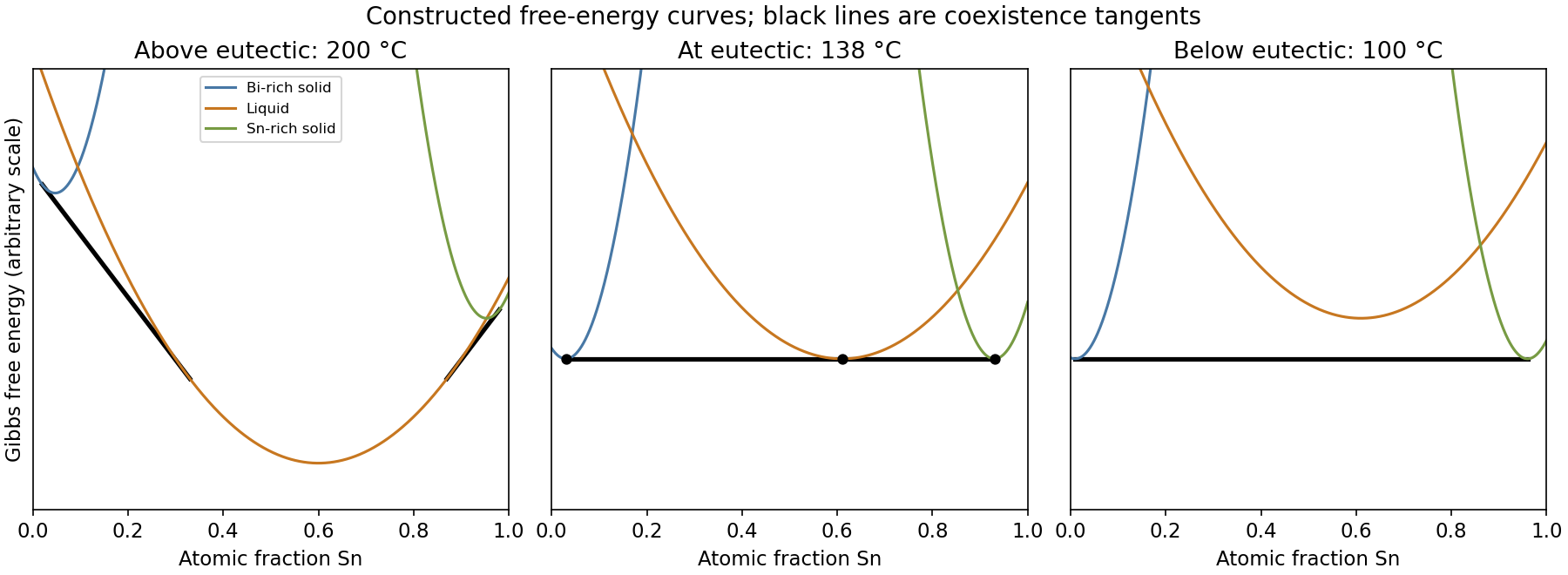
Qualitative Gibbs free-energy envelopes above, at and below a binary eutectic
. Original illustrative curves with constructed tangencies. Free-energy units and curvatures are arbitrary, not measured thermodynamic data for bismuth-tin. Details.
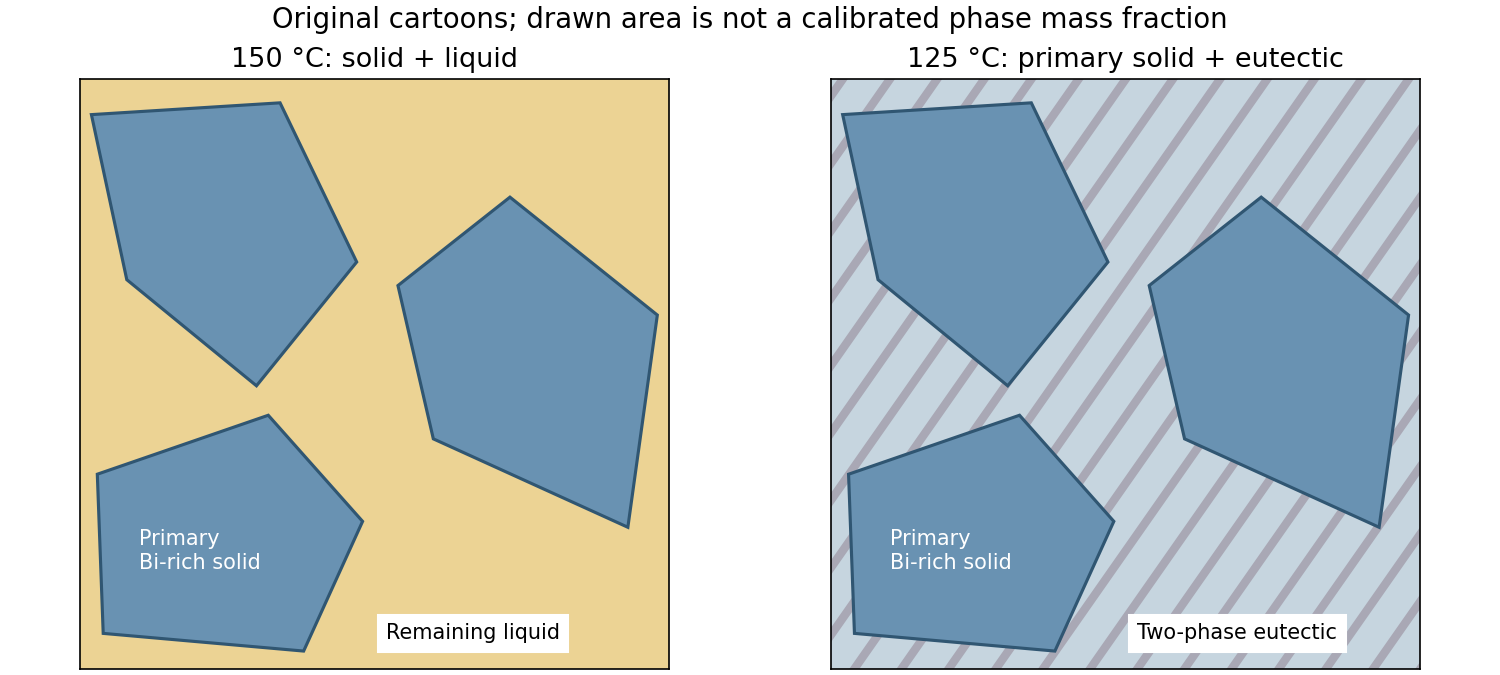
Convert atomic fractions to mass fractions before using the diagram's weight-percent scale:With and , the overall is Sn. At , the diagram gives approximately and . These are about and Sn. The lever rule givesThe microstructure has primary Bi-rich crystals surrounded by remaining liquid. The phase compositions and fractions are approximate readings of a printed phase diagram, not exact thermodynamic values. Faster cooling generally gives finer crystals, solute segregation and departure from these equilibrium compositions.
At , primary Bi-rich crystals are surrounded by a transformed two-phase eutectic microstructure. Reading approximately and gives phase compositions and Sn. Consequently,These are total phase mass fractions, including both primary and eutectic material. They differ from the microconstituent fractions: just before the eutectic reaction, roughly by mass is liquid and subsequently becomes the eutectic constituent, with roughly primary Bi-rich material. Further slow cooling changes the phase compositions and allows secondary precipitation. Faster cooling usually refines the primary crystals and eutectic spacing and increases retained segregation; the equilibrium diagram does not specify the resulting nonequilibrium fractions uniquely.

An FCC crystal slips on . For each slip system, Schmid's law gives , with . Enumerating the twelve systems for gives the maximum atHere and are perpendicular, while , and . Hence . Reversing both directed slip conventions describes the same physical system.
Applying Schmid's law at first yield,This infers the critical resolved shear stress for the initially active system, assuming the supplied tensile stress is the relevant uniaxial stress at yield and the twelve FCC systems have comparable initial slip resistance.
Initially, one slip system carries most of the deformation. Easy dislocation glide gives the nearly flat stage-I response, although lattice rotation and gradual dislocation interactions can already change the required tensile stress. In tension the loading direction expressed in the rotating crystal approaches the primary slip direction. Its path has the form until it reaches the symmetry boundary , at .
At that orientation, and have equal Schmid factors, . Conjugate slip therefore becomes competitive. Intersections between the two dislocation families generate obstacles, junctions and forest hardening, giving the sharp stage-II rise in flow stress. This is the ideal single-slip-to-conjugate-slip construction; real activation stresses can be shifted by latent hardening and imperfections.
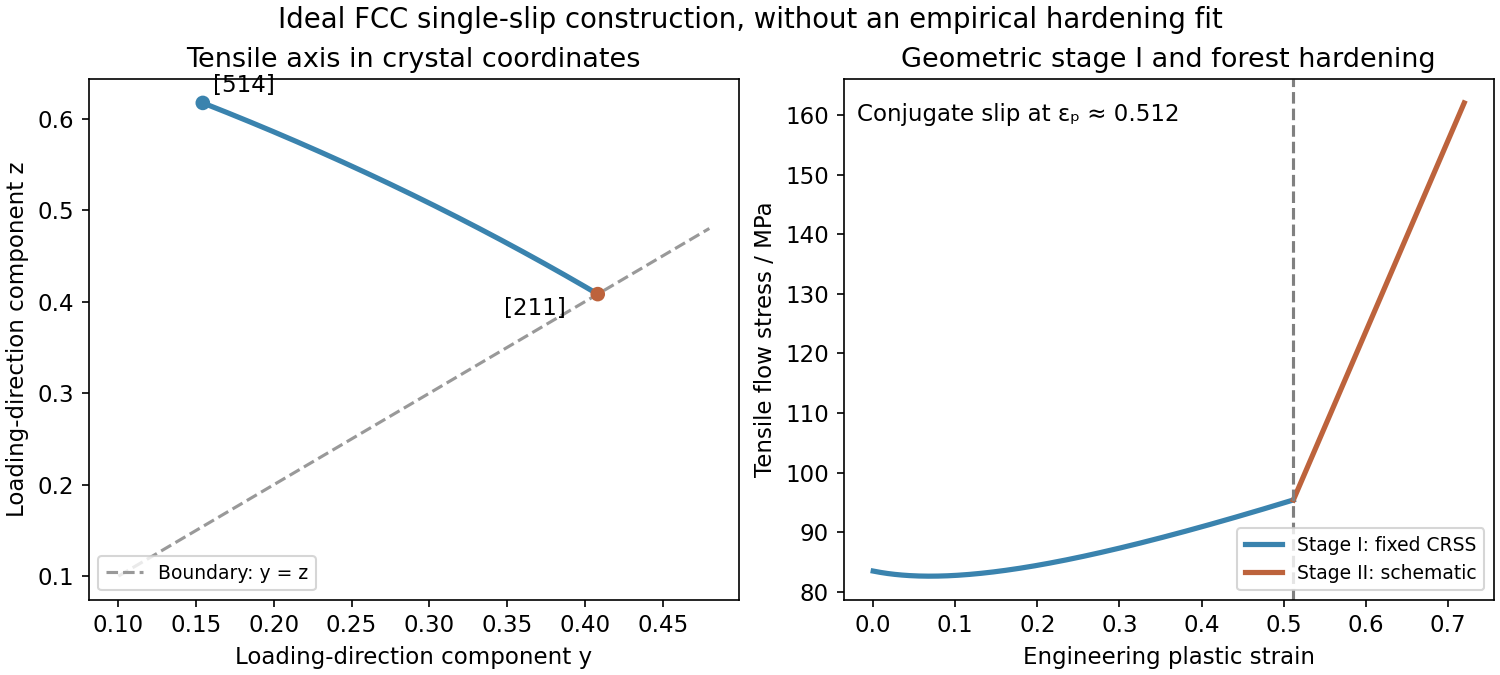

The number and spacing of primary slip planes remain fixed, so the length projected on their normal is invariant: . The initial and boundary loading directions are and , respectively. With normal ,ThereforeThis is engineering plastic strain in the ideal geometric model; its corresponding logarithmic strain is . Elastic extension and changes in slip resistance are neglected, as required by this construction.
The nuclear fuel supplies nuclei whose nuclear fission releases energy. Most of that energy becomes heat in the fuel and neighbouring material. The reactor transfers this heat to a working fluid; the fuel's chemical form and geometry must also remain compatible with its thermal and irradiation environment.
Nuclear fuel cladding separates the fuel and most fission products from the coolant, provides mechanical containment, and transfers heat across the fuel boundary. It must retain useful mechanical integrity and corrosion resistance during irradiation while avoiding excessive neutron absorption.
Control rods absorb neutrons. Changing their insertion changes the neutron balance and hence reactor reactivity; sufficiently strong insertion makes the chain reaction subcritical. They provide control and shutdown functions. Continued decay heat means that shutdown does not remove the need for cooling.
The coolant removes heat from the fuel region and carries it to a heat exchanger or directly to a turbine system. It can also act as a neutron moderator in some reactor types, but cooling and moderation are distinct functions and need not be performed by the same material.
Energetic neutron collisions create displacement cascades and Frenkel pairs: displaced atoms become self-interstitials, leaving vacancies. During migration, some opposite defects recombine, while others cluster or reach sinks. Interstitials can condense into extra atomic planes bounded by dislocation loops; vacancy clustering can instead give missing-plane loops. Their subsequent growth is driven by defect absorption and dislocation climb.
Randomly oriented loops do not select a macroscopic shear direction in an initially isotropic polycrystal. That does not prove that every external dimension remains unchanged: interstitial and vacancy loops have opposite relaxation-volume contributions, and an imbalance can change the volume. Macroscopic void swelling requires the additional vacancy-cavity mechanism; it must not be identified automatically with the mere presence of loops. Texture, stress-biased absorption and unequal loop populations can also give anisotropic dimensional change.
The annealed sample initially has relatively few obstacles to dislocation glide. After its elastic response it yields, undergoes appreciable plastic deformation and develops strain hardening. Irradiation produces dislocation loops and defect clusters that obstruct gliding dislocations, usually raising the yield strength. In a simple dispersed-obstacle model the strengthening scales as , with obstacle density and diameter .
Irradiated material often has less uniform plastic elongation and weaker subsequent hardening because slip localizes into channels that have cleared irradiation obstacles. Earlier necking or fracture can then reduce ductility. The elastic slope is much less affected than the yield stress in this schematic comparison; the exact strength and elongation depend on dose and temperature.
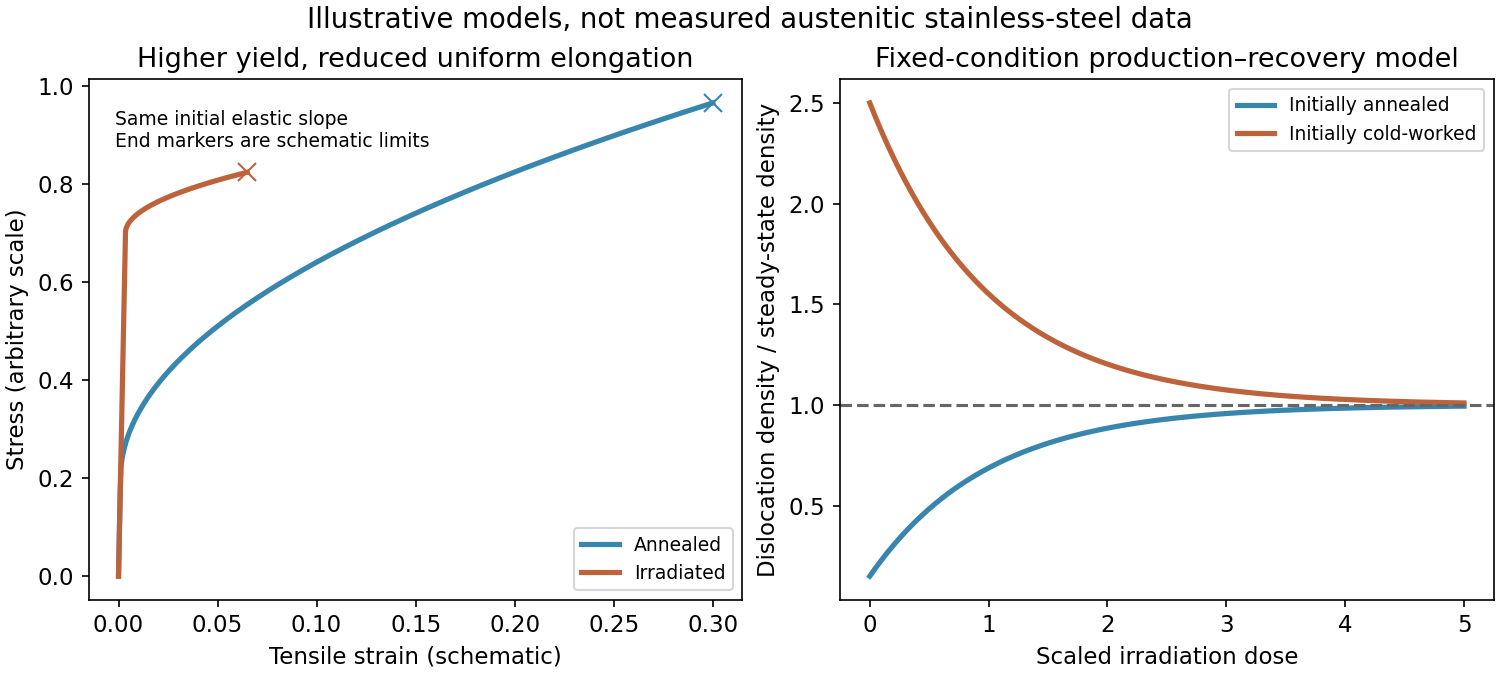

Irradiation both creates dislocation loops and supplies mobile point defects that allow existing dislocations to climb, rearrange and annihilate. At low initial dislocation density, net production can dominate; at high initial density, sink absorption and recovery can dominate. A simple illustrative rate equation isThus both initial states approach in this fixed-condition model. Here is irradiation dose, not a diffusion coefficient. The asymptote reflects a dynamic balance, not the cessation of damage. It need not be the same for different alloys, temperatures, dose rates or applied stresses.
TODO — user-deferred biology. This biological question is intentionally left unsolved under the current scope.
TODO — user-deferred biology. This biological question is intentionally left unsolved under the current scope.
TODO — user-deferred biology. This biological question is intentionally left unsolved under the current scope.
Articles by others on the same topic
There are currently no matching articles.