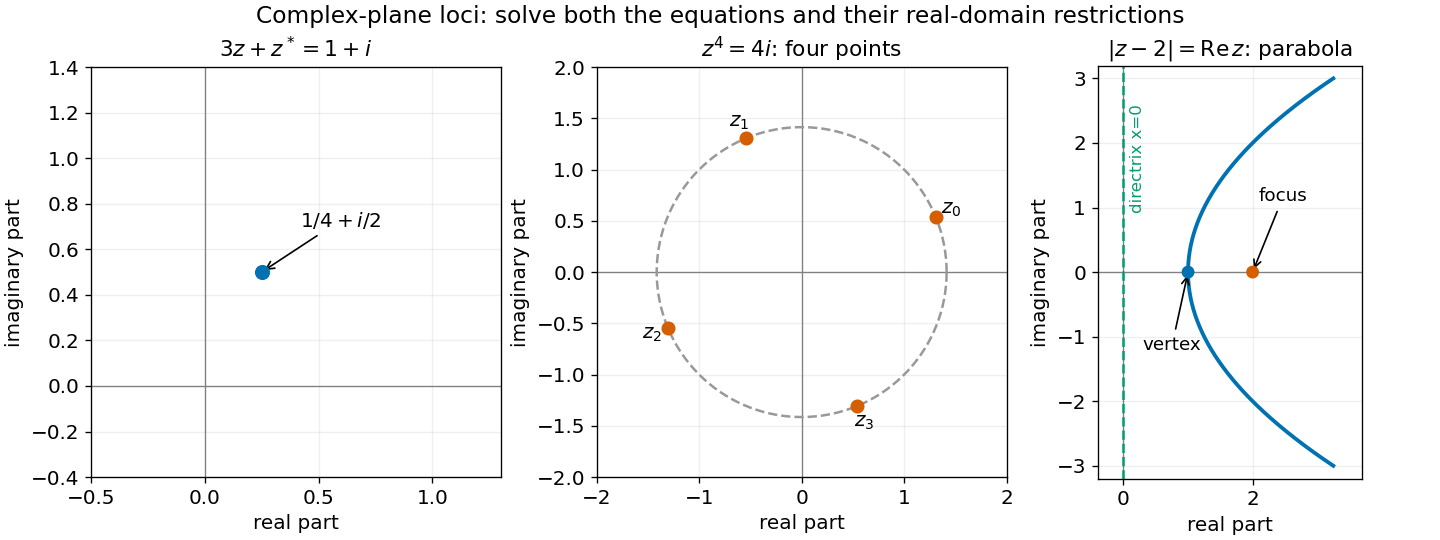
Write , with real . Its complex conjugate is , so equating real and imaginary parts gives , . Thus the complex plane locus is the single point
The modulus obeys , giving . The complex argument obeys modulo . The four distinct complex roots are thereforeThey form a square centred at the origin, on the circle of radius , with the first vertex at argument .
For , the equation becomes . Its right side must be nonnegative. Squaring then gives , whose points already have , so no extraneous branch has been introduced:This is a parabola opening along the positive real axis, with vertex , focus and directrix . The original modulus equation equates distance from the focus with distance from that directrix.

Articles by others on the same topic
There are currently no matching articles.