Source paper: www.whatdotheyknow.com/request/physics_preliminary_examinations/response/1162943/attach/3/Twain.7z?cookie_passthrough=1
Other held scans reproduce this examination. The cleaner copy with native text is used here.
Alternative scanned version: www.whatdotheyknow.com/request/physics_preliminary_past_papers/response/2680788/attach/2/2014%202017%20Physics%20Prelim.zip?cookie_passthrough=1
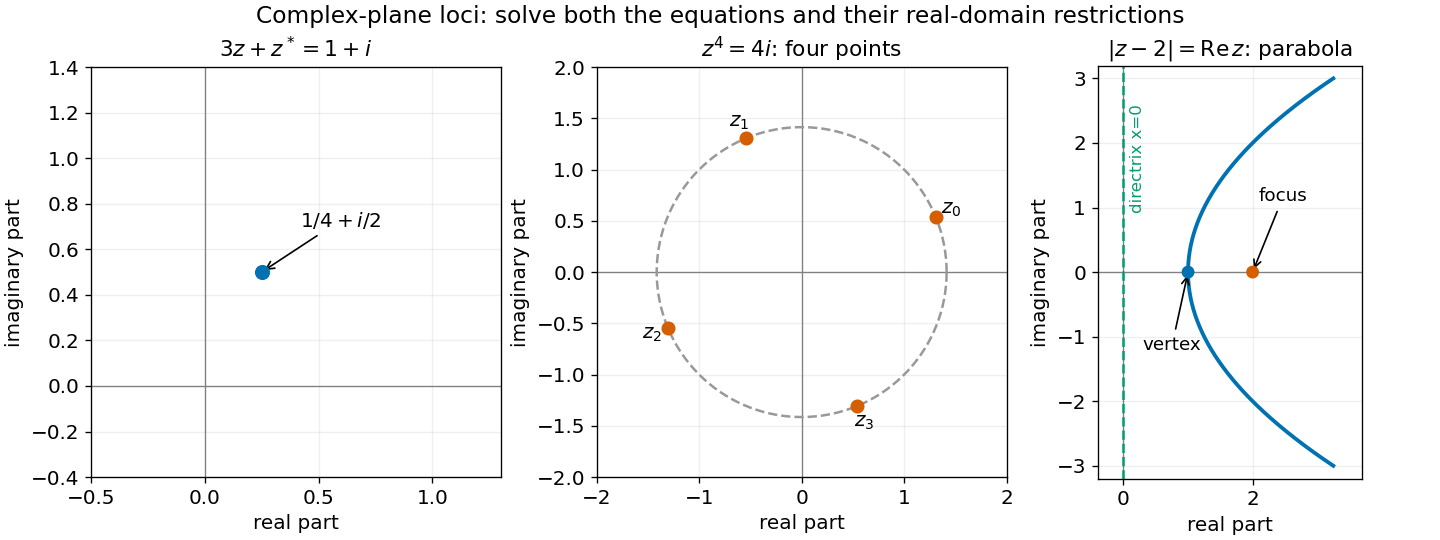
Write , with real . Its complex conjugate is , so equating real and imaginary parts gives , . Thus the complex plane locus is the single point
The modulus obeys , giving . The complex argument obeys modulo . The four distinct complex roots are thereforeThey form a square centred at the origin, on the circle of radius , with the first vertex at argument .
For , the equation becomes . Its right side must be nonnegative. Squaring then gives , whose points already have , so no extraneous branch has been introduced:This is a parabola opening along the positive real axis, with vertex , focus and directrix . The original modulus equation equates distance from the focus with distance from that directrix.

De Moivre's theorem states for integer . For , expanding the cube and taking its real part givesRearranging gives the required identity withNo division by is needed, so the proof also covers its zeros.
Let denote the three matrices in their printed order. A Hermitian matrix satisfies , a unitary matrix satisfies , and an orthogonal matrix is real with .
For the first matrix, and . It is therefore Hermitian and unitary. It is not real, and even allowing complex entries in the transpose test gives , so it is not orthogonal.
The third matrix is real, but direct multiplication givesIt is neither orthogonal nor unitary. Its unequal off-diagonal transpose entries also show , so it is none of the three. The common prefactor applies to the central diagonal entry as well; replacing that entry by one would describe a different matrix.
The matrix is real symmetric, so the spectral theorem guarantees an orthonormal basis of eigenvectors. Its characteristic determinant factors asSolving the three corresponding equations for the null space gives the normalized eigenvectorsTheir pairwise inner products vanish. With these vectors as columns,Since , this also gives .
The scalar triple product is the determinant with the three vectors as columns. A cyclic permutation of three columns is even, while exchanging two columns reverses the determinant's sign. ConsequentlyEquivalently, expand the first expression as and interchange the last two indices, using the antisymmetry of the Levi-Civita symbol. This argument includes linearly dependent vectors, for which both sides vanish.
Differentiating the logarithm givesThe real logarithm is valid where its argument is positive; gives the same derivative on the other nonsingular intervals.
For the first-order linear differential equation, an integrating factor on the interval containing isMultiplying the equation by it yields . Integration and therefore giveThe interval ends at singularities of the differential equation's coefficient ; a finite limiting value of the expression would not remove those coefficient singularities.
Yes. The two columns form the matrix , whose determinant is . They are therefore linearly independent and span the two-dimensional real vector space, so they form a basis.
No, as printed. Each displayed vector has only two components, so neither is an element of the stated without an additional embedding convention. Even if one inserts a zero third component, two vectors span at most a two-dimensional linear subspace and cannot form a basis of . This conclusion does not require guessing a missing third entry.
No. Calling the three vectors in order, direct addition gives . This nontrivial linear dependence prevents them from forming a basis of . The first two are not proportional, so the span has dimension two.
Yes, over . The column matrix is , with nonzero determinant . Every has the unique expansionThe scalar field matters: the same space regarded as a real vector space has dimension four.
If for a nonzero eigenvector, then implies , hence . Conversely, the real-symmetric spectral theorem gives with orthogonal . If every diagonal entry of is zero or one, then and therefore . Thus the necessary and sufficient condition isSuch a symmetric idempotent matrix is the orthogonal projection onto its eigenvalue-one eigenspace, with its eigenvalue-zero eigenspace as the kernel. Diagonalizability is essential to the sufficiency argument from eigenvalues alone; symmetry supplies it here.
Set , so . The new equation is a separable differential equation:Absorbing the constant scaling into , the real solutions areEach solution is taken on a connected interval avoiding its tangent poles. No constant real solution for was lost by separation, because is strictly positive for real .
The equation requires . Put , giving andAn integrating factor is , so . Integrating gives , henceReal differentiable branches require , with one sign on each connected solution interval. At , the original equation would demand , contrary to ; the zeros of the radicand are therefore not regular solution points. In particular, is not an additional solution.
For and initially , use the Bernoulli power substitution . The equation becomesWrite . A first-order linear differential equation then givesThe second line is the resonant case of a Bernoulli equation with exponential forcing. Recover using real branches for which the original power is defined; for example, unrestricted noninteger powers are unambiguous on .
The exceptional exponent makes the original equation linear: . Its solutions areDomain restrictions matter when the solution reaches zero. If and the real power at zero is defined, is also a solution. For , waiting-time solutions of a sublinear Bernoulli equation may stay zero until an arbitrary and then become positive, withThe joining derivative is zero because . For , the linear formula can pass through zero normally; for , the original negative power excludes zero. These qualifications prevent dividing out a valid zero solution or inventing one where the equation is undefined.
Dividing Newton's equation by the mass gives the stated model: is the acceleration, represents viscous damping, is the spring's restoring acceleration, and the right side is the applied driving force per unit mass. The complex notation is a convenience; the physical displacement is the real part. Put . The homogeneous characteristic roots areFor and damping , oscillations occur when , the underdamped case of the damped harmonic oscillator.
For a steady response , substitution givesTaking the modulus and phase givesThe phase is between zero and for positive damping and frequency; an unqualified arctangent loses the correct quadrant above resonance.
With the real drive and real response , the average driving power equals the dissipated viscous power:For , write this asIt is largest when the squared term vanishes, givingThis power peak is at even when the displacement-amplitude peak is shifted. The frequency bandwidth of viscous oscillator power absorption follows from the half-power condition :In fact the bandwidth identity is exact in this model. Sharp resonance additionally gives . With zero damping at exact resonance, there is no bounded steady harmonic response to which these finite-power formulas apply.
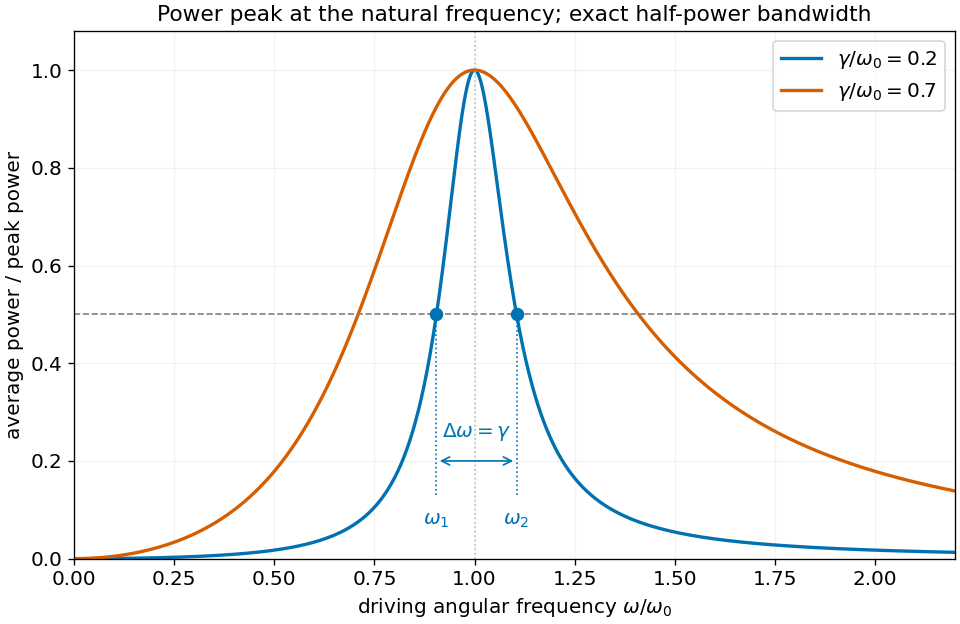
Driven-oscillator power peaks at the natural frequency; the exact separation of the half-power frequencies is the damping coefficient
. Details. 
Multiplication by each column of givesSince is invertible, its columns are an eigenbasis and the similarity transformation givesThere is an important source variant: the alternative scanned copy supplies an erroneous inverse with an extra factor and a different top-right entry. Calling that supplied matrix , direct multiplication gives , so it cannot be . Inverting instead givesThis is the inverse in the cleaner copy used here. Using the scanned erroneous matrix would make nondiagonal, so correcting the inverse is necessary before applying the stated diagonalization. The inverse-matrix verification test catches the error without assuming the claimed outcome.
A power of a diagonal matrix acts entrywise. ThusFrom , adjacent factors cancel in repeated multiplication, givingThis is the matrix power rule for a similarity transformation, proved directly rather than by taking powers of separate noncommuting factors.
All three eigenvalues are nonzero, so . The inverse matrix is thereforeMultiplying this matrix by gives , independently checking both the sign and the fractions.
The determinant is multiplicative and unchanged by a similarity transformation. HenceFor , expansion of the original determinant givesin agreement with the product of its eigenvalues.
For a positive integer , the identity givesThe stated nonnegative indexing includes as a special case: , whose squared norm is zero. Thus ; it cannot belong to a basis.
For distinct positive integers , the product-to-sum identity givesBoth cosine integrals vanish over , soIf one index is zero, the corresponding function is identically zero and the same answer follows immediately.
After discarding , the preceding inner products show that distinct sine functions are orthogonal; dividing each by makes them orthonormal. More precisely, their infinite expansions form an orthogonal basis of the odd part of in the Hilbert-space sense. This is not a claim that every arbitrary odd function is a finite linear combination of sines.
Take the inner product of with . Orthogonality givesTherefore the Fourier series of a periodic sawtooth, scaled to this interval, isIts periodic extension is piecewise smooth, so the Dirichlet convergence theorem for Fourier series gives pointwise convergence to inside the interval. At the jump endpoints of that periodic extension, the series instead converges to zero, the midpoint of the two one-sided limits.
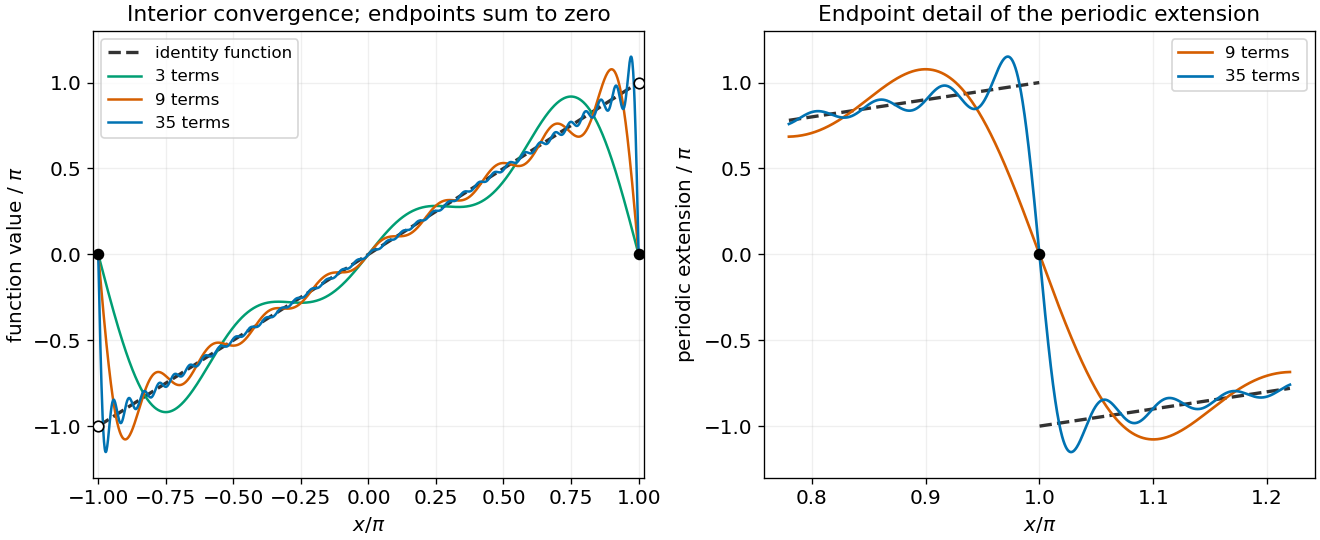
Fourier sine partial sums approximate the identity inside the interval, while their periodic extension has endpoint jumps
. Details. 
The function is an even function, while every sine basis function is an odd function. Their product is odd, so every sine coefficient is zero:The function itself is not zero, and therefore it cannot be represented by this sine basis. The basis spans the odd subspace, whereas the requested nonzero even function lies in its orthogonal complement. Equivalently, any pointwise limit of odd partial sums remains odd wherever both reflected points have limits.
Articles by others on the same topic
There are currently no matching articles.