For a twice continuously differentiable function, a finite second-order Taylor expansion about an interior point iswhere , , at that point. A differentiable interior extremum requires . For a strict minimum guaranteed by the quadratic term, the Hessian matrix must be positive definite. Completing the square gives . Thus sufficient nondegenerate minimum conditions areIf , the second-order test is inconclusive; for example has a strict minimum at zero despite a zero Hessian. The finite Taylor argument only needs regularity. The source's infinite Taylor representation additionally needs suitable analyticity: a smooth flat function, such as extended by zero at the origin, has every Taylor coefficient zero there but is positive nearby.
At an interior stationary point, let , , and . The quadratic change in the Taylor expansion is negative in every nonzero displacement when the Hessian matrix is negative definite. Applying the minimum test to gives the sufficient nondegenerate maximum conditionsThe quadratic term then dominates the smaller Taylor remainder in a sufficiently small neighborhood, proving a strict local maximum. A vanishing determinant requires higher-order analysis instead.
At an interior stationary point, a negative determinant of the symmetric Hessian matrix means its two eigenvalues have opposite signs. Along their eigenvectors the leading quadratic change has opposite signs, and the higher-order remainder cannot reverse these signs sufficiently close to the point. Hence the nondegenerate saddle condition isWhen the determinant vanishes, a saddle is still possible but is not determined by second derivatives alone: is a simple example. Thus these tests are decisive for nondegenerate stationary points, not an exhaustive classification from first and second derivatives of every smooth function.
The stationarity equations are and . Thus and , so . The real solutions are , and . The Hessian matrix isAt the origin its determinant is , giving a saddle. At either nonzero stationary point it has eigenvalues , so both are strict minima, with value :They are also global minima, because , with equality exactly at those two points. This is the special coefficient choice in a quartic double well with bilinear coupling.
The contours have exchange symmetry and inversion symmetry . Negative levels between and zero form separate loops around the two minima. The zero contour meets itself at the origin, reflecting the saddle there; positive levels form a single outer closed contour. At large radius the positive quartic terms dominate, so the contours remain bounded. There are no contours below .
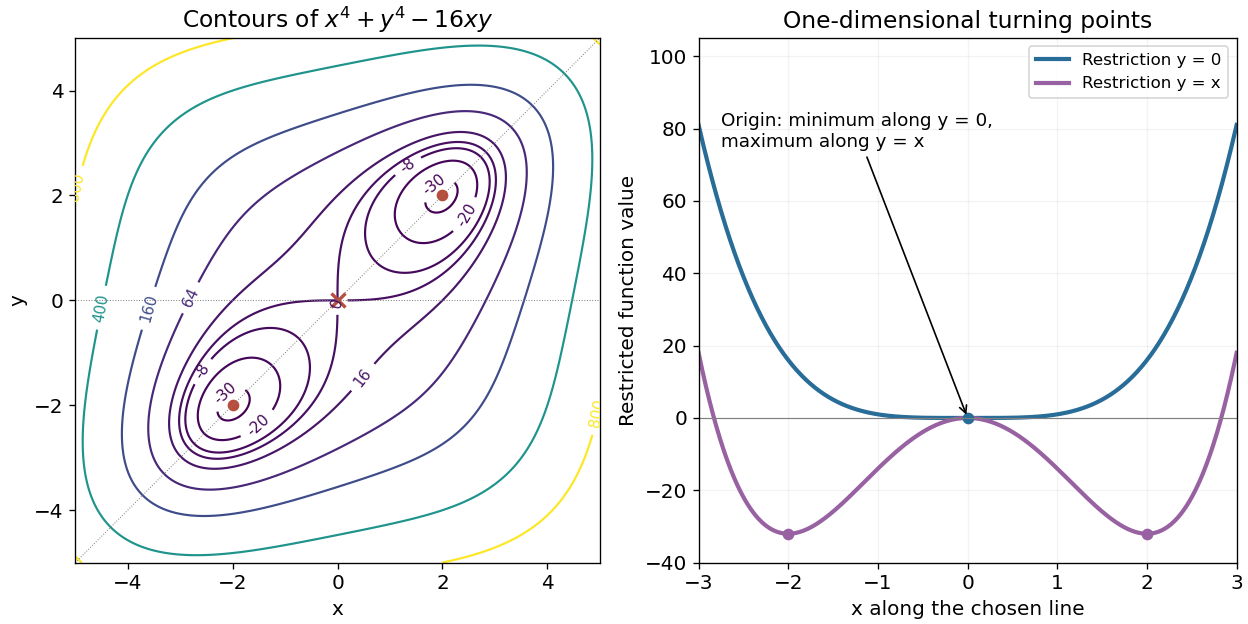
Quartic contours on the required square and one-dimensional restrictions near their turning points
. Details. 
The diagram marks the two minima and central saddle. The restrictions are classified separately below: a minimum or maximum along a single line need not be a two-dimensional extremum.
On , the restricted function is , so changes from negative to positive at zero. HenceThe restricted second derivative vanishes there, but the quartic term determines the minimum. This does not contradict the two-dimensional saddle: values decrease along other directions, including the diagonal near the origin.
On , the restricted function is . Its derivative is , so the turning points are . The restricted second derivative is , negative at zero and positive at . ThusThe corresponding points in the plane are and . Along the diagonal the derivative is , not a single arbitrary partial derivative; here , so their zeros and sign changes agree with the restricted-curve calculation.
Articles by others on the same topic
There are currently no matching articles.