The contours have exchange symmetry and inversion symmetry . Negative levels between and zero form separate loops around the two minima. The zero contour meets itself at the origin, reflecting the saddle there; positive levels form a single outer closed contour. At large radius the positive quartic terms dominate, so the contours remain bounded. There are no contours below .
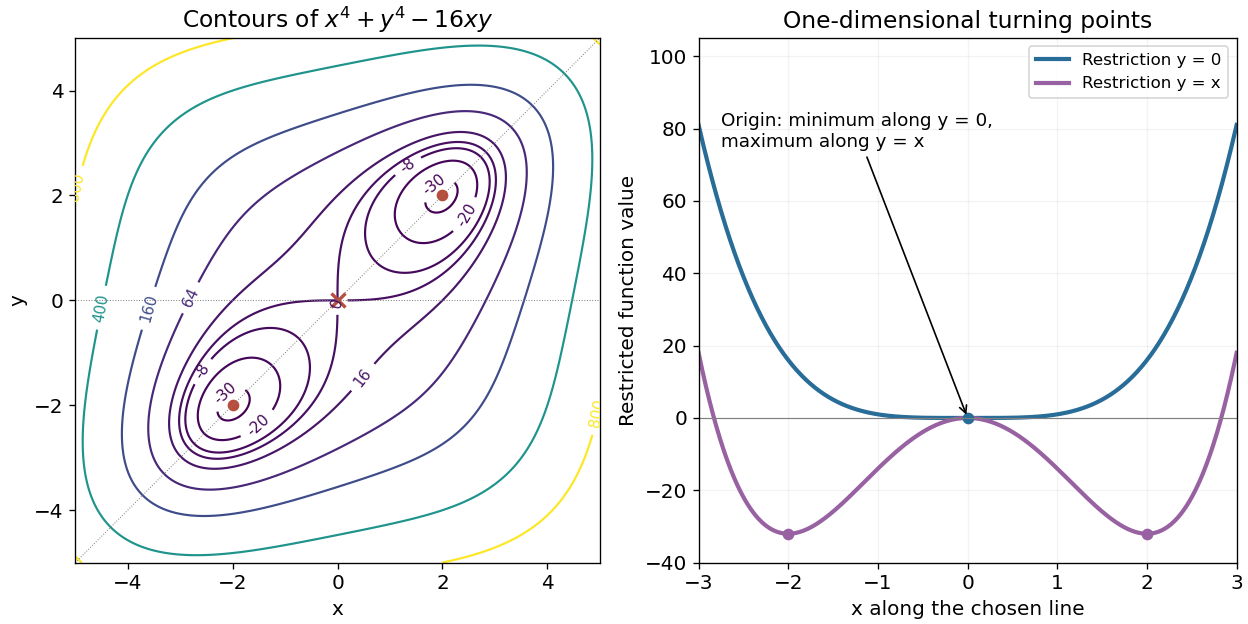
Quartic contours on the required square and one-dimensional restrictions near their turning points
. Details. 
The diagram marks the two minima and central saddle. The restrictions are classified separately below: a minimum or maximum along a single line need not be a two-dimensional extremum.
On , the restricted function is , so changes from negative to positive at zero. HenceThe restricted second derivative vanishes there, but the quartic term determines the minimum. This does not contradict the two-dimensional saddle: values decrease along other directions, including the diagonal near the origin.
On , the restricted function is . Its derivative is , so the turning points are . The restricted second derivative is , negative at zero and positive at . ThusThe corresponding points in the plane are and . Along the diagonal the derivative is , not a single arbitrary partial derivative; here , so their zeros and sign changes agree with the restricted-curve calculation.
Articles by others on the same topic
There are currently no matching articles.