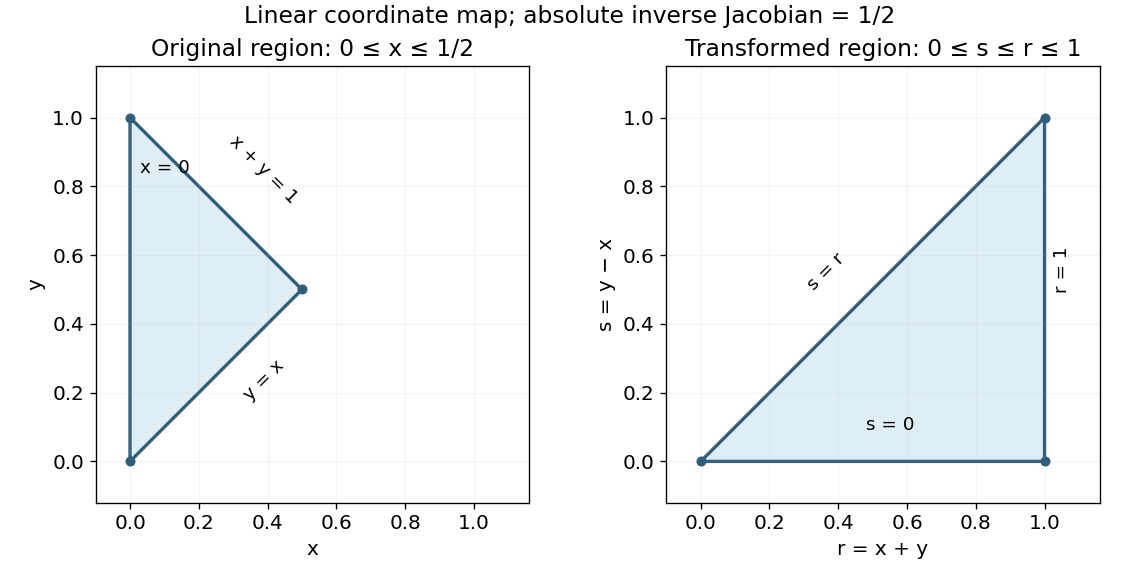
The original integration region is the triangle with vertices , and . Under , , its inverse map is , , with absolute inverse Jacobian determinant . The boundaries , , become , , . Thus the transformed triangle is , andThe endpoint singularities are integrable after the inner integral: is only a collapsed vertex, while has the usual inverse-square-root behavior. The diagrams indicate the complete triangles, rather than rectangular bounds that would include points absent from the original region.

Articles by others on the same topic
There are currently no matching articles.