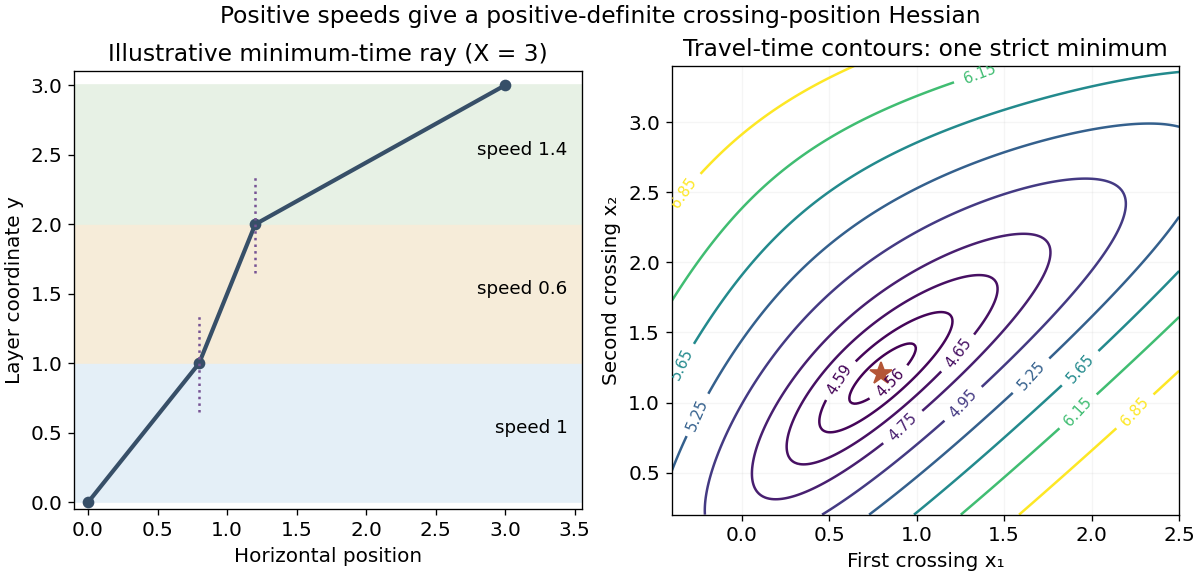
In each layer a minimum-time path is straight because the speed is constant there. The total time as a function of the two crossing positions isSetting its two partial derivatives to zero givesThe angles in the held diagram are measured from the vertical interface normals, so these ratios areThis is the layered-speed form of Fermat's principle and Snell's law. Signed horizontal displacements can be retained if the endpoint lies on the other side of the origin.
At a smooth interior stationary point, define . The second-derivative test gives a minimum for , a maximum for , and a saddle point for ; is inconclusive.
For the stated time function, putPositive physical speeds make all three coefficients positive. The positive Hessian of a layered travel-time functional here isThus the stationary path is a strict minimum, not merely a candidate of unspecified type. In fact the same positivity holds for all finite crossing positions, so the time function is strictly convex and the minimum is unique.

Articles by others on the same topic
There are currently no matching articles.