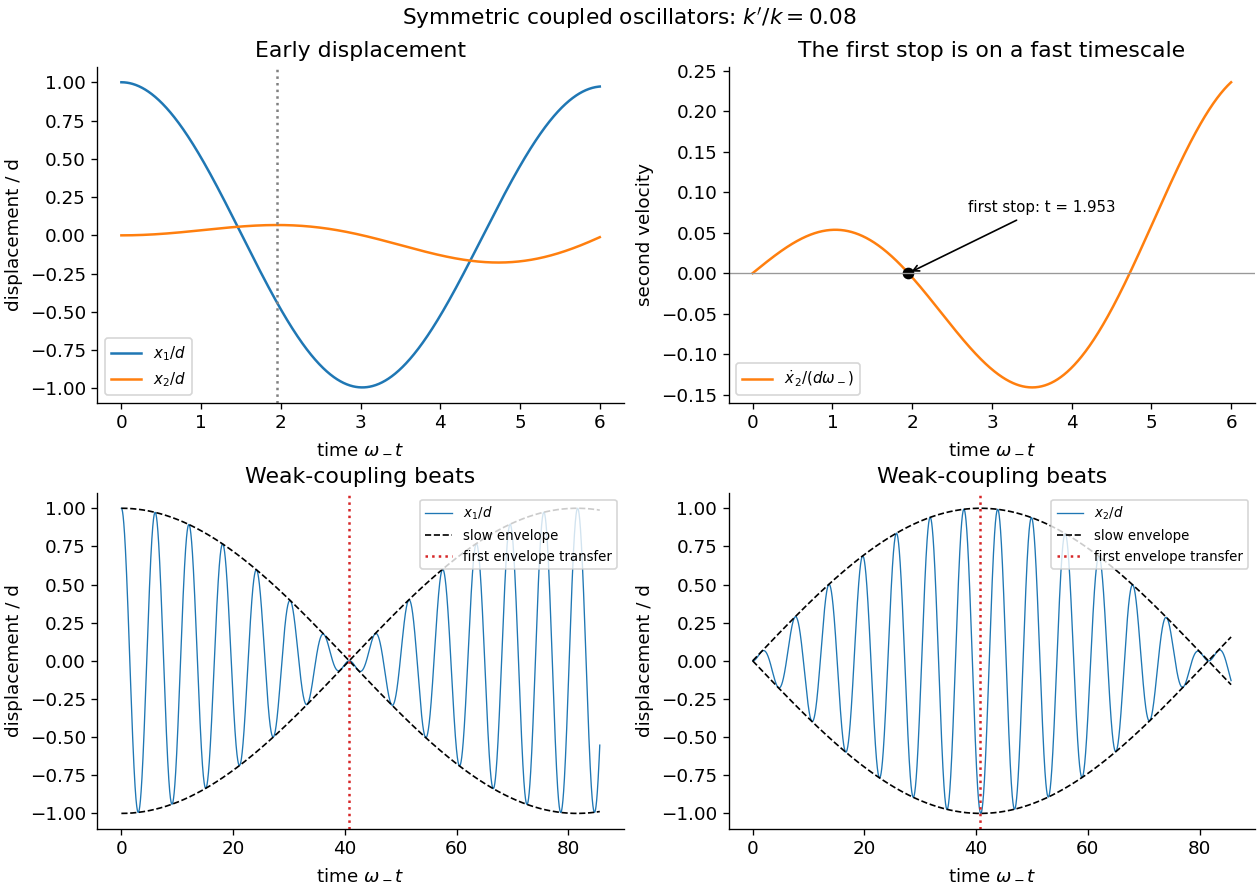
Let and . The sum and difference identities giveFor weak coupling, , so the slow sine and cosine envelopes produce beats. The first maximum of the second envelope is at , when the first envelope vanishes.
A literal first turning point of an initially stationary coupled oscillator is different from that slow envelope maximum. The first nonzero time at which the second mass is instantaneously at rest satisfiesSet and . Dividing the derivative by and expanding at of order one gives . The first positive root lies in , where , soThere is no earlier root: for , both terms in the exact derivative are positive when is sufficiently small. At the root the second displacement reaches its first local maximum. If the question instead intends the first envelope maximum, its time is . That is a slow amplitude-transfer time, and is not generally a time of zero instantaneous velocity. The distinction matters because both masses keep oscillating while the envelopes change.

Articles by others on the same topic
There are currently no matching articles.