The central spring extension is . Applying Hooke's law and Newton's second law to each mass givesIn matrix form . The positive off-diagonal coupling in the force equations means that displacing one mass pulls the other in the same direction.
The normal modes are the eigenvectors of the stiffness matrix. The in-phase mode has normalized vector ; its central spring is unstretched. The opposite-phase mode has normalized vector and stretches the central spring. Their frequencies areEach mode has arbitrary amplitude and phase. Thus is the general real motion. Equal coordinates belong to and opposite coordinates to ; the amplitudes are not fixed until initial data are supplied.
The initial vector has coefficient in each normalized normal mode. Zero initial velocities remove their sine terms. ThereforeAt zero these give and both derivatives vanish; substitution into the coupled equations confirms the opposite signs of the two higher-frequency components.
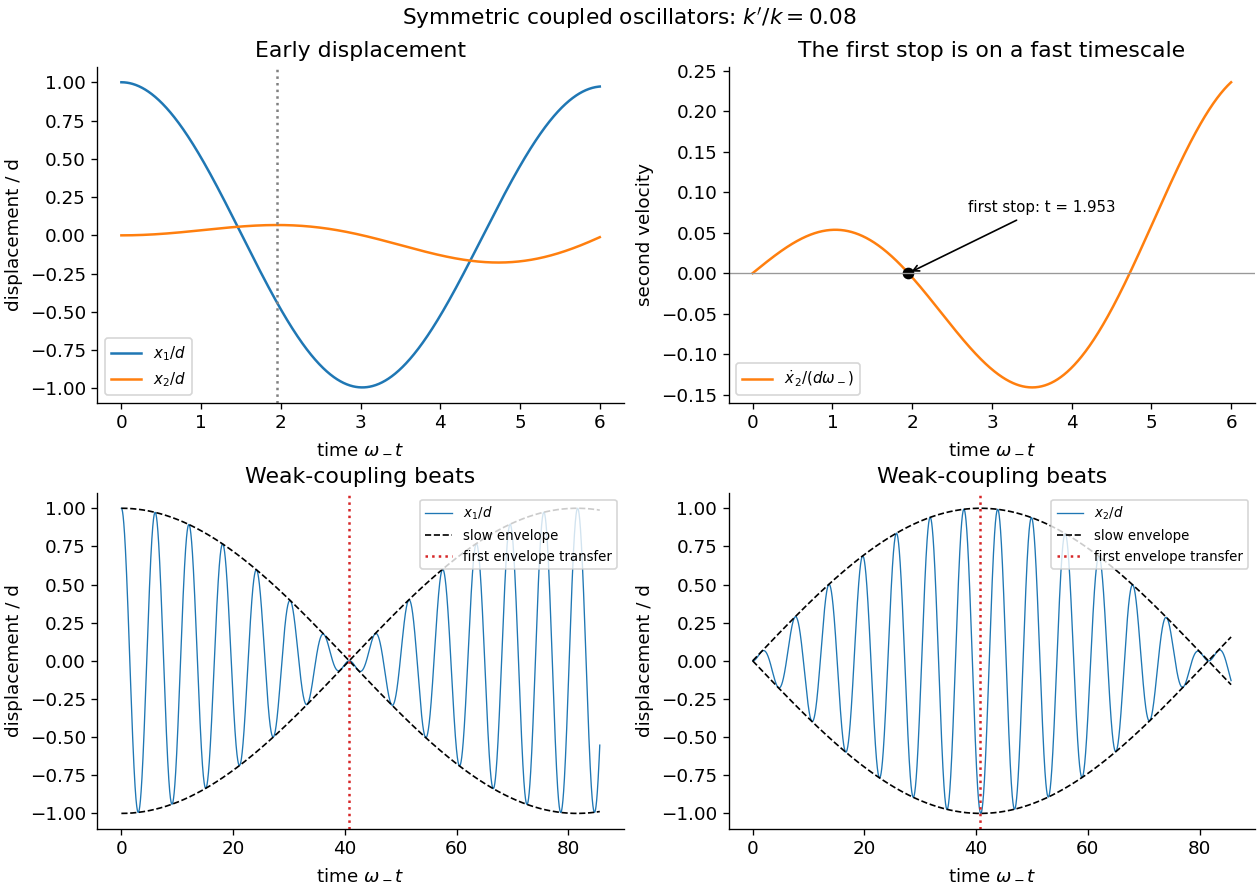
Let and . The sum and difference identities giveFor weak coupling, , so the slow sine and cosine envelopes produce beats. The first maximum of the second envelope is at , when the first envelope vanishes.
A literal first turning point of an initially stationary coupled oscillator is different from that slow envelope maximum. The first nonzero time at which the second mass is instantaneously at rest satisfiesSet and . Dividing the derivative by and expanding at of order one gives . The first positive root lies in , where , soThere is no earlier root: for , both terms in the exact derivative are positive when is sufficiently small. At the root the second displacement reaches its first local maximum. If the question instead intends the first envelope maximum, its time is . That is a slow amplitude-transfer time, and is not generally a time of zero instantaneous velocity. The distinction matters because both masses keep oscillating while the envelopes change.

Articles by others on the same topic
There are currently no matching articles.