Write . In the physically relevant strip , , the zero-current nullcline satisfiesThe left side increases strictly from zero to infinity, so there is exactly one nullcline height for each interior voltage. If is positive at the endpoints, its curve joins to ; when low-voltage activation is idealized as exactly zero, the limiting left branch can lie on .
The signs of the derivatives explain its folds:At low voltage, potassium's approximately linear contribution dominates and . During rapid sodium activation the last negative term can dominate, giving . Once activation saturates, becomes small and again. This folded conductance-model nullcline has the familiar shape: the curve has descending outer branches and an ascending middle branch in the plane. Equivalently, an intermediate fixed can give three zeros of as voltage rises, with positive, negative and positive at those crossings.
The rapid-activation description permits this folded shape; exact fold positions depend on . The figure supplies an explicit admissible sigmoid example. Its right panel shows as well as the recovery nullcline and an oscillating trajectory.
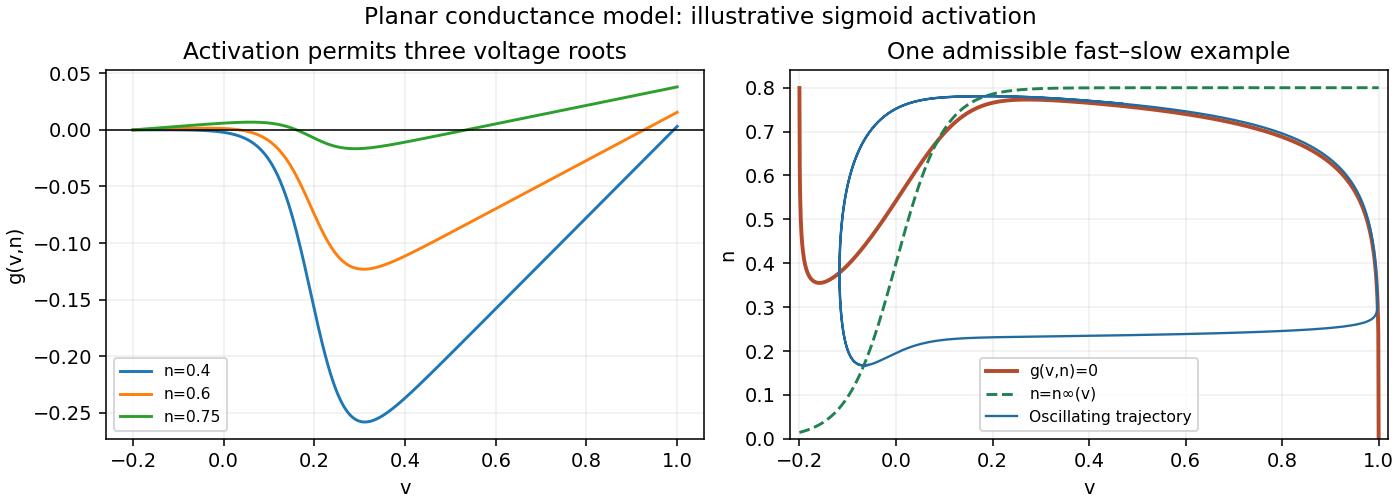

The voltage nullcline is and the recovery nullcline is . In the relevant region , so below the voltage curve and above it . Below the recovery curve , while above it .
For small , the outer voltage branches with attract fast voltage motion; the middle branch with repels it. Arrange the intersections so the equilibrium is on that middle branch, with recovery increasing along the high-voltage attracting branch and decreasing along the low-voltage attracting branch. The trajectory then drifts towards a fold, jumps rapidly to the other attracting branch at nearly constant , and repeats. This is a relaxation oscillation.
The local linear stability calculation supports the construction. At an equilibrium,A sufficiently steep recovery curve gives positive determinant, while gives positive trace. Hence the equilibrium is a repeller. The bounded physical rectangle can be chosen forward invariant, and a small neighborhood of the repeller removed to give a trapping annulus. The Poincaré-Bendixson theorem then supplies a periodic orbit. These conditions can be realized because the recovery function and the applied current control the intersection and its slope; oscillation is possible, not forced for every choice.
For the illustration, , , , , , and . The rectangle has inward-pointing flow, and the displayed numerical trajectory realizes the folded-branch mechanism.
Articles by others on the same topic
There are currently no matching articles.