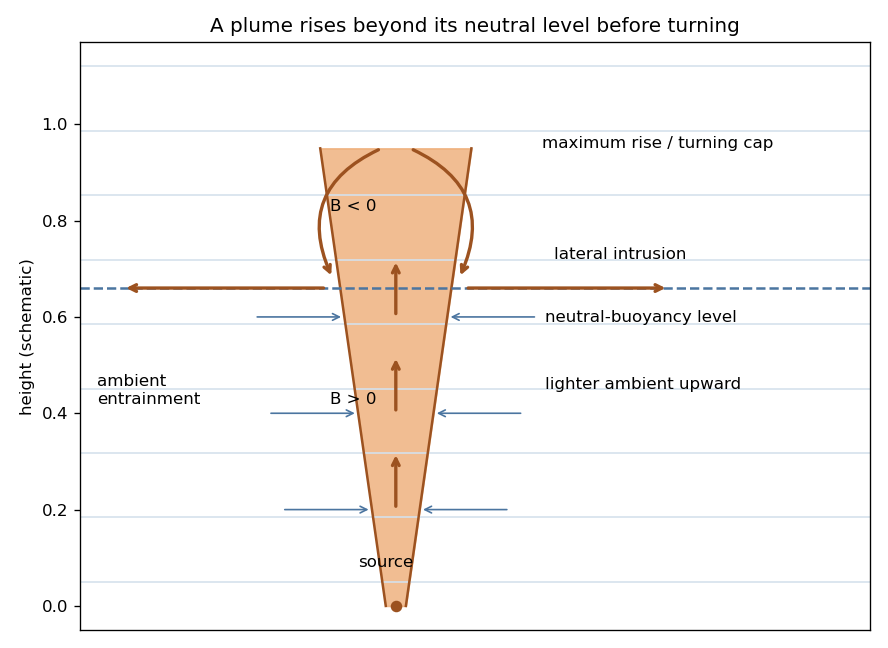
In a stably stratified ambient, entrained fluid is progressively lighter with increasing height. Relative to that ambient, the plume's buoyancy flux satisfies . It therefore becomes neutrally buoyant before its upward momentum vanishes. It overshoots, becomes negatively buoyant, and eventually turns and spreads laterally near its neutral-buoyancy level. The top-hat ascent equations cease to describe the overturning cap and lateral intrusion.
For constant , the balances give a useful exact relation:for an ideal zero-momentum source. The rising branch begins at , attains its largest momentum at , and reaches its terminal zero-momentum limit at . Entrainment and decreasing buoyancy make the associated rise interval finite.
An estimate follows already from the unstratified pure plume flux: , so . HenceThe coefficient depends on the entrainment coefficient and the distinction between neutral height, maximum rise and final spreading level. The scaling can also be obtained from the dimensions and . The sketch distinguishes the neutral level from the maximum rise.

Articles by others on the same topic
There are currently no matching articles.