The initial table of content was limited to the first level because it is larger than 1000 articles. There are 1585 articles in total. Expand a branch to load its children.
Identify the Lie algebra with the tangent space . For , its left-invariant vector field is . Let be its integral curve with . Uniqueness of integral curves and left invariance give wherever initially defined. Repetition of a local curve extends it to all real times. Thus is the unique one-parameter subgroup with derivative at zero, and the Exponential map of a Lie group is defined bySmooth dependence of solutions of differential equations on their initial data and parameters makes this map smooth.
The derivative at zero is particularly simple:It is the identity linear map from to . The inverse function theorem therefore proves that the Exponential map of a Lie group is a local diffeomorphism at zero, producing a local exponential chart. This proves the requested local assertion.
There is a necessary qualification to the other assertion: the image of every one-parameter subgroup lies in the identity component of a Lie group . The correct statement without a connectedness hypothesis isIndeed, if is a group homomorphism, its image is an abelian subgroup. It contains an identity neighborhood by the local result. An open subgroup of a connected group is the entire group: every coset is open, so its complement is also open. Thus , proving that this component is abelian.
Conversely, if is abelian, then is a one-parameter subgroup: its group law follows by commuting the factors. Its derivative at zero is . Uniqueness gives and, at , additivity. This proves the additivity of the Lie exponential map criterion. For connected it is exactly the stated equivalence with an abelian group. For disconnected the unrestricted claim is false: is a nonabelian Lie group, but its exponential is the homomorphism . The original PDF does not impose connectedness in that sentence, so that qualification cannot be omitted.
Now suppose is connected and abelian, of dimension . The exponential is a surjective group homomorphism, and its kernel is discrete by local injectivity at zero. The induced mapis a bijective Lie group homomorphism and a local diffeomorphism, hence a Lie group isomorphism. To identify the quotient, take linearly independent elements spanning the real linear span of , and let . Every coset of in has a representative in the bounded fundamental parallelepiped of these vectors. A discrete additive subgroup has finite intersection with a compact set: otherwise differences of arbitrarily close elements would approach zero, contradicting discreteness at zero. Thus is finite.
It follows that is a finitely generated torsion-free abelian group of rank , hence has a -basis of elements. These basis elements also span its -dimensional real span and are linearly independent over . Extending them to a real basis identifies with . Consequently the classification of connected abelian Lie groups isThe compact circle factors record the periods of the one-parameter subgroups.
The Lie algebra of SL2R is the space of traceless real two-by-two matrices. For in this space, the Cayley-Hamilton theorem gives , where . Expanding the matrix exponential, if thenIf , then and its trace is . If , thenIn every case . Buthas determinant one and trace . Thus is not an exponential, and the exponential map is not surjective.
Let , so and . Multiplication givesThe nilpotence also gives for every nonnegative integer , since all higher binomial terms vanish. Hence, for each positive integer ,These are unipotent matrices in SL2R. The integer is positive, since the displayed diagonal matrix is undefined at .
Put . Applying the group homomorphism to the identity just proved shows that is conjugate to for every positive integer . Thus the multiset of its eigenvalues is unchanged by taking their th powers.
Take . The fourth-power operation permutes this finite multiset. For each eigenvalue , iterating its permutation cycle gives for some positive integer . Since is unitary, , so : every eigenvalue is a root of unity. Choose a positive integer divisible by all their orders. Every eigenvalue of is then one. Because its eigenvalue multiset is also the original one, we obtainThis is square-power rigidity of a finite nonzero spectrum. Finiteness of the dimension is essential to the permutation-cycle argument.
Let be the normal closure of the upper unipotents . Conjugation by givesThus also contains every lower unipotent . We prove explicitly that these elementary unipotent generators of SL2R generate the full group.
For , multiplication givesSo all determinant-one diagonal matrices lie in . If has and , thenbecause its lower-right entry is . If , then and left multiplication by makes the upper-left entry equal to . The resulting matrix lies in by the preceding factorization, and restores . Therefore
Every unitary matrix is unitarily diagonalizable. Part (ii) therefore proves the stronger matrix statement , not merely a statement about its eigenvalues. The kernel of a group homomorphism is a normal subgroup, and it contains every upper unipotent. By part (iii) their normal closure is the entire group. ThusThis proves the triviality of finite-dimensional unitary representations of SL2R. In fact the argument used only the algebraic homomorphism property and finite-dimensional unitarity; it did not need continuity.
For a compact Lie group , the complex representation ring of a compact group is the Grothendieck group of finite-dimensional continuous complex group representations, with the relations . Multiplication is , and the unit is the trivial one-dimensional representation. The ring of class functions iswith pointwise addition and multiplication. The character of is . The trace identities for direct sums and tensor products makea well-defined ring homomorphism .
Normalize Haar measure by . Averaging a positive definite Hermitian inner product giveswhich is positive definite and -invariant. This proves unitarization of a compact-group representation. In a unitary representation the orthogonal complement of an invariant subspace is invariant. Induction on dimension therefore gives complete reducibility of compact-group representations. Hence every element of is a finite integral linear combination of irreducible classes.
We establish the needed character orthogonality for compact groups carefully. For irreducible unitary representations , let act on byIts average is a projection onto : averaging makes every image invariant, and it fixes every intertwiner. The trace of this action is , since the inverse of a unitary matrix has conjugate trace. Taking the trace of the projection givesFor completeness, Schur's lemma follows here from invariance of the kernel and image of an intertwiner. A nonzero intertwiner between irreducibles is an isomorphism. An endomorphism of an irreducible complex representation has an eigenvalue ; the noninvertible intertwiner must vanish. Thus the last dimension is one for isomorphic irreducibles and zero for inequivalent ones.
If a virtual character vanishes, integrating it against gives for every irreducible . The irreducible multiplicities therefore distinguish the classes, andThis also proves that two finite-dimensional representations with the same character are isomorphic.
For SU(2), the irreducibles are , , of dimension . One can see this classification through the usual operators : a highest-weight vector has , , and the relations , , give, by induction,The torus weights are integers. If but , the identity at forces . The vectors span an invariant irreducible module, which in an irreducible representation is the whole space. This is the symmetric-power module. Conversely its successive monomial weight vectors are linked by with nonzero coefficients, proving its irreducibility. Thus the classification of finite-dimensional representations of SU2 gives every irreducible, rather than just a list of examples.
On the maximal torus , their characters areWith , multiplication gives , starting with . Hence each is a monic integral polynomial of degree in . For example and . They form a basis over , soThe character map realizes this ring as the finite integral polynomials in , interpreted as continuous class functions. Its image is not the whole infinite-dimensional ring of continuous class functions; injectivity is the assertion being proved.
We prove uniform approximation, not just approximation in . The analytic facts used are: a continuous square-integrable kernel gives a compact integral operator on ; the spectral theorem for compact self-adjoint operators decomposes the closure of its range into its finite-dimensional nonzero eigenspaces; and continuous functions are dense in for normalized Haar measure on a compact Lie group. Normalized Haar measure on a compact group is both left- and right-invariant and is preserved by inversion.
Choose a continuous nonnegative function of integral one, supported in a sufficiently small symmetric neighborhood of the identity, with . Such functions are obtained from a local bump and its inverted bump followed by normalization. Define the convolution operatorIts kernel is continuous on , so is compact. The symmetry of makes it self-adjoint. It commutes with the left translations by a change of variable .
By Cauchy-Schwarz inequality and invariance of Haar measure,The same integral formula and continuity of the kernel show is continuous for every . Moreover, rewriting gives . Uniform continuity on the compact group therefore makes arbitrarily small when the support of is small. Also because and has integral one.
Fix and take so . ThenLet be the orthogonal projection onto increasing finite sums of the nonzero eigenspaces of . Since lies in the closure of the range, the spectral theorem gives in . Applying the smoothing estimate givesThus some satisfies .
Each nonzero eigenspace is finite dimensional, invariant under , and consists of continuous functions: if with , then . The finite sum containing therefore carries the finite-dimensional unitary representation . It is continuous, since translating each of its finitely many continuous basis functions depends continuously on in the uniform and hence the norm.
Let be evaluation at the identity on , and let the dual representation on be . For the linear functional on defined by ,The rank-one endomorphism of satisfies . ThereforeThis is the requested Peter-Weyl theorem, proved via the convolution proof of uniform Peter-Weyl approximation. The extra convolution after the spectral truncation is what upgrades the estimate to a uniform one.
To deduce a faithful finite-dimensional representation, first note that these representations separate points. For , choose a continuous function taking different values at and , and approximate it closely enough by a trace coefficient to retain that difference. The representation appearing in that trace must satisfy .
There is an identity neighborhood containing no nontrivial subgroup. Here is the Lie groups have no small subgroups argument: choose an injective exponential chart on a Lie-algebra ball of radius , and take with . If a subgroup contained a nonidentity in , choose the first integer with . Then , so its power lies outside , a contradiction. For a zero-dimensional group, take .
For every , choose a representation nontrivial at . The sets on which these representations are not the identity are open and cover the compact set . A finite subcover gives finitely many representations, whose direct sum has kernel contained in . A subgroup contained in is trivial, so this direct sum is faithful. Averaging its Hermitian form makes it unitary. Thus the finite faithful representation from point-separating representations yieldsUsing the no-small-subgroups neighborhood is essential; alone need not be compact, so a finite-subcover argument on that punctured set would not be valid.
A maximal torus in a compact connected Lie group is a compact connected abelian Lie subgroup maximal among such subgroups. By the connected abelian classification it is isomorphic to a product of circles. Such subgroups exist: choose one of largest dimension among compact connected abelian subgroups; a proper inclusion of connected Lie subgroups would increase dimension. Write for its Lie algebra.
Here are the main steps of the conjugacy assertion, with the critical arguments supplied. Average an inner product on over the adjoint action to obtain an -invariant positive definite inner product. It defines a bi-invariant Riemannian metric. Compactness makes this metric complete, and the Hopf-Rinow theorem joins the identity to any by a geodesic. For a bi-invariant metric the Levi-Civita connection on left-invariant fields is , so the geodesic starting with is . Consequently every has the form .
The Lie-algebra centralizer of is exactly . If commutes with , its one-parameter subgroup commutes with . The closure of the subgroup generated by and is compact, connected and abelian, so it is a torus; maximality forces it to equal , giving . The torus action on decomposes into finitely many character weight spaces. The zero-weight space is . Choose outside the finitely many kernels of the nonzero weight differentials. Then the centralizer of is exactly .
For an arbitrary , the continuous function attains a maximum. Put at a maximizer. Differentiating along givesHence , so . Exponentiating gives . This adjoint-orbit criterion for maximal-torus conjugacy proves
Restriction of representations is a ring homomorphism . If a virtual representation restricts to zero, its character vanishes on . Since characters are class functions and every element is conjugate into , it vanishes on all of . The injectivity of the character map proved in Question 3 then givesThe Weyl group is . For , the operator intertwines the restriction of with its twist by . Therefore every restricted representation, and every virtual difference of them, is fixed by :
For the special orthogonal group , takewhere is a real planar rotation. It is a maximal torus: its Lie-algebra centralizer consists of the independent infinitesimal rotations in those planes. Its character lattice is , so, writing ,Indeed commuting unitary torus matrices diagonalize simultaneously into one-dimensional characters, and the characters of the circle are exactly the integral powers.
The normalizer permutes the real rotation planes and can reverse each angle independently. Permutations of whole two-dimensional blocks have determinant one. A reflection in one rotation plane reverses its angle and has determinant minus one; combining it with reflection of the remaining fixed line gives an element of . Thus all independent inversions occur. Conversely a normalizer must permute the distinct nontrivial torus character pairs and preserve the fixed line, so there are no additional actions. The kernel of this action is exactly , giving
It follows that the restriction identifies with a subring of the signed-permutation-invariant Laurent polynomials. In this case we can prove equality. Invariance under individual inversions first givesFor one variable, every invariant is an integral combination of and , and these satisfy the recurrence . Applying this one coordinate at a time proves the assertion over the other Laurent coefficient rings. Permutation invariance and the Fundamental theorem of symmetric polynomials then givewhere are the elementary symmetric polynomials.
Let be the complexification of the defining -dimensional real representation. Its torus weights are . The characters of its exterior powers obeyFor , choosing linear terms and quadratic terms shows that the coefficient isIts leading term is with coefficient one; all other terms use with . By induction lies in the restriction image, because is the character of a genuine representation and all smaller already lie in the image. Hence every invariant polynomial lies there, proving the representation ring of an odd-dimensional special orthogonal group descriptionThe triangular change of generators is integral, so are algebraically independent polynomial generators. For , and this reduces to , with the three-dimensional defining representation as generator. These are genuine representations of the orthogonal group, not the half-integral spin weights of its simply connected double cover.
Put , and . The multiplication of matrix-coordinate triples is . In particular is central, , and every element has the unique normal form . ConsequentlyThe distinct normal-form monomials are the group basis, so this is an isomorphism, not merely a surjection from a presented algebra. This is the integral Heisenberg group algebra as a skew Laurent ring.
Here is the needed skew Hilbert basis theorem, including its proof. If is a left Noetherian ring and an automorphism, let be a left ideal of , where . DefineThese are left ideals of : adding lifts adds the coefficient, and left multiplication by multiplies its normalized value by . Multiplication of a lift by proves . The chain stabilizes at some . Choose finite generators for each , , and lifts with coefficient .
For of degree , write its normalized leading coefficient as . Thenhas smaller degree: the displayed summands have leading coefficients . For use the generators for without the shift. Induction on degree expresses every element of in terms of the finitely many chosen lifts. Thus is a left Noetherian ring. Passing to the opposite ring replaces by and proves the corresponding right-sided result.
This proof includes the ordinary Hilbert basis theorem when is the identity. Starting with the field , it makes Noetherian; localization at powers of makes Noetherian as well. Finally, for a left ideal in , its intersection with has finitely many generators. For each , some lies in , so is generated by those same elements in the skew Laurent polynomial ring. Right multiplication clears powers for a right ideal. Therefore is a left Noetherian ring and a right Noetherian ring.
The commutative Laurent polynomial ring is an integral domain and is invertible. Write nonzero elements asThe largest exponent in their product is , with coefficientThere is only one pair of exponents contributing at this degree, and the coefficient cannot vanish in the integral domain . Hence . Equivalently, forces or . This is skew Laurent extensions of domains are domains, and the argument works over the original field in any characteristic.
For a noncommutative domain , the right Ore condition on its nonzero elements requires that for every and nonzero , there exist and with . The Ore theorem says that this is precisely the condition for a division ring of right fractions in which embeds and every element is . The left-handed condition similarly gives left fractions.
For completeness, a right Noetherian domain satisfies the condition. If with , the right idealsform a strict chain of direct sums. Indeed, in a relation , the first term lies in and the rest in . Their zero intersection makes , hence ; cancel and repeat. Every new summand is nonzero in a noncommutative domain, contradicting the ascending chain condition. Thus exists, with , giving right common multiples. The opposite-ring argument gives left common multiples when is a left Noetherian ring. This proves right Noetherian domains satisfy the Ore condition.
A sketch of the fraction construction also explains the theorem. Pairs represent . They represent the same fraction when a common right denominator also satisfies . Addition uses . For multiplication choose with ; thenFurther common denominators prove well-definedness and the ring identities. The original map is injective because all nonzero denominators are regular; a zero fraction numerator would satisfy for . Every nonzero fraction has inverse , so the ring is a division ring. This construction has the universal property of inverting all nonzero elements.
Apply this to the two-sided Noetherian noncommutative domain . Its left Ore property expresses any right fraction as a left one: choose with , yielding . Hence one division ring is simultaneously the left and right classical ring of quotients of ; the two constructions agree by their universal property.
Work over , or another field of characteristic zero. The Weyl algebra is generated by with commuting 's, commuting 's and . Its ordered monomial basis of a Weyl algebra consists of the monomials . One way to verify independence is to apply a finite operator relation to the formal exponential : after canceling that exponential the relation becomes a polynomial identity , so every coefficient vanishes. The relations already reorder every word into that basis.
Give both generators degree one. The Bernstein filtration isThus . Commutator terms have lower degree, accounting for the commutative symbol algebra. Since that algebra is Noetherian, leading-symbol generation followed by finite downward degree cancellation proves that is Noetherian on both sides.
A left finitely generated module has a good filtration, for example for a finite generating set of the module. More generally one allows fixed degree shifts of the generators. The associated graded module is finite over the symbol algebra. DefineThis is the characteristic variety of a Weyl algebra module for the Bernstein algebra filtration. It records where the module's leading symbols remain nonzero and makes noncommutative module growth accessible to commutative algebra.
For a fixed algebra filtration it is independent of the good filtration. Any two such filtrations differ by bounded shifts and conversely, since each finite set of generators occurs in bounded degree in the other filtration. If a degree- operator has symbol annihilating , its th power maps into . For , bounded-shift comparison forces the power of that symbol to annihilate . Reversing the argument gives equal radicals of ideals of annihilators. This is independence of characteristic support from a good module filtration. Changing the algebra filtration itself, for example to the order filtration of a Weyl algebra with the in degree zero, need not preserve the same variety; the convention matters.
The Hilbert-Serre theorem gives an eventual cumulative polynomialHere is also the Gelfand–Kirillov dimension of a module, and is an integer multiplicity of a filtered module for nonzero . Finite generation bounds .
Here is a proof sketch of the essential lower bound, rather than an appeal to its name. For a nonzero , choose a nonzero monomial of greatest total degree in its ordered expansion, say . The operations and differentiate this expansion with respect to and . Apply them and times. Lower-degree terms die, and every other monomial of the same degree also dies unless it has exactly those exponents. The result is a nonzero scalar multiple of the chosen coefficient. Characteristic zero is essential for the factorials. Expanding the repeated commutators therefore givesChoose . If acted as zero on all , every would vanish, contrary to . Hence the linear action mapis injective. It follows that . Comparing polynomial degrees gives . ThusThis proves Bernstein inequality for Weyl algebra modules through the faithful finite-step action of a Weyl algebra.
The bound is sharp. The polynomial representation has the zero section as its characteristic variety of a Weyl algebra module, namely and dimension . It is a simple module: differentiate a nonzero polynomial sufficiently to obtain a nonzero constant, then multiply by the to generate the whole module. The module similarly has characteristic variety of a Weyl algebra module , a fiber of the cotangent bundle. A nonzero free module has the whole cotangent bundle and dimension . No nonzero finite-dimensional module exists for , also seen by taking the trace of .
Modules attaining dimension are holonomic Weyl algebra modules (with the zero module included conventionally). Every nonzero subquotient remains of dimension by the lower bound and monotonicity of growth. Compatible filtrations in a short exact sequence make the leading multiplicity of a filtered module additive. Since each nonzero factor has positive integer multiplicity of a filtered module, the number of factors in any strict submodule chain is bounded by . Together with Noetherianity, this proves finite composition length. It illustrates why characteristic variety of a Weyl algebra module and multiplicity of a filtered module provide useful structure beyond a list of presentations. In positive characteristic there are finite-dimensional Weyl modules, so the characteristic-zero inequality and this discussion must not be asserted without its field hypothesis.
Whenever the graded pieces are finitely generated over , define the Poincare series of a graded module byAdditivity means for every short exact sequence in the indicated category. Dimension over a field is a basic example; length is another when the modules have finite length.
The Hilbert-Serre theorem needs finite-generation hypotheses: take commutative Noetherian and generated over it by homogeneous of positive degrees . For finitely generated graded , every is then finite over , andIf negative grading indices are allowed for the module, the numerator is a Laurent polynomial instead. In standard degree one, the coefficients are eventually polynomial functions of the index.
To prove this, regard as finite over the surjective polynomial presentation . Induct on . At only finitely many homogeneous generator degrees occur, so the series is a polynomial. For the last variable of degree , put and . The polynomial ring is Noetherian by the Hilbert basis theorem, hence is finite; both and are finite modules over the ring with that variable removed. The degree- exact sequence isAdditivity, followed by summing over , givesThe induction hypothesis supplies the remaining denominator factors. This proves Hilbert-Serre theorem for an additive coefficient function. If all , expanding proves eventual polynomial coefficients directly.
An arbitrary positively graded ring in the introductory wording is not enough by itself. For example with every variable of degree one and is a cyclic graded module, but is not finite-dimensional over , so the dimension-valued series is not even defined. The theorem above states the standard hypotheses that make the requested definition and rationality valid.
Choose a basis of the Lie algebra and filter its universal enveloping algebra by word length: and is spanned by products of at most basis elements. The relations replace a degree-two commutator by degree one, so the degree-one symbols commute.
The Poincaré-Birkhoff-Witt theorem says the ordered monomials are a basis. Its relevant proof can be seen by reordering an inverted neighboring pair using the displayed relation. Reordering terminates because same-length terms have fewer inversions and bracket terms have smaller word length. Disjoint swaps commute; the only overlapping three-letter reorderings differ by . The Jacobi identity therefore makes the reduced ordered expression independent of the reordering path. Ordered monomials have no remaining relations and form the basis. Their degree- symbols giveFor generators of the finitely generated module , put . This is a good filtration, and is finite over the three-variable polynomial ring. Define the dimension of a filtered module as the Krull dimension of its associated graded module, equivalently the degree of the eventual cumulative polynomial , or the Gelfand–Kirillov dimension of a module. Two good filtrations have bounded shifts, so the growth degree is independent of the generators. Sinceits polynomial degree is at most three. Therefore every nonzero finitely generated -module has dimension at most . The zero module may be assigned the usual separate empty-support convention. This bound also follows immediately from its support of a module inside affine three-space.
Let and form the Rees algebra . It is generated over by , so the Hilbert basis theorem makes it Noetherian. The Rees module is finite over it, generated by finitely many generators of the module in degree zero. Hence its graded submodulehas finitely many homogeneous generators, all in degrees at most some .
For , each degree- generator contributes a multiple from . This is contained in , because multiplication by puts its coefficient both in and in . Thus . The reverse inclusion follows directly by multiplication: it stays in and in . ConsequentlyThis is the Artin-Rees lemma, proved through finite graded generation rather than an assumption that the intersection filtration initially has that form.
Write the negative filtration as , with . Completeness is used in the separated sense ; in particular the intersection of all filtration terms is zero.
For any left ideal , its induced associated graded ideal is a left ideal of . Choose finite homogeneous generators and lift them to , with orders , meaning . Let . At each order , the leading symbol of the current residual is a sum of the generator symbols with homogeneous coefficients. Lift these coefficients to (zero when ) and subtract . The new residual lies in .
Iterating expresses as partial sums of , with residuals tending to zero. For fixed the successive coefficient increments have orders tending to infinity. Separated completeness therefore supplies . Multiplication is continuous by the multiplicative filtration, soThe sum on the right is finite, despite the convergent process used to obtain its coefficients. It belongs to the actual left ideal generated by the lifts; no assumption that is closed was made. Every left ideal is consequently finitely generated, and is a left Noetherian ring. This is the left-handed complete negative filtered-graded transfer of Noetherianity; the separated-completeness hypothesis is essential to the limiting argument.
A uniform pro-p group is a finitely generated powerful pro-p group whose lower p-series , has constant successive indices. For odd , the powerful pro-p group condition means , with closed generated powers understood. For it means . For finitely generated powerful pro-p groups, uniformity is equivalent to being a torsion-free group.
It is convenient to use general matrix size , then put . Let . The required kernel is , the inverse limit of its finite p-group quotients. For odd , the convergent matrix logarithm and matrix exponential seriesare inverse maps between and . The valuation bounds for ensure convergence and integrality. They give and hence a bijective power map : the unique root of is .
Direct matrix multiplication gives , so and it is a powerful pro-p group. MoreoverThe elements topologically generate: their th powers give all matrix basis directions in , since . Successive correction of each matrix entry, followed by completeness, approximates every element by words in these generators.
Its lower p-series is exactly and the indices are constant; thus the group is a uniform pro-p group. Alternatively, the logarithm excludes nontrivial p-power torsion. Setting gives a uniform pro-p group kernel of dimension and generator number , with indices . This is the odd-prime principal p-adic congruence subgroup is uniform result. The odd-prime condition matters: is nontrivial order-two torsion in .
Use for the basis element of the group algebra , so and . The kernel of the augmentation map is the augmentation ideal . This algebra must not initially be identified with a Laurent polynomial ring: the additive group is not abstractly generated by the integer .
For , map onto and call its kernel . It is generated by for : differences of basis elements in one coset have the form . Since each such ,by the characteristic- binomial identity. Thus .
The quotient group is a cyclic group of order , generated by the image of . Its group algebra isThe image of is and its th power vanishes, proving the reverse inclusion. HenceThis is cyclic finite quotients of the p-adic augmentation filtration.
For any , choose . The finite quotient then identifies with , a one-dimensional space generated by the image of . The degree-one symbol of consequently gives a surjective graded map , and no power of vanishes in its degree. ThusThe same finite quotients show that the I-adic completion is , and its associated graded ring is identical. The proof therefore covers the completed group algebra interpretation too, while proving the literal ordinary-algebra statement without assuming completion. Applying part ii to a ring would require its actual completeness, not just this polynomial associated graded ring.
For subgroups write for the subgroup generated by their group commutators. A nilpotent group has a central series: a finite chain with . Equivalently its upper central series, defined by and , reaches . Indeed every central series term lies in by induction, and the upper central series itself is central. A third equivalent definition is that the lower central series , terminates at : reversing this series gives a central series, and induction along any central series gives .
The least such is the nilpotency class. Nontrivial abelian groups have class one. Upper-unitriangular matrices have class two: their group commutators lie in the central top-right-entry subgroup, and further group commutators vanish. The same example works over a finite field or over the integers, so nilpotence is not a finiteness property. Subgroups and quotients inherit nilpotence by intersecting or mapping a central series; finite direct products of groups have class at most the largest factor class. Every nilpotent group is soluble, since its derived series is contained successively in the lower central series. The converse fails: is soluble but its center is trivial, so it cannot be a nontrivial nilpotent group. Extensions of nilpotent groups need not be nilpotent, as the extension with quotient shows.
To prove the finite classification, first note that every nontrivial finite p-group has nontrivial center. In its class equation, every noncentral conjugacy class has size divisible by , so the center's order is divisible by . Induct on the group order: the smaller p-group is nilpotent, and lifting its central series and adjoining proves nilpotent. A finite direct product of groups of prime-power-order groups is consequently nilpotent.
Conversely suppose is finite and nilpotent. We need the normalizer condition for nilpotent groups. For any proper subgroup , choose the first upper-central term not contained in . Then . Every commutes with modulo , so it normalizes . Choosing proves .
Let be a Sylow subgroup and put . Since is normal in , it is the unique Sylow p-subgroup of . Any element normalizing must therefore normalize , so . If were proper, the normalizer condition would contradict this equality. Hence : every Sylow subgroup is normal. For Sylow subgroups belonging to different primes, , so they commute. Their product has order the product of their orders, namely , and has trivial intersections between each factor and the product of the others. Multiplication therefore givesThis proves finite nilpotent group decomposition in both directions without assuming the classification in the normalizer argument. It also shows that a finite group is nilpotent exactly when all its Sylow subgroups are normal. The finite hypothesis is essential to the prime-power direct-product statement; an infinite cyclic group is nilpotent but is not such a finite product.
A soluble group is one whose derived series terminates: , , and for some finite . Each factor of this series is abelian. Conversely, if a subnormal series has abelian factors, repeated commutation moves down the series, so the derived series terminates. This explains the usual alternative definition in terms of abelian factors. The least is the derived length.
Subgroups are soluble because ; quotients are soluble because a group homomorphism maps a derived subgroup onto the derived subgroup of its image. Solubility is also closed under extensions: if has derived length at most and has length at most , then and . Abelian and nilpotent groups are soluble; has derived subgroup and derived length two. In a finite group, solubility is equivalent to every composition factor being cyclic of prime order: simple soluble groups are abelian and therefore cyclic of prime order, while a composition series with these factors builds a soluble group by extensions. This need not give an ambient-normal series with cyclic prime-order factors, which is the stronger property of supersolubility.
A Hall subgroup for a prime set is a subgroup whose order uses only primes in and whose index uses only primes outside . Its order is the full -part of . Sylow's theorem is the singleton-prime case; solubility allows all prime sets, although Hall subgroups need not be normal, as the order-two subgroups of show.
Prove Hall subgroup existence in soluble groups by induction on . The trivial group is immediate. Choose a nontrivial minimal normal subgroup . It is elementary abelian of some prime characteristic : is characteristic in and normal in , so minimality and solubility force . A nontrivial Sylow subgroup of this finite abelian group is characteristic, making a p-group. The subgroup of pth powers is characteristic and proper, so minimality makes it trivial. This proves minimal normal subgroups of finite solvable groups are elementary abelian.
By induction has a Hall -subgroup . Let be its inverse image. Then is a -number. If , the whole is a -group and is the desired Hall subgroup. If , has order prime to . We now prove the required complement existence explicitly, rather than invoking a splitting theorem as a substitute.
Write additively as an -vector space. Choose representatives for with . Conjugation gives a well-defined action of on , because changing a representative by an element of the abelian group does not change that action. Define by . Associativity yieldsSince is invertible in , set . Sum the identity over and use the bijection to obtainChanging representatives to removes the multiplication error:Thus is a homomorphic section. Its image has order , intersects trivially, and complements in . This is coprime splitting over an elementary abelian normal subgroup. Finally is a -number and is a -number, soOnly existence was needed here; the fuller Hall theorem also gives conjugacy and containment of arbitrary -subgroups. Solubility makes the elementary-abelian minimal-normal induction possible and cannot simply be omitted.
An group automorphism preserves element orders and sizes of conjugacy classes. A nonidentity involution in has cycle type and class sizeFor its class to have the same size as the transposition class, it must satisfyFor fixed the left side grows strictly with . When , it is , which is two at and at least six at , never the required four. For equality first occurs at , since , and thereafter the left side is larger. For it is already larger at : the ratio is at , and increases with , its successive ratio being . This proves the symmetric-group involution class-size collision result. Therefore, for , every group automorphism maps transpositions to transpositions.
Now recover the underlying points from transpositions. Two distinct transpositions fail to commute exactly when their two-element supports meet. A maximal family of pairwise intersecting edges of a complete graph is either a vertex star or a triangle. Indeed, after selecting edges and , every edge either contains 1 or is ; if the latter occurs, all edges lie in that triangle. For , the stars have size and triangles size three, so stars are recognized purely by the multiplication structure of .
An group automorphism must thus permute the stars, giving a permutation of the points. The unique transposition shared by stars is , so its image is . Since transpositions generate , the whole group automorphism is conjugation by .
At , stars and triangles both have three elements, but their generated subgroups distinguish them: the transpositions in a star generate all of (since for its center ), while a triangle generates the fixing the fourth point. The same reconstruction follows. At , conjugation by induces every permutation of its three transpositions (a transposition swaps the other two, and a three-cycle rotates all three), so a transposition-preserving group automorphism is again inner. At the only group automorphism of is the identity, and are trivial (if the empty-set degree is included). ThusThe small-degree adjustments are necessary: a cardinality-only star argument would not cover .
Use the six-point matching geometry. A duad is an edge of the complete graph on six points, a syntheme is a perfect matching of its three pairs, and a pentad is a one-factorization: five pairwise edge-disjoint synthemes covering all fifteen duads.
First count the pentads without assuming their number. There are fifteen synthemes: the partner of the first point has five choices, the least remaining point then has three possible partners, and the last pair is forced. For a fixed syntheme , eight others share no edge with it: inclusion-exclusion gives . Two edge-disjoint synthemes have union a six-cycle. The complement of that cycle is a triangular prism, consisting of two triangles with three corresponding cross edges. It has precisely four perfect matchings: the all-cross matching and three matchings using one cross edge plus one edge from each triangle. The all-cross matching leaves two odd triangles and therefore cannot be completed by two matchings. The other three matchings are pairwise edge-disjoint and partition the prism. Hence extend to exactly one pentad.
Each pentad through uses four of its eight disjoint partners, and every partner gives exactly one completion. Thus lies in two pentads. Counting incidences gives pentads in total. Distinct pentads cannot share two synthemes because two disjoint synthemes determine their unique completion. Every syntheme therefore identifies a distinct pair of pentads; there are fifteen such pairs, so this incidence map is a bijection.
Permuting the six original points permutes the six pentads, defining a group homomorphism . It is faithful. If an element fixes every pentad, it fixes every syntheme by the pair-incidence bijection. A duad is the unique common edge of two distinct synthemes containing it, so every duad is fixed as well. A permutation fixing all two-element subsets fixes every point, by intersecting and for distinct . The kernel of a group homomorphism is therefore trivial. Both groups have order , so labeling the pentads produces an group automorphism of .
It remains to prove this group automorphism is outer. A transposition, say , fixes no pentad. If it fixed one, the unique syntheme in that pentad containing the duad would be fixed. Every other syntheme in the pentad contains 1 and 2 in separate edges. Swapping them changes those two edges but leaves the third edge unchanged. Hence is a distinct syntheme sharing an edge with , impossible for two members of the same pentad. Thus acts without fixed points on the six pentads and becomes a product of three disjoint transpositions.
Inner automorphisms preserve cycle type, whereas sends a single transposition to a triple transposition. ConsequentlyThis realizes the exceptional class-size coincidence from part (a). It is the full symmetric-group version of the pentad construction of the exceptional alternating-group automorphism, with faithfulness proved directly from incidence rather than borrowed from a simplicity theorem.
Choose . Since acts regularly, identifies with the underlying set of , and the given action becomes left multiplication .
A permutation centralizing all satisfiesConversely every right translation commutes with every left translation. To make the multiplication convention explicit, define . Then , using rightmost-first composition. The map is injective and its image is the entire centralizer, since any possible can be written . ThusThis is centralizer of a regular permutation subgroup. If one instead writes right multiplication as , the resulting map is an antihomomorphism; including the inverse avoids suppressing that reversal. Choosing a different base point changes the identification but not the isomorphism type.
Retain the identification with the left regular action. A group group automorphism of satisfies , so it normalizes and fixes the identity point.
Conversely let a normalizing permutation fix the identity. Its conjugation on induces a group group automorphism characterized by . Evaluating at the identity gives , so the whole identity stabilizer in the normalizer is exactly . For arbitrary , put . Then fixes the identity and is an group automorphism; thus every element has a unique expression .
The translation subgroup is normal in its normalizer, its intersection with the group automorphism subgroup is trivial, and the multiplication rule isConsequentlyThe action in this semidirect product is the natural evaluation of group automorphisms on . This normalizer is the holomorph, realized as all permutations . The decomposition is established from the regular group action itself rather than only from an order comparison.
Choose and identify with by . Normality means that the point stabilizer acts on by conjugation, andDouble transitivity therefore says that is transitive on . All nonidentity elements of have the same order. By Cauchy's theorem for finite groups, some element has order a prime dividing , so that common order is . Cauchy's theorem excludes every other prime from , hence is a finite p-group.
By the center argument from Q1, . The center is characteristic in and therefore invariant under the conjugation action of . Its nonidentity elements form a nonempty invariant subset of the transitive set , so . Thus is abelian of exponent :This is elementary abelian regular kernels in doubly transitive groups; knowing only that all element orders agree would not by itself prove commutativity.
Every is uniquely with and , because regularity supplies the unique sending to . Hence . The conjugation action of on is faithful: an element centralizing and fixing fixes every , and is the identity permutation. Group automorphisms of an elementary abelian p-group are exactly invertible -linear maps, so . Choosing a vector-space basis therefore givesUnder this embedding, is the translation subgroup and the point stabilizer is a linear subgroup transitive on nonzero vectors. The action is assumed to have at least two points, as usual for a doubly transitive group.
The orbits of a normal subgroup form a block system: , so every group element permutes these orbits. By primitivity the orbits are either all singletons or one whole orbit. In the singleton case fixes every point, giving .
In the other case is transitive. For each choose with . Then , so . Work in the quotient . If with , the image of is the image of , which equals the image of because . All conjugates of thus have the same image in .
By hypothesis those conjugates generate , so the quotient is generated by the single subgroup , and equals it. Since is abelian, is abelian. The kernel of a group homomorphism of a group homomorphism to an abelian group contains the commutator subgroup, yieldingThis is the normal-subgroup argument behind the Iwasawa simplicity lemma. Faithfulness is not needed for this version: retaining the pointwise kernel of a group homomorphism as the second alternative is essential. In a faithful primitive group action it says every nontrivial normal subgroup contains .
For distinct coordinates , let , where is the matrix unit. For this is a transvection: it fixes the hyperplane with th coordinate zero pointwise, has determinant one and inverse . We show these elementary transvection matrices generate over any field.
Let . Row addition is left multiplication by an . If the current diagonal pivot is zero, a nonzero entry occurs below it in the same remaining column, since the remaining square block is invertible; adding that row makes the pivot nonzero. Row additions then clear the entries below the pivot. Repeating produces an upper-triangular matrix with nonzero diagonal. Clearing the entries above the diagonal, starting from the last column, gives a diagonal matrix with . Thus it remains to realize determinant-one diagonal matrices using elementary transvections.
In a two-coordinate block putDirect multiplication givesThe diagonal matrix is the product, for , of these blocks on coordinates , with entries . Their final th entry is . Therefore , and hence , is a product of elementary transvections. All row operations used are invertible transvections, and no division except by a nonzero pivot or has been made. This provesThe identity element can be omitted from the generating set. This is transvections generate the special linear group; ordinary row scaling alone would not prove it, because such a scaling can leave .
Let and let act on its one-dimensional subspaces. First identify the kernel of a group homomorphism in . A matrix fixing every coordinate line is diagonal, and fixing every line forces all diagonal entries equal. Thus the projective kernel of a group homomorphism is . These scalars are central. Conversely a central matrix commutes with all : comparing entries in shows all off-diagonal entries of vanish and all diagonal entries agree. Therefore the kernel of a group homomorphism is exactly . This proves scalar kernel of the projective linear action and faithfulness of the induced -action.
The action is doubly transitive. Given two ordered pairs of distinct lines, choose two independent representatives of each pair and extend them to bases. A linear map taking the first basis to the second sends the desired lines correctly. If its determinant is , postcompose with a diagonal map in the target basis that scales its first basis vector by and fixes all the others. It preserves the two target lines and corrects the determinant. Thus an element of sends either ordered pair to the other. Double transitivity implies primitivity: a block containing two distinct points must contain every point by the transitive point-stabilizer action.
For , considerProducts add the functionals, so is abelian. If fixes , write . Then , and the new functional still vanishes on . Thus the image of in is normal in the point stabilizer. Its conjugates contain all elementary transvections: changing the center line to gives every map with , including . Part (b) then shows that those conjugates generate .
It remains to prove perfectness, not assume it. Use . For , distinct giveEvery generator is therefore a group commutator, so . For and , choose with , possible because a quadratic polynomial has at most two roots. With ,Both coefficients are nonzero, so every upper and lower elementary transvection is again a group commutator. Part (b) proves perfectness in this case as well. Quotients of perfect groups are perfect, hence in exactly the stated range.
Apply part (a) to the faithful primitive -action and its abelian normal point-stabilizer subgroup . Every nontrivial normal subgroup contains , so it is the whole group. A transvection is not scalar, showing . We have provedThe proof works for infinite fields too and uses no finite-order count. The excluded two-dimensional fields give the familiar soluble exceptions and .
Let be a prime power and let carry a nondegenerate alternating bilinear form . The symplectic group over a finite field isIn a symplectic basis its matrix description is , where . The definition is valid in characteristic two: alternating means , and then the form is also symmetric.
Count ordered symplectic bases with and all - and - pairings zero. There are choices for . Nondegeneracy makes a nonzero linear functional, so there are choices for satisfying .
The span is nondegenerate. Thus , and its bilinear orthogonal complement is nondegenerate of dimension . For completeness, a vector in the radical of a bilinear form of is orthogonal both to and to , hence to all and therefore zero. Recursing constructs and counts every symplectic basis. If is their number, with .
The symplectic group over a finite field acts freely and transitively on symplectic bases: there is a unique linear map sending one ordered basis to another, and its equality of basis pairings ensures it preserves . Its order is consequently , givingThe exponent is . The counting is valid for every prime power , including .
Identify a subset with its indicator vector . Symmetric difference becomes coordinatewise addition modulo two, so the subsets form a vector space of dimension , with the singleton subsets as a basis. The proposed form becomes the dot productDistributivity proves bilinearity, and commutativity proves symmetry. Its Gram matrix in the singleton basis is , so it is nondegenerate. A permutation merely permutes coordinates and preserves the dot product, proving invariance under .
Write for the full subset. Its bilinear orthogonal complement consists exactly of even-cardinality subsets. If is even, in , so . For any , , so the restricted form is alternating.
Nondegeneracy of the full form gives ; one can also see this directly by testing against all vectors , which forces all coordinates of an element of to be equal. Hence the radical of a bilinear form of the restricted form isDefine the quotient form by . Adding to either representative does not change the pairing with , so it is well-defined. It is alternating, and a class pairing to zero with all classes has a representative in , hence is zero. ThereforeBoth spaces are -invariant, so the coordinate action descends and preserves the quotient form. This is the symplectic quotient of the binary subset module. The evenness assumption is essential because otherwise does not lie in its own bilinear orthogonal complement.
Set in part (b). The quotient has dimension four and a nondegenerate alternating form. The coordinate action therefore definesProve it is faithful before comparing orders. If a permutation lies in the kernel of a group homomorphism, it fixes the quotient class of each two-element subset . That class has exactly the two representatives and . Their cardinalities are two and four. A coordinate permutation preserves cardinality, so it must fix itself, not exchange it with its complement. Thus it fixes every two-element subset. Intersecting the fixed sets and shows it fixes each singleton , so it is the identity. Hence is injective.
By part (a),An injection between finite groups of equal order is surjective. Choosing a symplectic basis of identifies the form with the standard one, soThis realizes the exceptional isomorphism through a concrete binary permutation module. Equality of orders alone would not establish it; the faithful form-preserving action supplies the required group homomorphism.
Let be a finite affine open cover of the projective scheme . For a coherent sheaf , form the Čech cochain complexThe two ways to omit any pair of indices have opposite signs, giving . Its cohomology groups areA projective scheme over a field is a separated scheme. Finite intersections of its affine opens are affine, and a coherent sheaf is quasi-coherent. Higher sheaf cohomology of a quasi-coherent sheaf on an affine scheme vanishes. Thus this is an acyclic cover and the acyclic cover theorem identifies the displayed Čech cohomology with . In particular its degree-zero kernel glues compatible local sections to . A cover by opens also gives vanishing for .
For the cohomology of twists on projective space, take with the usual grading and . On an intersection indexed by the nonempty set ,This follows directly from the construction of the twisting sheaf on projective space: sections of the twist are the degree- homogeneous fractions in the corresponding localization. The Čech differential preserves each Laurent monomial , where and . Such a monomial appears precisely in summands withThe complex therefore decomposes as the direct sum of finite-dimensional cochain complexes indexed by these exponent vectors. Their differentials have only the alternating signs of the simplex incidence maps.
If , this is the ordinary unaugmented simplex cochain complex: its degree-zero kernel consists of the common value on every vertex and has dimension one, while all higher cohomology vanishes. If , choose . A cochain homotopy inserting into the ordered index list, with the sign of that insertion, contracts this subcomplex. Insertion or deletion of preserves the condition ; in , terms inserting and deleting different vertices cancel in pairs, while the term inserting then deleting is the identity. Thus this entire monomial subcomplex is acyclic. Finally, if all , the monomial occurs only in the full intersection, in degree , and contributes one copy of there.
For , these three cases give the complete answer:In the first case counting nonnegative exponent vectors gives . In the top case write with ; then , givingThis is the Laurent-monomial description of top cohomology on projective space. All intermediate degrees vanish for every twist, and the top degree vanishes when . If , then and every twist is trivial, so for every integer , with all higher groups zero.
Use homogeneous coordinates . Multiplication by these degree-one sections defines the sheaf morphismOn , write , with , and let be the standard vector in component using the local line bundle frame of . Then , so is surjective since . Its kernel is a locally free sheaf with basisIndeed any vector in the kernel is uniquely a sum of these vectors, by solving for its -th component.
The Kähler differential sheaf has basis on , since this chart is a polynomial affine scheme. Define the local map . To check that these isomorphisms glue, on put and . ThenThe twisting sheaf on projective space frame changes by , henceFor , use , and ; the same formula applies. Thus the differential and kernel frames have identical transition matrices. We obtain the cotangent form of the Euler sequence:This construction works over any field, including positive characteristic.
The Kähler differential sheaf has rank . Taking determinant line bundles in this locally split short exact sequence of sheaves givesThe left side is the tensor product of copies of , and . ConsequentlyIt is the canonical bundle of projective space. The determinant identity can also be seen directly by taking the wedge of the kernel basis followed by a lift of the quotient basis; changing that lift by a kernel vector leaves the wedge unchanged.
The identification with means that is a smooth plane conic. An arbitrary singular or nonreduced conic over an algebraically closed field cannot be identified with the projective line, so this is a necessary qualification implicit in the requested description.
Choose an equation for and a degree-two equation whose restriction to defines . Its homogeneous ideal in is . These equations form a regular sequence: is a non-zero-divisor in the polynomial ring, and modulo the ring is a polynomial ring in three variables, in which the nonzero quadratic is again a non-zero-divisor. The generator classes therefore form a basis of the conormal sheaf, with their grading shifts:One can verify the absence of relations from the two-generator Koszul complex: a relation between is a multiple of , whose coefficients become zero modulo . This is the normal sheaf of a projective complete intersection calculation. Dualizing the conormal sheaf gives
These twists are restrictions from , not intrinsic degree-one twists on . A line in the plane cuts the degree-two curve in two points counted with multiplicity, so the degree of a line bundle is two. The Picard group of the projective line then givesEquivalently, the degree-two Veronese embedding pulls each linear coordinate back to a quadratic. Thus the normal bundle of a smooth plane conic isThe same splitting follows from the normal sequence for the two embeddings:Its outer terms are and . The extension group class lies in , by the preceding Čech cohomology calculation, so the sequence splits. Both methods distinguish the ambient twist from the intrinsic degree on the curve.
For a projective scheme over , define its Hilbert functor on -schemes by assigning to the set of closed subschemes such that is a flat morphism of finite presentation and is proper. For projective , the properness is automatic for these closed families. A morphism sends a family to ; base change preserves the required properties, making this a contravariant functor. The embedding in is part of the data, so these are embedded families rather than families modulo automorphisms of .
Choose a very ample line bundle on . In a flat projective family of finite presentation the fibre Hilbert polynomial is locally constant. Requiring polynomial gives a subfunctor represented by ; the unrestricted Hilbert functor is represented by the disjoint union over . For the specified , use its polynomial and let be the resulting -point of the Hilbert scheme .
A Zariski tangent space vector at is a -morphismwhose restriction to is . Here is the ring of dual numbers. Locally such a morphism sends to , where , so these morphisms form the vector space . By the representing property of the Hilbert scheme, the same tangent vector is exactly a first-order embedded deformationwith the last equality an equality of embedded closed subschemes.
Let be the ideal sheaf of , and define its normal sheaf byThis definition is valid even when or is singular; it need not give a locally free sheaf. We now derive the tangent-space identification by constructing inverse maps, rather than merely invoking the normal sheaf's name.
Work on an affine open subscheme , put , and let define a flat deformation with special fibre . The flatness criterion over dual numbers says that a -module is flat exactly whenFlatness implies this by tensoring . Conversely lift a -basis of to . It generates over : after removing the linear combination representing an element modulo , the remainder is times another element, whose residue is another finite basis combination. For independence, reduce a relation modulo to remove its constant coefficients. The remaining relation says that a linear combination of the lifts belongs to the kernel of , hence to , so its remaining coefficients vanish modulo too. The lifts are a free -basis, establishing flatness.
Applying this criterion to givesIndeed follows by lifting each to and multiplying by . Conversely, if , then the class of is in the kernel of on , hence in ; reducing modulo gives .
For , choose a lift and defineTwo lifts differ by an element of , so this is well defined. Addition and multiplication of lifts by elements of prove that is -linear. For , one has in , so it factors through an element of .
Conversely, for such a homomorphism defineThis is an ideal: multiplying by gives , and . Its reduction is . To prove that its quotient is flat, suppose . The condition says . Choose lifting ; then , soThus the kernel of is its image, and the criterion proves flatness. These constructions are inverse: the graph condition reconstructs every lift in , and changes by account for all choices.
Localization respects both constructions. The local maps therefore glue exactly to global sections of the internal Hom sheaf ; conversely such a section gives compatible local ideals that glue to . HenceThe middle identification uses that every map to kills . The zero map gives the product deformation ; addition and scalar multiplication of the maps give the canonical vector-space operations on the tangent space. This proves the Zariski tangent space of a Hilbert scheme formula without a smoothness or regular-embedding hypothesis.
Work over with a finite-dimensional semisimple Lie algebra . Choose a Cartan subalgebra , its root system , a positive system and its simple roots. Let be the Weyl group, generated by the corresponding root reflections, and put , the Weyl vector. The finite-dimensional irreducible highest-weight representation is indexed by a dominant integral weight .
If is the weight lattice, its group ring has formal symbols with multiplication . The formal character iswhere is a weight space. For a weight , define the Weyl alternant ; the sign is the determinant of on the real root span, equivalently the parity of its expression in simple reflections.
The Weyl character formula isThe second denominator is the Weyl denominator formula. The quotient can initially be taken in the fraction field of the group ring; the formula says it is the finite character on the left, so its apparent singularities are removable. The shifts by make strictly dominant.
Let and identify the real weight and Cartan spaces using a Weyl group-invariant positive inner product. For a regular , meaning for every root, specialize to . Then the value of the formal character at is , but both Weyl alternants in the Weyl character formula vanish there. We compute their leading terms instead of substituting into that zero-over-zero expression.
ExpandFor every root reflection , replacing by changes the sign of , by replacing with in the sum. Replacing by also changes its sign, by replacing with . Thus the polynomial vanishes whenever or lies on any reflecting hyperplane. It is divisible by in its first variables and by in its second variables. Distinct positive roots give distinct linear factors; each product has degree .
The polynomial has degree in each group of variables. Therefore for , and for it has the formwith a constant independent of both variables. At , the Weyl denominator formula givesConsequently . For strictly dominant , its leading coefficient is nonzero, and the ratio of the two Weyl alternants tends toThe coroot is , so the root-length factors cancel in each ratio. This proves the Weyl dimension formula by the lowest-degree alternant proof of the Weyl dimension formula, including the limiting step.
Apply the Weyl character formula with . In the Weyl denominator formula, replace every formal exponential by . This givesDividing by and cancelling each factor yieldsThe last expression is a compact way of writing the same character; individual half-root exponentials may need a larger formal lattice, but their full product lies in the group ring of the weight lattice. Expanding the first expression, a subset contributes the weight . Different subsets with the same sum give that weight's multiplicity. In particular , consistent with the Weyl dimension formula. This is the case of the character of a Weyl-vector multiple.
The complex Special orthogonal Lie algebra consists of endomorphisms preserving a nondegenerate symmetric bilinear form infinitesimally:In an orthonormal basis this is , with the commutator bracket and dimension . Its compact real form is obtained by taking real skew-symmetric matrices. For diagonal root calculations it is more convenient to use an isotropic basis with , including .
A maximal torus of the complex special orthogonal group isIts Lie algebra is the Cartan subalgebraIn the compact real form the corresponding torus consists of independent rotations in two orthogonal coordinate planes, fixing the remaining direction. Define for , and , .
Writing for the matrix unit in the isotropic basis, lies in and satisfiesThus the nonzero root spaces are one-dimensional and the root-space decomposition isExplicit generators for four positive root spaces areThe transposes of these matrices generate the negative root spaces. Each transpose still satisfies the bilinear-form condition and reverses the displayed diagonal weight. These eight root vectors and the two independent Cartan matrices exhaust the dimension ten; a matrix commuting with every is diagonal and the form condition makes it lie in . This also proves that the torus has maximal dimension.
Give the real root span an inner product with orthonormal. The B2 root system consists of four short roots on the coordinate axes and four long roots on the diagonals. Choose the long-first simple rootsThe positive roots are , and . The corresponding simple reflections areThey generate every signed permutation of the two coordinates. Thus the Weyl group has order eight and is the symmetry group of a square; every element sends to or , with independent signs.
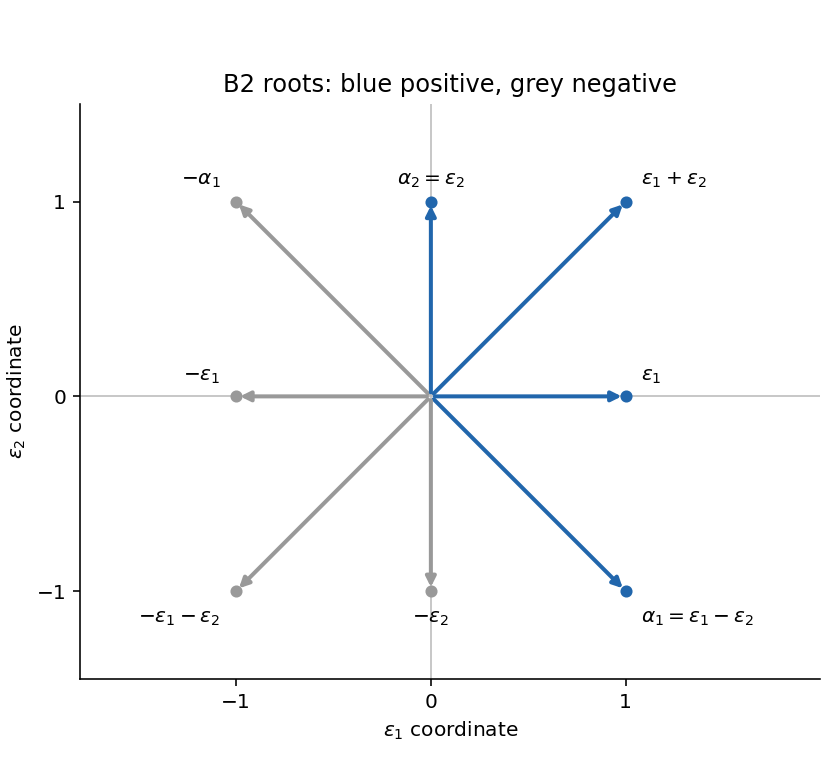

Since form an integral basis of , the root lattice is . The simple coroots are and . Therefore the weight lattice isSolving gives the fundamental weightsThe cone of dominant weights isIndeed and are exactly the two simple-coroot pairings. This describes representations of the Lie algebra, or of its simply connected Spin group; half-integral weights are allowed. For representations descending to itself, the weight must lie in , equivalently must be even.
Every finite-dimensional irreducible Lie algebra representation has highest weight for unique integers . The Weyl vector isso . In the Weyl dimension formula, the factors for the four positive roots, ordered as , are respectivelyHenceIn particular the two fundamental representations have dimensions five and four. The highest root is , so the Adjoint representation has dimension ten. These also fix the dimensions of the crystals below. Our numbering places the long root first; interchanging a B2/C2 numbering without interchanging the associated fundamental-weight labels would give the wrong dimension formula.
Articles were limited to the first 100 out of 1585 total.
Articles by others on the same topic
There are currently no matching articles.