Take a dense lower layer and write . In the Boussinesq approximation the fractional density difference is small; use the reference density in inertia and retain the difference in buoyancy. The one-layer model additionally treats the ambient as much deeper, with negligible distributed horizontal inertia away from the head. The shallow water approximation requires depth small relative to the horizontal variation length, small vertical accelerations, nearly hydrostatic pressure, and an approximately depth-uniform horizontal velocity. Neglect mixing, viscosity, bed friction and rotation. A slowly varying rectangular channel allows cross-sectional averages without large lateral separation.
A slice of width contains volume . Its outgoing volume flux is , so volume conservation gives . The integrated hydrostatic excess pressure is . Pressure on the sloping side walls contributes to the longitudinal force. The conservative momentum equation is thereforeUse the volume equation to simplify it. The resulting shallow water equations areOmitting the wall force would incorrectly introduce a width term into the material acceleration equation.
For the principal matrix is . Its eigenvalues are , where . For they are real and distinct, so the system is strictly hyperbolic. It degenerates at a dry front. From the volume equation, . Combine this with the momentum equation to obtain the variable-width shallow-water characteristics:In a constant-width channel are Riemann invariants along the corresponding characteristic curves; with varying width they satisfy compatibility equations with a source term.
The volume alone does not specify the early release geometry. For a concrete sketch, use a rectangular lock initially occupying with depth , at rest, and remove its gate at . Let and impose a gravity-current front condition , with fixed . The Benjamin deep-ambient front condition gives for the usual deep-ambient idealization.
A rarefaction wave propagates back from the release. Before information returns from the closed wall, its invariant is . With , the fan has , . The front-adjacent shelf hasThe fan extends from to ; a uniform shelf connects its tail to the finite-depth head at . A small nonhydrostatic head displaces ambient fluid; the hydrostatic interior model does not resolve its overturning structure.
The fan head first reaches the rear wall at . The wall condition is , and the returned positive characteristic curve begins to alter the interior. In the still-undisturbed fan it solves , henceIt reaches the fan's uniform shelf at , then propagates with speed to the head at . These times refer to this particular initial lock and front closure. After that first arrival, the finite supply influences the front: the constant-speed slumping stage gives way to deceleration and eventually the finite-volume inertial gravity current with , depth proportional to and speed proportional to . The initial fan and reflected signal are shown below; later characteristic trajectories change as the current adjusts.
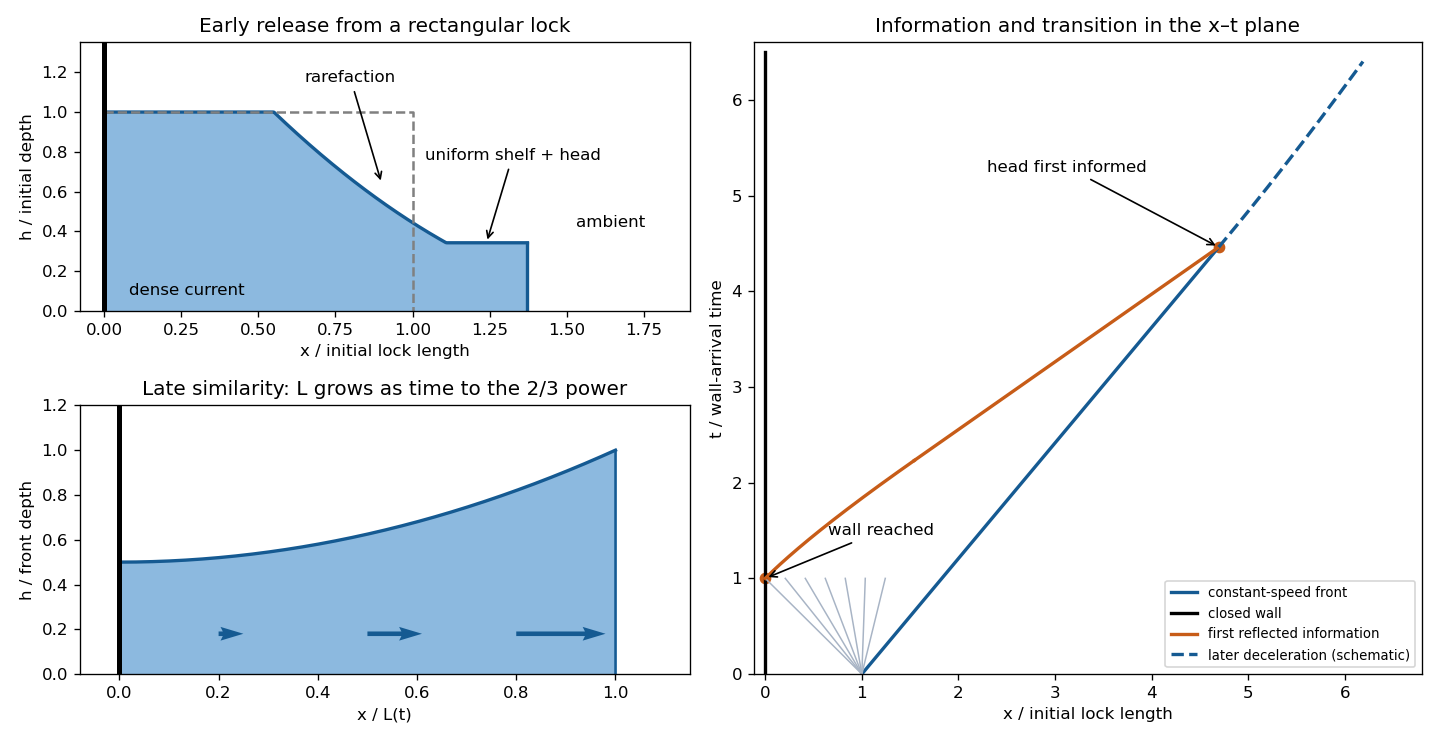
For the unit-width channel put , and . Fixed volume gives , soThe closed rear wall has . Substituting into volume conservation gives , or . The wall sets this constant to zero. Wherever , . Thus the velocity is and its material acceleration is .
Use a constant-Froude gravity-current front condition , with the front depth normalized by . Differentiating its square and using the volume relation gives . The Euler equation now reduces toIntegrate from to obtainA filled rear-wall solution needs ; is the limiting zero rear-depth profile. Integrating the front equation gives the complete similarity solutionHere is the horizontal velocity; the virtual origin accounts for matching to the finite initial release. With the Benjamin deep-ambient front condition, and , this simplifies toThe volume, wall condition and finite front depth can all be checked directly. Choosing another physically appropriate nose Froude number changes the coefficient and profile; the interior equations alone cannot choose it.
Use complex amplitudes , with and , and take physical real parts. The two-dimensional linearized Boussinesq equations giveThe first and third equations imply and ; the buoyancy equation gives . Insert these into the vertical momentum equation. The amplitude of the internal gravity wave satisfiesOscillatory vertical propagation requires ; in a well-mixed region , the bounded solution is evanescent rather than a vertically propagating internal wave.
The vertical parcel displacement has , so its complex amplitude is . The horizontal momentum equation and incompressibility giveAt a material density interface the displacement is continuous, hence . Continuity of pressure must be imposed on the displaced interface. Since the mean hydrostatic gradient is , continuity of Lagrangian pressure gives . A stable upward jump gives , and thereforeThe same derivative jump follows by integrating the amplitude equation through the delta-function contribution at the interface. At a continuous-buoyancy stratification change, and both and are continuous. Assuming Eulerian pressure itself continuous across a density jump would miss the restoring interfacial force.
The lower-layer dispersion relation givesThe incident phase is ; its vertical group velocity is positive, even though its vertical phase velocity is negative. Write the lower field as and the upper bounded field as . Interface continuity gives andThus the internal-wave response of a sharp buoyancy interface isAt fixed incident this is largest at , where . Consequently , or . The maximum does not coincide with the free frequency for two homogeneous layers: the stratified lower radiating layer has a different dynamic pressure response. The upper field is evanescent, so in this ideal lossless problem it carries no mean outgoing vertical energy flux; the reflected wave has .
For the upward incident internal gravity wave, . Using real physical fields, its time-averaged vertical energy flux per unit area isThe assumed mixing power is . A deepening law also requires the gravitational potential energy of the mixed layer. The wave problem specifies a well-mixed half-space above the interface, but supplies neither a finite upper mixed-layer depth nor a replacement buoyancy/energy boundary condition. There is therefore no unique finite-layer from the printed information alone.
The missing parameter can be displayed explicitly. Let the initially mixed upper region have finite depth , with a fixed upper boundary at , and conserve its integrated buoyancy while homogenizing down to . Its new buoyancy isIntegrate over the initial and final profiles in . The potential energy of mixed-layer deepening with an initial buoyancy jump isWith and a maintained constant incident flux, the resulting law isThe right-hand side is positive and determines a unique depth once is supplied. Initially for , already showing why the upper depth matters. If the added assumptions instead specify a zero initial mixed depth, the cubic term gives ; the initial jump then has no finite volume above it to mix with. Neither assumption is contained in the original half-space wave statement. Literal homogenization of the entire upper half-space is the limit and costs infinite energy for any fixed positive . This limitation should not be concealed by a guessed entrainment depth or by keeping the upper buoyancy fixed while claiming conservation.
For a rising light plume use in the Boussinesq approximation, with ambient density as the inertial reference. The full cross-sectional kinematic volume flux, momentum flux and buoyancy flux of a top-hat plume areHere momentum flux per unit reference density is meant, not momentum per unit volume. The Batchelor entrainment hypothesis says ambient fluid crosses the plume edge at mean inward speed , where is the dimensionless entrainment coefficient. Volume added per unit height is . With , the integrated plume balances in uniform ambient density areSeek a pure plume with no persistent source volume or momentum scale. Equating powers of gives and ; constant buoyancy gives . Equating coefficients yields, relative to the ideal source or a fitted plume virtual origin,Thus , and . A finite nozzle or nonzero source momentum requires a near-source transition rather than this singular point-source solution at arbitrarily small .
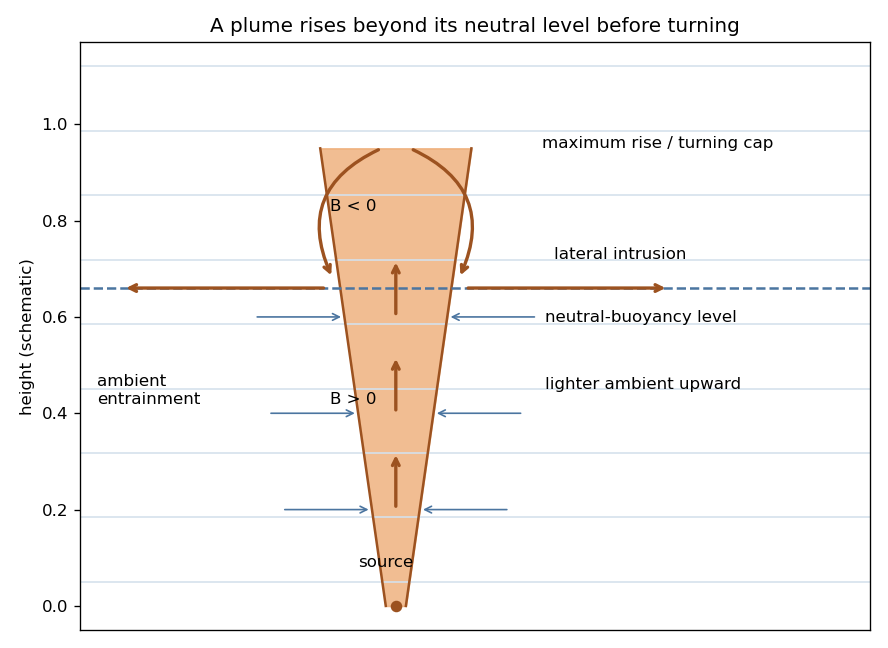
In a stably stratified ambient, entrained fluid is progressively lighter with increasing height. Relative to that ambient, the plume's buoyancy flux satisfies . It therefore becomes neutrally buoyant before its upward momentum vanishes. It overshoots, becomes negatively buoyant, and eventually turns and spreads laterally near its neutral-buoyancy level. The top-hat ascent equations cease to describe the overturning cap and lateral intrusion.
For constant , the balances give a useful exact relation:for an ideal zero-momentum source. The rising branch begins at , attains its largest momentum at , and reaches its terminal zero-momentum limit at . Entrainment and decreasing buoyancy make the associated rise interval finite.
An estimate follows already from the unstratified pure plume flux: , so . HenceThe coefficient depends on the entrainment coefficient and the distinction between neutral height, maximum rise and final spreading level. The scaling can also be obtained from the dimensions and . The sketch distinguishes the neutral level from the maximum rise.
The ratio compares the reference constant-stratification rise length with the height at which the actual buoyancy frequency equals . Equivalently, the actual gradient sampled around that reference height is . Positive means stratification strengthens upwards; negative means it weakens upwards.
For a finite-rise branch at fixed , increasing makes the gradient stronger at each fixed normalized height , so decreases. A small means a larger region of weaker-than-reference stratification and permits relatively greater rise. For , the same comparison reverses: increasing weakens the sampled stratification, increases , and can permit escape when the upper stratification decays sufficiently fast. At the ratio is one. Comparison at is not an exact equality for nonzero , because the plume samples a whole range of heights, not only .
Using the pure plume as a scaling estimate before appreciable buoyancy loss,when and the lower integral is regular. This gives the preceding monotonic trends, but not a universal numerical height. In particular, sufficiently negative powers are singular at a literal point source at . A finite source elevation or a regularized near-source stratification must then be specified, as in part (d); no finite positive source buoyancy can absorb an infinite near-source buoyancy loss. Once such a finite source is used, has an integrable far-field tail for . A sufficiently buoyant plume can then retain positive buoyancy and rise without bound. The exact decaying-buoyancy infinite-rise branch in part (d) is another, specially matched possibility.
Write and use full positive coefficients, , , . Comparing exponents in the three plume equations givesSolving these equations yieldsThe coefficient equations are , and . ThusFor a rising plume with , the first equation requires , the momentum equation , and the decreasing-buoyancy equation . Together these requireThey are the physical plume similarity in power-law stratification branches, not positive-plume solutions for arbitrary powers. The endpoint coefficients are singular; the endpoints cannot be included by simply substituting into these formulas. At the prescribed positive source coordinate , the matched source buoyancy isfinite and positive for every finite in the open range. In contrast, the same branch has divergent buoyancy at the mathematical origin . A source at positive height makes the branch physically usable. Merely saying a power is finite at a nonzero coordinate would not itself determine this range; positivity and the plume balances are essential.
At large , and increase without bound, decreases to zero, radius grows proportionally to height, and mean upward velocity decreases but remains positive. The integrated buoyancy loss is finite because . The weakening ambient stratification never makes this matched plume negatively buoyant at a finite height; its upward momentum continues to grow even while its speed decreases through entrainment. Consequently its maximum rise height is infinite in this ideal model. This particular exact branch requires its three source fluxes to match the displayed coefficients; it is not a proof that every source in the same ambient escapes.
For stationary horizontally homogeneous means, incompressibility gives and the impermeable boundary makes throughout. With no imposed horizontal mean pressure gradient, the balances reduce toThe last equation includes the vertical Reynolds stress; omitting it requires an additional small-normal-stress approximation. The total vertical buoyancy flux is and the horizontal momentum flux is a signed constant with . These are fluxes per unit reference density.
The local down-gradient closure defines eddy viscosity and eddy diffusivity byA parcel moving upwards typically retains the smaller momentum or scalar value from its previous height in an increasing mean profile; its fluctuation then correlates negatively with upward motion. This motivates positive coefficients, but is a closure assumption, not a universal theorem about turbulent or convective fluxes. The mean gradients obeyFor positive applied traction on a fluid above a bottom boundary, and the mean velocity decreases away from the forcing boundary. The usual atmospheric convention specifies the stress absorbed by the boundary and has the opposite sign of ; scalar and Richardson-number results are unchanged. At large Reynolds number and Péclet number, outside the molecular wall sublayers, and , so molecular transport can be neglected in these flux-gradient relations. Large bulk numbers do not justify doing this exactly at a smooth solid wall.
Choose the length convention ; a dimensionless multiplier can be absorbed into the similarity functions. Dimensional analysis under the stated local dependence givesTo obtain a log-linear expansion one also needs a regular neutral limit: take and , with positive . Dimensions alone do not specify these constants or guarantee differentiability. Let denote the shear sign. In the high-number regime of part (a), integrate the reciprocal expansions from a reference height to obtain the near-neutral log-linear surface-layer profilesTheir leading terms are logarithmic; the first buoyancy-dependent corrections are linear in height. The additive constants require boundary or reference data and cannot be obtained from the prescribed fluxes alone.
The gradient Richardson number isThus is nearly neutral, shear-dominated turbulence: the buoyancy contribution is small relative to shear production. Stable flux has , and positive Richardson number; heating has , and negative Richardson number. The smallness condition is on the magnitude, not an automatically satisfied signed inequality for every negative .
Use positive jumps and for the hot salty lower reservoir. The Boussinesq density excess below the interface is proportional to . Static stability therefore requireswith one the neutral limiting value. For the lower layer is lighter overall and ordinary overturning convection replaces the statically stable interface.
In the stable hot-below, salty-below configuration, thermal diffusivity exceeds salt diffusivity. Heat transfer can destabilize thin adjacent fluid regions before the stabilizing salt difference is erased, causing the diffusive regime of double-diffusive convection. As , stabilization by salt dominates, interfacial convective exchange is strongly suppressed, and the specified heat-flux model tends to zero at fixed . This limit is not a claim that molecular heat conduction itself ceases.
Let , and . At steady volume, the weir outflow equals the inflow . The well-mixed heat and salt balances giveWith and , the flux ratio implies , where . The actual interface ratios are , and .
The original PDF uses in the heat-flux law; the converted TeX's exponent is a transcription error. Using the PDF yieldsSubstitute this into the heat balance to obtain the double-diffusive overflow reservoir relationsFor the usual heat-dominated positive upward buoyancy flux, and give . Then the right-hand side after substituting decreases from to zero as runs from zero to one; there is a unique physical steady root. The net upward buoyancy flux is .
With inflow and overflow both zero and fixed reservoir volume , the transient balances are and . ThereforeThe last equality uses the initial steady state. Define , where the latter is the pre-shutdown flow. The post-shutdown double-diffusive reservoir cooling equation isSeparate variables. An explicit primitive of isDifferentiate it to verify the three powers. HenceFor , increases monotonically to one only at infinite time, with up to the choice of time origin. The reservoir approaches , but its salinity tends to , leaving the positive salt contrast . Thus and the double-diffusive flux shuts down asymptotically. The assumption of a stationary interface and continued applicability of this flux parameterization is part of the reservoir model, not a claim about every actual hydrothermal pool.
Assume a sharp interface, uniformly mixed warm upper air with fixed reduced gravity , cool ambient air entering below, no wind, no wall heat exchange, negligible source volume, and quasi-steady Boussinesq flow through the small vents. Neglect the interior approach velocity. The hydrostatic buoyancy head between the two vents is .
Both openings carry the same volume flux . The discharge coefficient law gives a pressure loss at each opening. Adding the two losses gives , not the single-opening value with an extra factor . Cool replacement air displaces the warm layer, so . With , integrate to obtainThe ideal model sets thereafter. The formula applies only while the parenthesis is nonnegative; squaring a negative value would invent renewed filling. A finite aperture or a diffuse final interface invalidates the idealization near exhaustion.
Write for the height of the warm-layer interface above the heat source. A negligible-volume point heat source supplies a pure plume with conserved buoyancy flux . The given plume buoyancy implies its volume flux at the interface isAt steady displacement ventilation, the plume feeds the warm layer at the same rate it empties through the upper vent: . The upper-layer buoyancy balance gives , soEliminate and to getThe height equation has one solution with . Its height is independent of source strength in this ideal pure-plume model, while its warm-layer density contrast increases as . The sketch shows cool replacement air below, an entraining plume through that region, and the upper mixed layer feeding the ceiling vent.
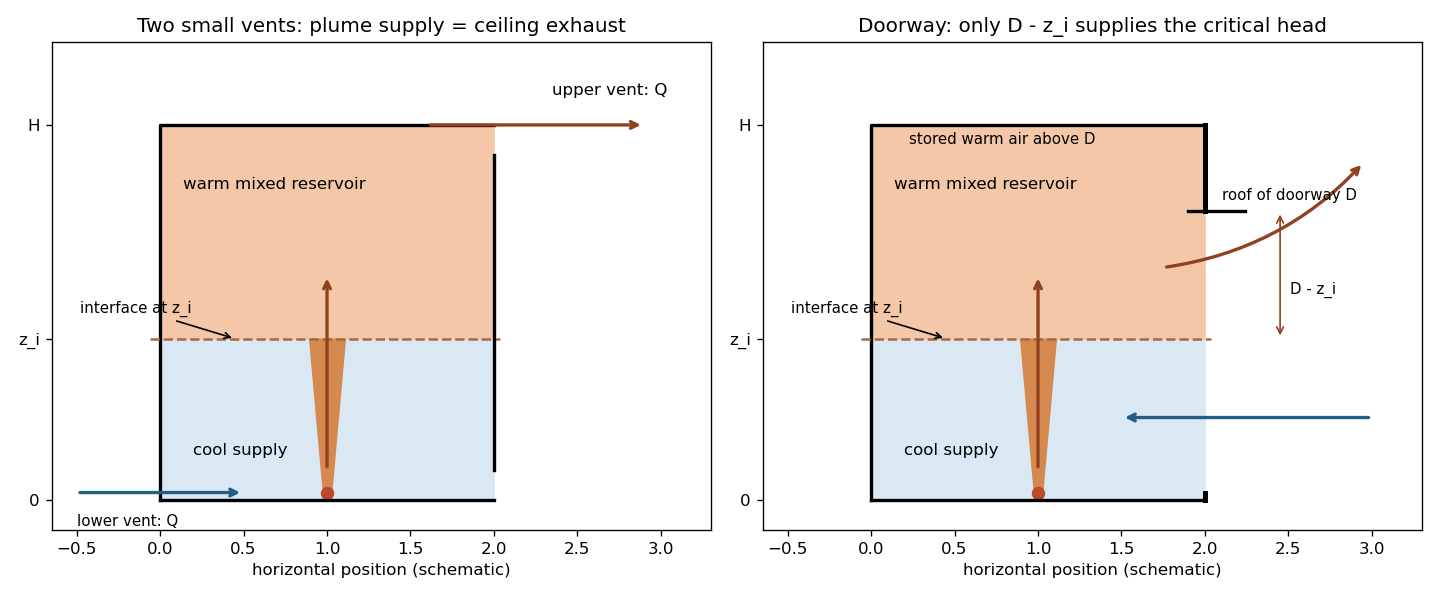
Plume-fed displacement ventilation through two vents and through a hydraulically controlled upper doorway
. Details. For a one-layer shallow water flow the Froude number is . Supercritical flow has , so both characteristic speeds point downstream. Subcritical flow has , allowing information to travel upstream. At hydraulic control the flow passes through at a geometry-induced critical section; that condition fixes discharge in relation to upstream head when the exit is free.
For escaping light air, reflect the usual lower-layer picture vertically: a lowered doorway roof acts as an inverted broad-crested weir. The lower return flow can be ignored dynamically only while it has a sufficiently large available area and small velocity. If the warm interface lies far below the doorway top, the cool inflow occupies a substantial dynamically active fraction of the opening; its inertia and pressure cannot be replaced by a motionless deep ambient. A two-layer exchange model is then required. If the warm layer reaches below the doorway bottom, the assumed separate lower replacement path is lost entirely.
Outside a freely controlled doorway the outgoing current becomes supercritical and then rises rapidly. That upturn violates the small-vertical-acceleration shallow water approximation, but it does not alter the upstream discharge as long as it does not submerge or back-pressure the control. Information cannot return through the supercritical outflow to the critical section. A blocked conservatory or a drowned doorway is different and can move the control upstream.
Assume a steady inviscid light layer of constant reduced gravity under a roof at , with depth , interface , and slowly varying width . The ambient is deep and approximately motionless; neglect entrainment, friction and approach variations across the section. Let be pressure relative to the ambient hydrostatic pressure. Then in the light layer and when the ambient pressure offset is chosen zero. The steady Bernoulli equation along a light-fluid streamline is . With , this becomes the hydraulic flow in an inverted channel energyAt fixed and fixed flux,The energy curve has a minimum at , with . Above that minimum there are a thin supercritical branch and a thick subcritical branch. A lowered roof increases ; it is the inverted counterpart of raising a bed crest.
For a single smooth obstruction in a constant-width channel, energy exceeding its largest permits entirely subcritical passage or entirely supercritical passage, depending on the boundary data. At the limiting head a subcritical upstream current can pass through critical flow at the roof minimum and emerge supercritical; this is the usual freely discharging control. A reverse transcritical branch would need suitable imposed downstream data and is not the usual free discharge. If the supplied head is below the required minimum, no smooth steady flow with that flux exists: upstream adjustment changes the discharge or head. A supercritical current encountering deep downstream warm fluid can undergo a hydraulic jump to the subcritical branch, with an energy loss rather than a second conservative branch switch.
For a rectangular section the jump conserves and . Hence for , and the lost specific energy is . This remains positive after vertical reflection. The energy and profile sketches label the roof and the lower boundary of the light layer explicitly.
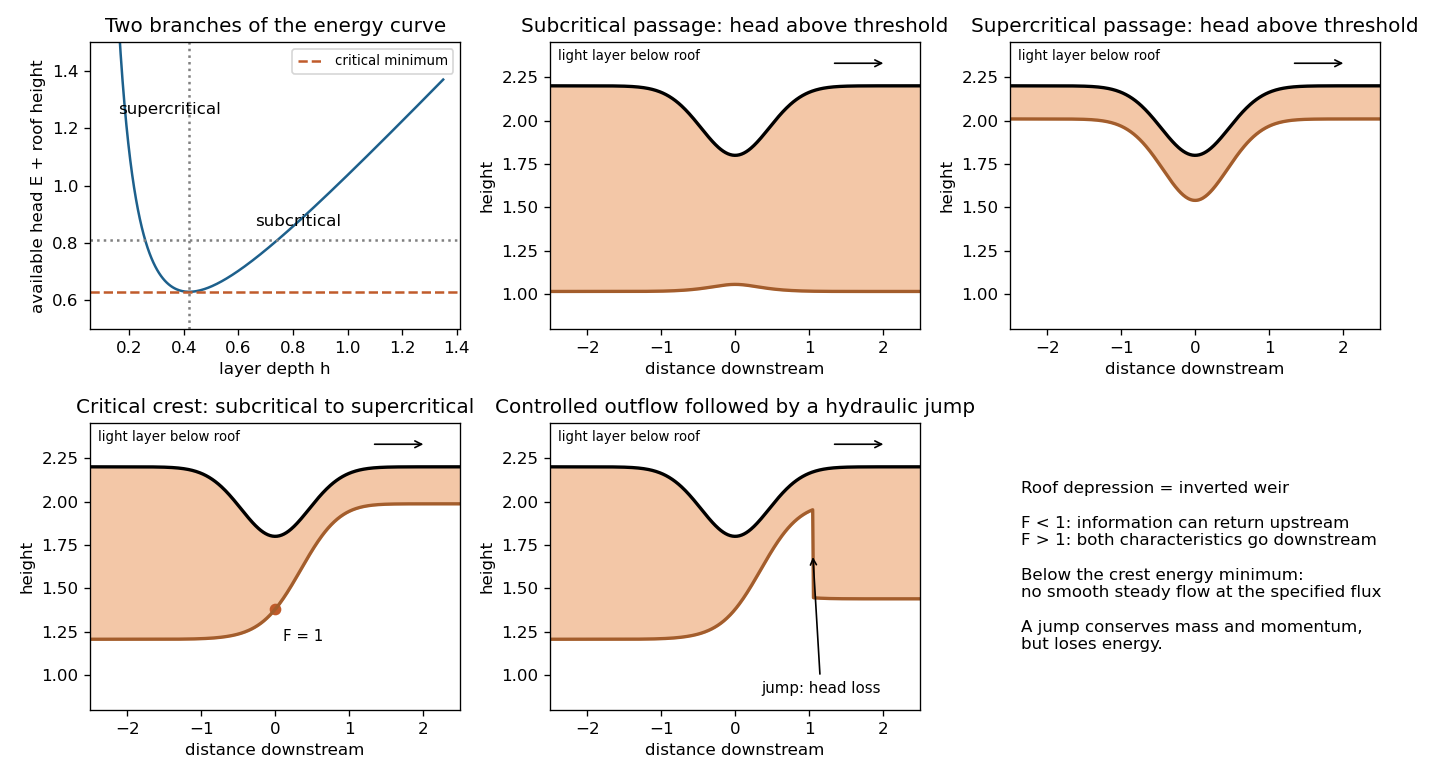
Energy branches and subcritical, supercritical, controlled and hydraulic-jump flows beneath a lowered roof
. Details. The room's nearly motionless upper reservoir has interface . A doorway roof at height has available light-layer head . Evaluate the Bernoulli equation in the room and at a freely controlled doorway: upstream and at its critical section. Therefore andThis is the ideal broad-crested weir law, not a small-orifice law with . A nonideal doorway would require its own measured loss correction.
When the floor heat source is on, volume conservation and buoyancy flux conservation still give and . Combine these with the doorway relation to obtain the plume-fed doorway ventilation equilibrium:There is one interface-height root in the indicated interval. The result is physically appropriate only if its upper outflow is thin enough for the one-layer doorway model to remain valid.
If , air in the volume above the doorway is part of the upper thermal reservoir and can store heat and alter transients. But its extra depth does not add available head at the doorway: only enters the critical condition. In the steady ideal well-mixed model it shares the same density as the outflow. Treating the whole as the doorway head would overestimate discharge.
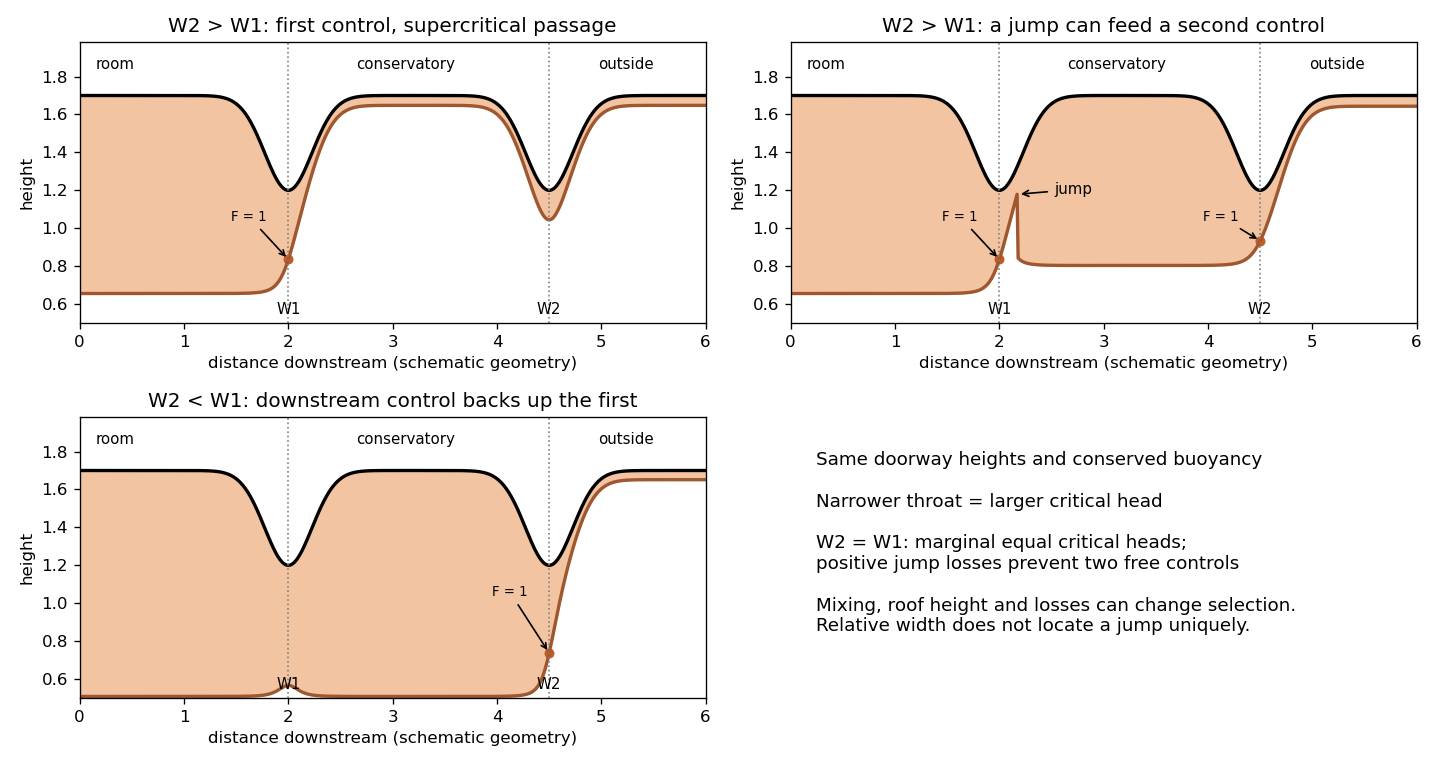
Let be the first doorway width and the conservatory's outer doorway width. For a hydraulic comparison assume the same reduced gravity and conserved volume flux through both, negligible losses except at any hydraulic jump, and roofs at the same doorway height . Their critical depths and limiting energies areThe narrower doorway has the larger minimum required head. This gives the possible two successive hydraulic controls rather than a universal jump location.
If , the first doorway can remain the discharge control. Its supercritical outflow may pass through the wider second doorway without being controlled there. Alternatively, if warm air accumulates in the conservatory, the first jet can undergo an inverted hydraulic jump, feed a subcritical intermediate reservoir, and accelerate to a second critical section at the outer doorway. The wider second throat has a lower critical energy, so the difference can accommodate the positive head loss at the jump. Whether this second configuration occurs, and where its jump stands, depends on conservatory dimensions and downstream head.
If , an outflow set solely by critical flow at the first doorway lacks the energy to pass the narrower second doorway: , and a jump cannot increase energy. Warm air backs up in the conservatory. The downstream doorway becomes the dominant control, and the first doorway is subcritical or submerged by the intermediate layer. During adjustment an upstream-moving bore or jump can propagate towards or through the first doorway. A permanently freely controlled first doorway followed by a narrower same-height control is impossible under the conserved-buoyancy assumptions.
If , the equal-energy idealization is marginal. Both throats can reach critical conditions in a lossless configuration, but any positive interposed jump loss prevents two independent critical sections at the same flux and buoyancy. Small losses or differences in effective discharge geometry select the downstream restriction and can drown the first. A constriction should not be assumed controlled simply because it exists.
The sketches show these admissible regimes. Mixing with cool conservatory air, heat loss, finite return-flow inertia, different roof elevations or aperture losses change the comparison and need additional data. In particular relative widths alone do not determine the actual conservative-room temperature or the position of a jump.


Articles by others on the same topic
There are currently no matching articles.