For a rising light plume use in the Boussinesq approximation, with ambient density as the inertial reference. The full cross-sectional kinematic volume flux, momentum flux and buoyancy flux of a top-hat plume areHere momentum flux per unit reference density is meant, not momentum per unit volume. The Batchelor entrainment hypothesis says ambient fluid crosses the plume edge at mean inward speed , where is the dimensionless entrainment coefficient. Volume added per unit height is . With , the integrated plume balances in uniform ambient density areSeek a pure plume with no persistent source volume or momentum scale. Equating powers of gives and ; constant buoyancy gives . Equating coefficients yields, relative to the ideal source or a fitted plume virtual origin,Thus , and . A finite nozzle or nonzero source momentum requires a near-source transition rather than this singular point-source solution at arbitrarily small .
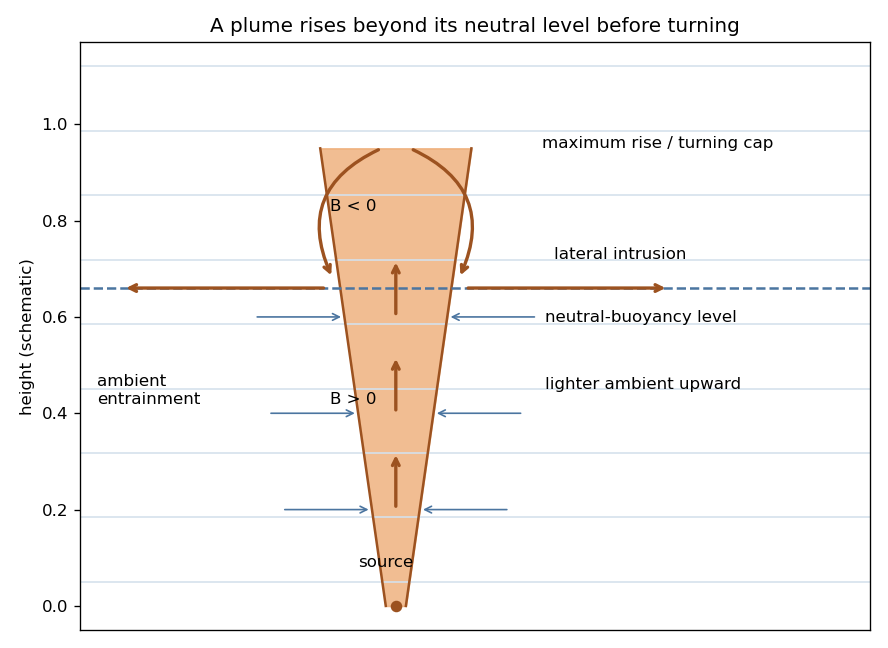
In a stably stratified ambient, entrained fluid is progressively lighter with increasing height. Relative to that ambient, the plume's buoyancy flux satisfies . It therefore becomes neutrally buoyant before its upward momentum vanishes. It overshoots, becomes negatively buoyant, and eventually turns and spreads laterally near its neutral-buoyancy level. The top-hat ascent equations cease to describe the overturning cap and lateral intrusion.
For constant , the balances give a useful exact relation:for an ideal zero-momentum source. The rising branch begins at , attains its largest momentum at , and reaches its terminal zero-momentum limit at . Entrainment and decreasing buoyancy make the associated rise interval finite.
An estimate follows already from the unstratified pure plume flux: , so . HenceThe coefficient depends on the entrainment coefficient and the distinction between neutral height, maximum rise and final spreading level. The scaling can also be obtained from the dimensions and . The sketch distinguishes the neutral level from the maximum rise.

The ratio compares the reference constant-stratification rise length with the height at which the actual buoyancy frequency equals . Equivalently, the actual gradient sampled around that reference height is . Positive means stratification strengthens upwards; negative means it weakens upwards.
For a finite-rise branch at fixed , increasing makes the gradient stronger at each fixed normalized height , so decreases. A small means a larger region of weaker-than-reference stratification and permits relatively greater rise. For , the same comparison reverses: increasing weakens the sampled stratification, increases , and can permit escape when the upper stratification decays sufficiently fast. At the ratio is one. Comparison at is not an exact equality for nonzero , because the plume samples a whole range of heights, not only .
Using the pure plume as a scaling estimate before appreciable buoyancy loss,when and the lower integral is regular. This gives the preceding monotonic trends, but not a universal numerical height. In particular, sufficiently negative powers are singular at a literal point source at . A finite source elevation or a regularized near-source stratification must then be specified, as in part (d); no finite positive source buoyancy can absorb an infinite near-source buoyancy loss. Once such a finite source is used, has an integrable far-field tail for . A sufficiently buoyant plume can then retain positive buoyancy and rise without bound. The exact decaying-buoyancy infinite-rise branch in part (d) is another, specially matched possibility.
Write and use full positive coefficients, , , . Comparing exponents in the three plume equations givesSolving these equations yieldsThe coefficient equations are , and . ThusFor a rising plume with , the first equation requires , the momentum equation , and the decreasing-buoyancy equation . Together these requireThey are the physical plume similarity in power-law stratification branches, not positive-plume solutions for arbitrary powers. The endpoint coefficients are singular; the endpoints cannot be included by simply substituting into these formulas. At the prescribed positive source coordinate , the matched source buoyancy isfinite and positive for every finite in the open range. In contrast, the same branch has divergent buoyancy at the mathematical origin . A source at positive height makes the branch physically usable. Merely saying a power is finite at a nonzero coordinate would not itself determine this range; positivity and the plume balances are essential.
At large , and increase without bound, decreases to zero, radius grows proportionally to height, and mean upward velocity decreases but remains positive. The integrated buoyancy loss is finite because . The weakening ambient stratification never makes this matched plume negatively buoyant at a finite height; its upward momentum continues to grow even while its speed decreases through entrainment. Consequently its maximum rise height is infinite in this ideal model. This particular exact branch requires its three source fluxes to match the displayed coefficients; it is not a proof that every source in the same ambient escapes.
Articles by others on the same topic
There are currently no matching articles.